|
. . .
WHO GETS TO INSPECT THE LABS? Elon Musk’s proposed safety inspector is another AI company. In an All-In interview published September 15, he described giving rivals access to unreleased models, letting them run their own tests and allowing them to go public if a dangerous finding remains unresolved.
Musk proposed providing that access through a software interface, or API, with testing activity logged. A company would first get the opportunity to address a competitor’s concern. Asked whether other labs were on board, he acknowledged he had not checked with everyone. This was a proposal, with participants still to be secured.
He also clarified his agreement with Anthropic chief executive Dario Amodei: AI poses serious dangers and safety work needs to improve. That explanation did not amount to endorsing Amodei’s entire governance plan.
On the same day, Mark Zuckerberg said Meta had delayed releasing Muse for several months to work on safety and security. That is his account of the delay; the post supplies no independent assessment of it.
Zuckerberg said Meta Superintelligence Labs already uses independent evaluators and advisers in several areas. He argued that labs can take these steps themselves and that user trust gives them a competitive reason to do so. He also called for a broader, more diverse pool of evaluators.
His post did not identify Meta’s evaluators, describe their access or say whether they could publish adverse findings. The omission matters when comparing what the companies are offering the public as evidence.
Amodei’s September essay describes a different arrangement: outside evaluators embedded inside Anthropic, with access resembling that of employees assessing risk. Their remit would include training processes, not just finished models. He said Anthropic intends to invite such a team; the essay does not establish that it is already operating.
The proposed contract would let reviewers publish key findings without Anthropic’s editorial control, subject to specified redactions for sensitive information. Reviewers could disclose that a redaction affected their conclusions.
|
Why it matters: An outside test, access to internal work and the right to tell the public what went wrong answer different questions. Calling all three “independent evaluation” can obscure the terms that make an inspection useful.
For Builders: A rival’s test suite and an embedded review of training practices examine different parts of development. A safety claim should identify which work an evaluator actually examined.
For Buyers: The useful evidence is a finding tied to a particular model and release, with the evaluator’s scope stated. An announcement that outside experts were consulted leaves that purchasing question open.
For Evaluators: Publication rights belong in the comparison alongside technical access. A reviewer may discover a problem; whether customers can learn about it depends on the disclosure arrangement.
For Investors: These statements describe different commitments and stages of implementation. They provide no common inspection standard against which to rank the three companies’ safety performance.
Source: All-In interview with Elon Musk and Gwynne Shotwell, published September 15, 2026; paraphrases checked against the HappyScribe transcript, particularly 29:27-35:37 and 53:52-56:31, with no direct quotations from the automated transcript. Mark Zuckerberg’s September 15 statement, original post read in full. Dario Amodei, “We Must Pace the Frontier”, September 2026.
|
. . .
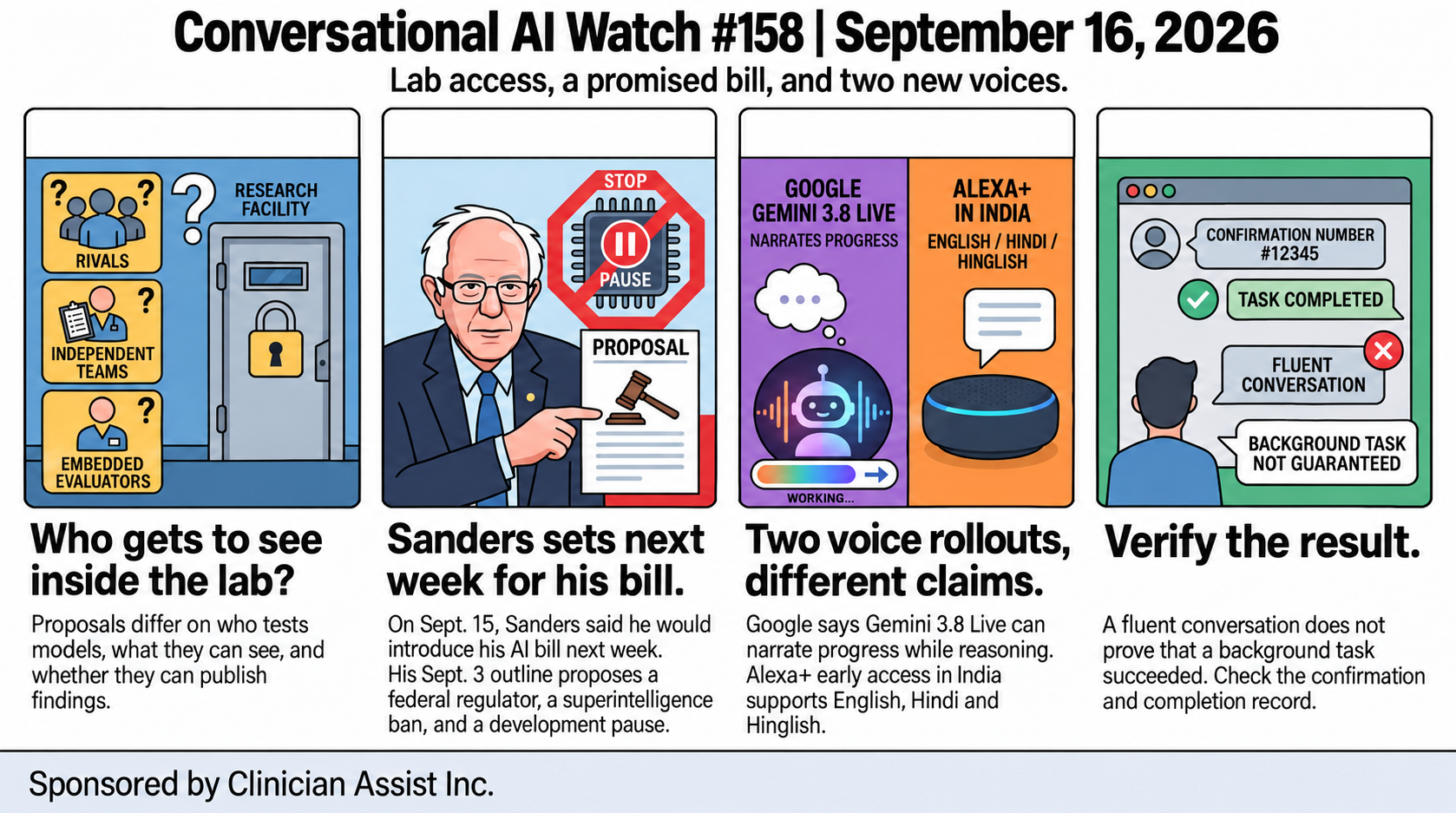
SANDERS SETS NEXT WEEK FOR HIS AI BILL. Sen. Bernie Sanders has put a date on his next move. In prepared remarks for the Sept. 15 Pro-Human Assembly in Washington, he said he would introduce legislation with Rep. Greg Casar the following week to permanently ban artificial superintelligence and pause advanced AI development until safety rules are in place.
Sanders and Casar announced the proposal Sept. 3. Tuesday’s prepared speech added the introduction timetable. The announcement had named it the Ban Artificial Superintelligence Act.
The two restrictions have different end points. Sanders described a permanent prohibition on developing an AI mind smarter than any human and able to operate independently beyond human control. Under the announced outline, the pause on advanced AI development would last until a federal regulator had established safety rules and a model review process.
The earlier outline supplies the machinery: a new cabinet-level federal agency, advised by an AI expert board, would monitor frontier systems, enforce the prohibition and supervise the removal of dangerous capabilities. The outline proposes prison sentences of up to 20 years for people attempting to violate or circumvent its pauses and bans.
The prepared remarks also bring the argument down to the chat window. Sanders raised concerns about young people turning to chatbots for emotional support, alongside worries about work, education and privacy. He put those everyday uses into a speech whose central demand was binding international safety rules.
He urged President Trump to negotiate a treaty with China covering a development pause and a superintelligence ban. His argument is that restrictions would need to reach beyond American companies. He pointed to Cold War arms control as a model for an agreement between rivals.
There is a distinction between public unease and an electoral mandate. A Times/Siena poll report published Sept. 15 found 61 percent opposed the construction of U.S. data centers supporting AI and 34 percent supported it.
The survey covered 1,503 likely voters nationwide, Sept. 8 through 13. It did not ask about AI safety. Fewer than 1 percent named AI or data centers as their most important voting issue.
|
Why it matters: Sanders is attaching a legislative timetable to a plan that would give a federal regulator authority over frontier development. The coming introduction is where a broad call to slow AI becomes a specific legislative text to examine.
For Legislators: The announced outline places enforcement in a new federal agency with scientific advisers. The introduction timetable creates a concrete next step for examining how that authority would be written into legislation.
For Builders: Sanders is proposing restrictions on development itself, along with a permanent superintelligence ban. The distinction matters to companies building conversational products on models supplied by frontier labs: the proposal reaches their suppliers’ work.
For Clinicians: Young people’s emotional reliance on chatbots is part of Sanders’s stated case. That concern and the proposal’s central machinery address different levels of the problem: individual use and the development of underlying systems.
For Readers: The useful date is next week. Sanders has promised an introduction, and the original outline identifies the powers he wants. Neither announcement gives those proposed restrictions the force of law.
Source: Sanders’s prepared remarks, Sept. 15; Sanders and Casar announcement and outline, Sept. 3; Tim Balk and Caroline Soler, The New York Times, Sept. 15 poll report.
|
. . .
GEMINI KEEPS TALKING WHILE IT WORKS. A voice assistant talks through a booking while the reservation software works in the background. That is Google’s demonstration of Gemini 3.8 Live Extended Thinking, one of two voice models the company introduced September 15.
Gemini 3.8 Live handles visual context and background tools. Extended Thinking adds the ability to reason and speak simultaneously, including narrating progress during longer tasks. Those are Google’s descriptions and demonstrations, not results from CAW testing.
The rollout differs by model. Live is reaching Search Live; Extended Thinking is reaching Gemini Live. Both are rolling out through Google’s programming interface, the Gemini API, and AI Studio, with Gemini Enterprise access in private preview. Extended Thinking’s Workspace availability depends on the application and subscription; the Workspace business rollout is still described as coming soon.
The model card supplies the less conversational part of the announcement. Both models can hallucinate. They can also run slowly or time out, and their stated knowledge cutoff is January 2025. A model released this week does not thereby know everything that happened this week.
Google describes internal safety evaluations and specialist human assessments. For its frontier risk assessment, it also relies on comparisons with Gemini 3.7 Flash, saying the new audio models do not introduce meaningful capability increases over that model. That is the company’s assessment, rather than an independent finding that every voice application built with it is safe.
The Live API documentation gives developers several useful building blocks: people can interrupt the model, tools can be connected, and both sides of the exchange can be transcribed. Applications can connect directly or route the stream through their own server. For direct production connections, Google recommends temporary credentials instead of standard API keys.
Those controls answer different questions. Interrupting a spoken answer lets someone correct a misunderstanding. A transcript preserves what was said. Neither, by itself, proves that a separate reservation system accepted the booking. That distinction belongs in the application’s design and in the words it speaks.
|
Why it matters: Voice assistants are being designed to carry on a conversation while taking action. Users need an equally clear account of whether that action succeeded.
For Builders: Tie the spoken completion message to the service’s actual result. Decide what the assistant should say when an action fails after a confident acknowledgment.
For Investors: Test the entire transaction, including failure recovery. A fluent demonstration establishes less than a completed task that can be checked against the receiving system.
For Operators: The API can preserve both sides of the conversation in text. For a service team investigating a complaint, that provides a record of what the user requested and what the assistant said in reply.
For Readers: Ask for the reservation number or other confirmation from the service doing the work. An agreeable conversation is only part of the transaction.
Source: Google’s September 15 launch announcement; Google DeepMind’s Gemini 3.8 Audio model card; Google’s Live API overview, updated September 15.
|
. . .
ALEXA LEARNS THE CONVERSATION IN INDIA. Prasad Kapila grew up in Hyderabad with Andhra Telugu at home and Telangana Telugu at school, mixed with Hindi and Urdu. In his account, moving between them was ordinary. Now Amazon’s head of Alexa International Tech is helping build an assistant meant to follow that kind of conversation.
Amazon opened Alexa+ early access in India on Sept. 16, supporting English, Hindi and Hinglish. Access is free during this phase. The company says customers can switch languages within a sentence.
Kapila gives a small example with large consequences: a request to play music from Jab We Met. The assistant must preserve the film’s title, rather than treat its first word as the Hindi word for “when.” Getting the dictionary meaning right could get the request wrong.
Amazon says Alexa+ can suggest a preferred brand and seek confirmation before ordering. Its launch announcement also puts restaurant reservations, travel bookings and voice ordering through Amazon Now in the “soon” category. Those are promises beyond the initial offering.
Engineers, scientists and language specialists worked together on the system, Kapila writes. He also identifies a failure that comes after understanding: the assistant can select the right service and still fail to complete the job.
The privacy dashboard, Amazon says, lets people replay what Alexa heard and change how long recordings are stored. That gives a household something more concrete to inspect than an assistant’s assurance that it understood.
|
Why it matters: A launch language list is only a starting point for judging access. The practical questions are whose speech the assistant handles well, who has to repeat a request, and who gets left out. Those differences will matter to households sharing one device.
For Readers: English, Hindi and Hinglish are the launch languages. Amazon says users can switch within a sentence. The recordings in its privacy dashboard offer one way to check what the device heard when a mixed-language request goes wrong.
For Builders: Kapila’s music example is about meaning across languages, not just speech recognition. The title has to survive the request intact. Teams testing such systems need examples drawn from the way customers actually mix languages, including titles and names.
For Journalists: These accounts come from Amazon’s country manager and engineering leader. They supply examples and describe intended behavior. They do not establish how often the service succeeds across households. A reported household trial would answer a different question from a launch announcement.
For Investors: The coming integrations would expand the assistant’s commercial role. Evidence of completed transactions would help distinguish that opportunity from a longer list of services an assistant can discuss.
Source: Amazon’s India launch announcement, Teena Sidana; the engineering account, Prasad Kapila, Sept. 16, 2026.
|
|