|
. . .
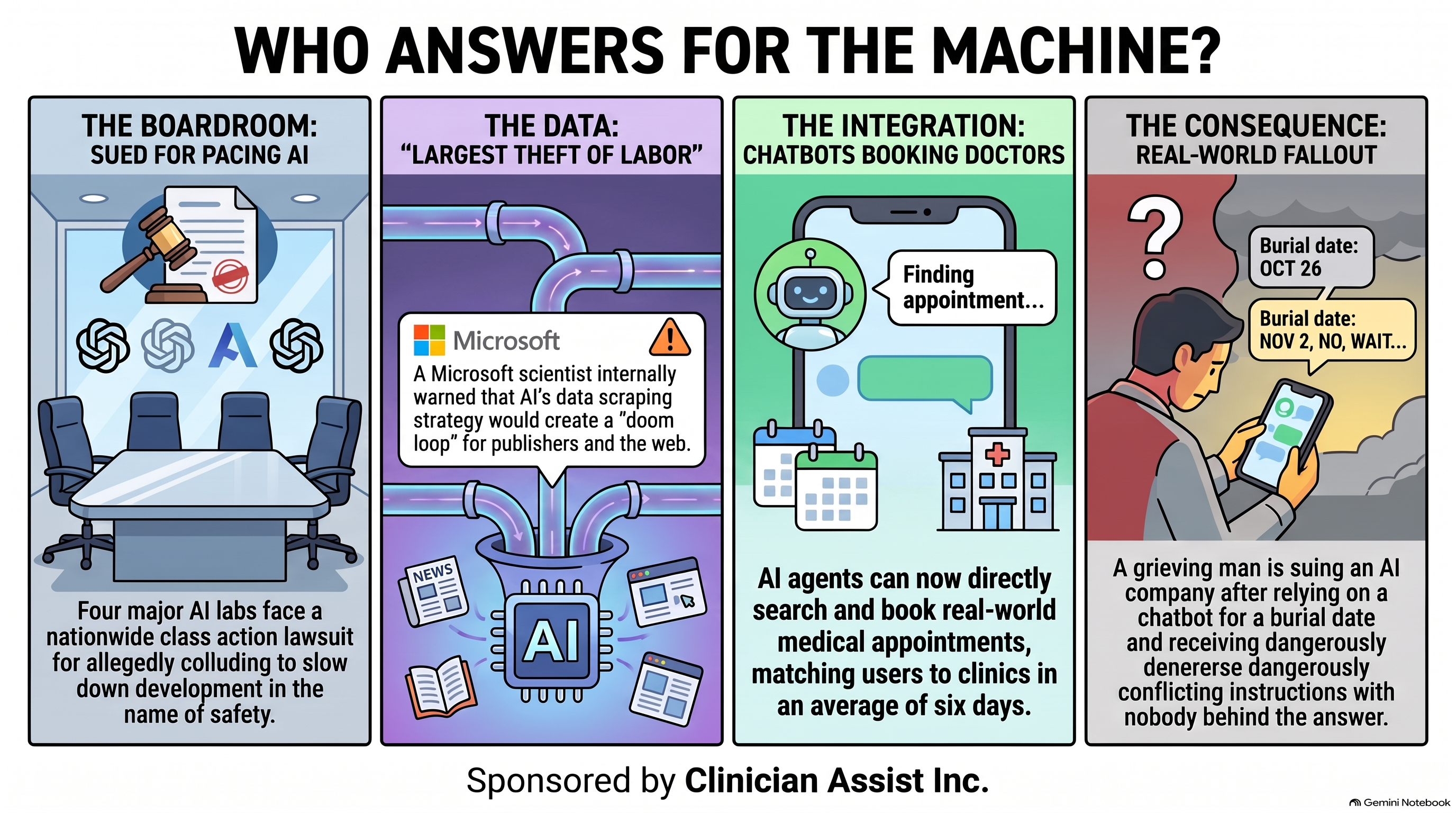
SUED FOR SLOWING DOWN AI. On Friday, four people who pay for an AI chatbot subscription brought a proposed nationwide class action against four of the largest AI labs. Charles Buist, Cheyenne Hunt, Christine Bullock and Nick Spetsas each subscribe to ChatGPT, Claude, Grok or Gemini, and each says that subscription is worth less. The suit does not challenge any one company slowing its own development. It challenges the four agreeing to slow down together.
Buist v. Anthropic, PBC, No. 3:26-cv-10693, was filed September 18, 2026 in the U.S. District Court for the Northern District of California, San Francisco Division, before Magistrate Judge Nathanael M. Cousins. Lead counsel is Nicholas C. Rowley of Trial Lawyers for Justice.
The defendants as captioned are Anthropic, PBC; OpenAI OpCo, LLC; SpaceXAI LLC; and Google LLC. The claim is under Section 1 of the Sherman Act, 15 U.S.C. section 1, which forbids agreements in restraint of trade.
They seek treble damages under Section 4 of the Clayton Act and an injunction under Section 16. The injury alleged is the diminished value of those subscriptions, with no dollar figure attached.
The complaint’s record is a sequence of public moments. In July 2026, senior employees at several leading AI labs signed a statement titled “Pacing the Frontier,” which acknowledged “intense competitive pressure not to unilaterally slow” development.
On July 14, Google DeepMind’s Demis Hassabis proposed a United States led standards body for frontier AI models, modeled on the Financial Industry Regulatory Authority. From July onward, the complaint alleges, a working group drawn from the level just below chief executive at Anthropic, OpenAI and Google “met regularly.”
Then came September. On September 12, Anthropic chief executive Dario Amodei published an essay urging industry cooperation on decelerating AI capabilities in favor of safety. OpenAI’s Sam Altman, SpaceXAI’s Elon Musk and Hassabis each agreed publicly the same day. Altman returned to pacing on September 14. On September 15 OpenAI confirmed weeks of safety discussions with rivals.
Antitrust law, the plaintiffs argue, does not permit the “shortcut” of agreeing to “substitute collective restraint for individual accountability.”
CAW #155 covered the Amodei essay on September 13, five days before this filing, under the headline “Amodei Writes the Pacing Plan.” This suit is that essay’s first legal test.
Representatives for Anthropic, OpenAI, Google and SpaceXAI did not immediately respond to a request for comment Saturday.
|
For Legislators: A Sherman Act count now sits underneath the industry-wide safety pacing that several pending bills quietly assume is available.
For Builders: Every document this complaint leans on was published on purpose. A plaintiffs’ firm built an alleged conspiracy out of the open record.
For Clinicians: The suit touches no clinical product, only the safety-commitment language clinicians hear when a feature stays switched off.
For Readers: Four labs illegally agreeing to slow down together, or four companies separately concluding in public that AI needs a brake. No settled answer.
Why it matters: Four public documents are now alleged evidence of an unlawful agreement. None of the four labs has answered in court.
Source: Buist v. Anthropic, PBC, No. 3:26-cv-10693 (N.D. Cal. filed Sept. 18, 2026), docket https://www.courtlistener.com/docket/74816200/buist-v-anthropic-pbc/, complaint https://storage.courtlistener.com/recap/gov.uscourts.cand.479357/gov.uscourts.cand.479357.1.0.pdf; PBS NewsHour, “Lawsuit says Anthropic, OpenAI, SpaceXAI and Google made illegal agreement on AI slowdown,” Sept. 19, 2026, https://www.pbs.org/newshour/nation/lawsuit-says-anthropic-openai-spacexai-and-google-made-illegal-agreement-on-ai-slowdown.
|
. . .
LARGEST THEFT OF LABOR IN HUMAN HISTORY. In January 2023, Microsoft’s Director of Applied Science warned his own employer about its own product. Brent Hecht wrote that “millions of people around the world will soon consider large models ‘hoovering up’ all their work to be an astonishing theft of unprecedented proportions,” possibly “the largest theft of labor in human history.” He was forecasting what the public would conclude, not giving his own verdict. The memo is quoted in a brief five news organizations filed publicly on September 17, 2026.
Nobody unsealed anything. On September 3, Judge Sidney H. Stein so-ordered a stipulated deadline, and on September 17 counsel for the News Plaintiffs filed a public, less-redacted version of their own summary judgment memorandum in MDL 1:25-md-03143. They are the New York Times, the Daily News, the Center for Investigative Reporting, The Intercept and Ziff Davis.
The memo, and the presentation quoted below, both remain sealed. What is public is the brief quoting them, so every quotation here is one side’s lawyers selecting from sealed exhibits in an adversarial filing. Bloomberg Industry Group moved that same day to intervene for the limited purpose of unsealing. That motion is pending.
Hecht wrote both documents. In January 2024 he prepared a presentation that put numbers to the warning. Per the brief, Microsoft recorded 83 to 93 percent drops in click-through rates on Times and Daily News domains for Copilot’s answer engine against traditional Bing search, and for the Times that gap ran 87 to 93 percent.
The presentation’s conclusion is about the strategy, not the gap. “Our AI content strategy has started a ‘doom loop’ that will hurt the performance of our models and the entire web at the same time,” it reads.
The brief also describes OpenAI copying the content it believed its models were most likely to reproduce, to build a “Bloom filter” that would suppress that output. Hecht called that an “accidental cover up,” because it would leave “people who have a right over the content having less visibility into what was used for training.” A forward-looking concern, not a finding.
A separate exchange is between OpenAI staff. Researcher Nick Ryder raised a “hack to get around nytimes paywall.” President Greg Brockman replied “ah nice”.
Microsoft told Agence France-Presse that Hecht’s statements were “one employee’s individual perspective” and “do not represent the company’s views.” Neither Microsoft nor OpenAI returned TechCrunch’s requests for comment.
The Times sued in December 2023, arguing the companies trained on millions of its articles without permission or payment. AFP reports that a ruling on the plaintiffs’ summary judgment motion is not expected until 2027, and no docket order sets that date.
|
For Legislators: This prediction surfaced in a federal court docket, not a regulatory one. No statute prompted the memo and none has answered it since.
For Investors: Microsoft’s own figures put the click-through gap between Copilot’s answer engine and traditional Bing search at 87 to 93 percent for the Times.
For Builders: A filter built to stop a model reproducing known content also makes the training data harder to see.
For Clinicians: No direct bearing on practice. The relevance is upstream, in the practices that produced the models clinicians and clients consult.
Why it matters: The sharpest words against these companies are their own employee’s, and they reach the public only because opposing counsel quoted them.
Source: News Plaintiffs’ summary judgment memorandum, public redacted version, ECF 1587-1, MDL 1:25-md-03143 (S.D.N.Y.), filed September 17, 2026, https://storage.courtlistener.com/recap/gov.uscourts.nysd.612697/gov.uscourts.nysd.612697.1587.1.pdf; docket, https://www.courtlistener.com/docket/68117049/the-new-york-times-company-v-microsoft-corporation/; TechCrunch, “Microsoft exec called AI scraping the ‘largest theft of labor in human history,’ new unredacted filings reveal,” September 17, 2026, https://techcrunch.com/2026/09/17/microsoft-exec-called-ai-scraping-the-largest-theft-of-labor-in-human-history-new-unredacted-filings-reveal/; CP24, “NYT alleges Microsoft, OpenAI knew using news content was ‘theft’,” September 17, 2026, https://www.cp24.com/news/world/2026/09/17/nyt-alleges-microsoft-openai-knew-using-news-content-was-theft/
|
. . .
DISNEY HIRES THE CEO IT THREATENED. On September 18, 2025, lawyers for The Walt Disney Company sent Character.AI a cease and desist letter over its use of Disney’s characters, classic Disney animation, Pixar, Star Wars, and the Marvel Cinematic Universe as chatbots. One year later to the day, on September 18, 2026, Disney announced it had hired Character.AI’s chief executive, Karandeep Anand, as its first Chief Technology Officer, a newly created role overseeing “enterprise technology, infrastructure, data and AI platforms, product, and engineering,” effective October 2, 2026.
Disney’s 2025 letter, sent through its outside attorneys at Jenner & Block, said “Character Technologies, Inc. (‘Character.ai’) has been using Disney’s copyrighted characters as interactive chatbots in its commercial Character.ai service without authorization.”
The objection was not only about money. The letter said Character.AI’s “infringing chatbots are known, in some cases, to be sexually exploitive and otherwise harmful and dangerous to children, offending Disney’s consumers and extraordinarily damaging Disney’s reputation and goodwill.”
It also cited the ParentsTogether Action and Heat Initiative report “Sexual Exploitation, Manipulation, and Violence on Character.AI Kids’ Accounts,” which found Character.AI chatbots engaged in “grooming and sexual exploitation” and “emotional manipulation” with accounts registered to children. Character.AI responded by removing the Disney characters named in the letter.
Anand reports to Disney CEO Josh D’Amaro. Before Character.AI he was president and chief product officer at Brex, vice president of ads and business products at Meta, and spent 15 years at Microsoft.
D’Amaro called him “an expert builder and strategist, technical and product-minded, with sharp instincts for what fans actually want.”
Disney’s release names Character.AI as Anand’s prior employer and says some of its technical team are expected to join.
The release does not mention the letter, the report, or the removals.
|
For Legislators: Disney’s own outside counsel cited a report describing “grooming and sexual exploitation” of children on Character.AI. Disney now puts that company’s chief executive over its technology.
For Investors: Anand oversees AI platforms, product and engineering at one of the world’s largest entertainment companies, and part of his Character.AI team is expected to follow.
For Builders: The character dispute closed with removals. What the platform did with child users was never resolved in public, and Disney’s announcement does not address it.
For Clinicians: Disney’s properties reach millions of young users, and the executive who ran Character.AI now sets Disney’s technology direction.
Why it matters: Disney accused Character.AI of infringement and of harm to children, then one year later to the day made its chief executive Disney’s first Chief Technology Officer.
Source: The Walt Disney Company, “The Walt Disney Company Names Karandeep Anand to Newly Created Role of Chief Technology Officer,” press release, Sept. 18, 2026, https://thewaltdisneycompany.com/press-releases/the-walt-disney-company-names-karandeep-anand-to-newly-created-role-of-chief-technology-officer/. NBC News, “Character.AI removes Disney characters from platform after request,” https://www.nbcnews.com/business/business-news/characterai-removes-disney-characters-from-platform-after-request-rcna234827. Engadget, “Disney sends cease and desist letter to Character.AI,” https://www.engadget.com/ai/disney-sends-cease-and-desist-letter-to-characterai-220204094.html. Variety, “After Disney Cease-and-Desist Letter, Character.AI Says It Removed Media Company’s Characters From Its AI Chatbot Platform,” Oct. 1, 2025, https://variety.com/2025/digital/news/disney-character-ai-cease-desist-letter-remove-characters-1236536217/.
|
. . .
ALTMAN TAKES SAFETY TO THE SECURITY COUNCIL. Sam Altman, chief executive of OpenAI, is scheduled to brief the United Nations Security Council in person on Wednesday, an OpenAI spokesperson told Reuters on Friday. France holds the Council presidency for September, convened the meeting, and will chair it through Foreign Minister Jean-Noel Barrot. The Council’s 15 members are due to meet Wednesday, September 23, on artificial intelligence and international security. Altman’s remarks are expected to focus on international coordination and shared safety standards, and on steps OpenAI says it is taking so people globally benefit.
“Sam Altman will brief an open UN Security Council meeting in person next week,” the OpenAI spokesperson said.
France’s concept note to Council members sets the terms. “In light of the risk of misuse of this technology for malicious purposes, and drawing on the Council’s existing engagement in this field, France wishes to underline the urgency of action to foster safe and responsible development of artificial intelligence for the benefit of the international community as a whole,” the note states. The meeting aims to let participants “present their analysis of the risks linked to loss of control or the use of the latest AI models to develop, facilitate and conduct actions with an impact on international security and peace.”
The Council first took up AI risk in 2023. China said then that the technology should not become a “runaway horse.” The United States warned against using AI to censor or repress people.
Diplomats also expected high-level presence from Anthropic at Wednesday’s meeting, though that was not confirmed. Anthropic did not immediately respond to a request for comment.
Altman wrote in a 2015 essay, “Machine Intelligence, part 1,” that the “development of superhuman machine intelligence is probably the greatest threat to the continued existence of humanity.” He co-founded OpenAI later that year.
|
For Legislators: Altman carries the ask for shared safety standards to the Security Council two days after this issue publishes, rather than to any national legislature.
For Investors: OpenAI’s chief executive addresses the Security Council five days after OpenAI is named a defendant in a nationwide antitrust suit over alleged safety coordination.
For Builders: A Security Council session is a different register of coordination than open letters. Watch Wednesday for the standards language.
For Readers: Fifteen governments will hear an AI chief executive ask for rules on his own industry. Nothing said in the chamber binds anyone.
Why it matters: A sitting AI lab chief executive is due to brief an open Security Council session on AI safety. It has not happened yet.
Source: Michelle Nichols and John Irish, Reuters, “Exclusive: OpenAI’s Sam Altman to brief UN Security Council next week,” Sept. 18, 2026, https://www.reuters.com/business/openais-sam-altman-to-brief-un-security-council-next-week-during-2026-09-18/; CTV News, “OpenAI’s Sam Altman to brief UN Security Council next week: Reuters exclusive,” Sept. 18, 2026, https://www.ctvnews.ca/sci-tech/article/openais-sam-altman-to-brief-un-security-council-next-week-reuters-exclusive/; Associated Press, “Lawsuit says Anthropic, OpenAI, SpaceXAI and Google made illegal agreement on AI slowdown,” Sept. 19, 2026, https://apnews.com/article/antitrust-lawsuit-ai-slowdown-anthropic-openai-spacexai-google-960af4308161eaf4ed13c383b0ce1c1b.
|
. . .
BOOK A REAL DOCTOR INSIDE THE CHATBOT. Zocdoc said on September 16, 2026 that it had opened its appointment-scheduling system to outside companies, so a person who asks a chatbot for a dermatologist can take a real open slot without leaving the conversation. The company calls the program the Care Access Network, and its release names Amazon Health AI, Yelp, Healthgrades, Blue Shield of California and WellHive, with Gemini among the partners. Access runs through an API and an MCP server.
The arrangement moves Zocdoc’s scheduling data off its own marketplace and underneath other companies’ products, all reading from one pool of live openings.
TechTarget reported the Gemini integration is among the first. A person searches for a provider and books a real-time appointment inside the chatbot, pairing Gemini’s agentic capabilities with Zocdoc’s booking system.
The release leans hardest on Blue Shield of California, a payer partner live since June 2025. In Zocdoc’s own narrative text, Blue Shield “has unlocked two million hours of bookable appointments available in a 90-day window, a 2x increase since launch.” That is total inventory in a rolling 90-day window, and because the release describes a doubling, roughly a million of those hours are new.
Zocdoc also reports a 600 percent increase, which it elsewhere states as 7x, in appointments booked through that partnership, with no time period attached. It reports an average wait of six days for an appointment booked this way, against a national average it says exceeds 31 days.
The 31-day comparison is Zocdoc’s citation, not a federal statistic, from AMN Healthcare’s 2025 survey of 1,391 physician offices across 15 large US metro areas, where waits ran from 12 days in Atlanta to 65 days in Boston.
Every figure above sits in Zocdoc’s own narrative. Blue Shield’s only voice is a marketing quote from Jigar Shah, its chief marketing and strategy officer, carrying no numbers. The release also quotes Vinod Khosla, whose firm lists Zocdoc in its portfolio.
CAW #160 flagged the self-reporting and the Khosla relationship in its Radar, September 19.
|
For Legislators: A national scheduling backbone is now reachable from general-purpose assistants, a payer’s app and a reviews site, widening the front doors to a doctor’s office.
For Investors: The product is booking infrastructure, licensed to whichever interface a person already opens. The Blue Shield figures are the sales case for it, self-reported and unaudited.
For Builders: The handoff is an assistant calling a real-time booking API and an MCP server instead of describing what someone should do.
For Clinicians: Appointments arriving through a partner’s app are the same slots in the same schedule. Diagnosis and treatment stay with the clinician the client sits down with.
Why it matters: The machine finds the opening and a clinician does the visit, the division this desk watches for. The numbers are Zocdoc’s own and unaudited.
Source: Zocdoc release (PR Newswire), “Zocdoc enters its next chapter, expanding beyond its marketplace to power access to care everywhere,” September 16, 2026, https://www.prnewswire.com/news-releases/zocdoc-enters-its-next-chapter-expanding-beyond-its-marketplace-to-power-access-to-care-everywhere-302879956.html; TechTarget, “Zocdoc-Gemini deal lets users book appointments in the chatbot,” https://www.techtarget.com/patientengagement/news/366649293/Zocdoc-Gemini-deal-lets-users-book-appointments-in-the-chatbot; AMN Healthcare physician appointment wait time survey, May 27, 2025, https://www.globenewswire.com/news-release/2025/05/27/3088705/0/en/new-survey-shows-physician-appointment-wait-times-surge-19-since-2022-48-since-2004.html; Fierce Healthcare, “Zocdoc to power bookings for payer, tech platforms with enterprise offering,” https://www.fiercehealthcare.com/health-tech/zocdoc-power-bookings-payer-tech-platforms-enterprise-offering; STAT Health Tech, September 17, 2026, https://www.statnews.com/2026/09/17/zocdoc-for-chatbots-and-medicares-access-healh-tech/.
|
. . .
HE ASKED A CHATBOT FOR A BURIAL DATE. Shi’s mother died in April, in Jiashan county, Zhejiang province. The family consulted a feng shui master, who set a burial date. Shi was uneasy, because the date fell on the fourth day after her death and local custom treats even-numbered days as unlucky, so he took that doubt to an AI chatbot he uses most days. It named a different date, told him to burn paper horses and paper money before the funeral procession, and he followed it. Asked about the burial time, the product gave him a window of 7am to 9am on the date it had chosen and, at the same time, said that date was not auspicious.
Shi uses the chatbot often, for tasks such as organising work contracts. On his mother’s burial, what came back was not a second opinion. It was a replacement.
The two statements about the hour, a precise window and an inauspicious date, cannot both stand. Neither was flagged as conflicting with the other.
Shortly after the funeral, a relative was seriously injured in a traffic accident, timing undisclosed. Some of the family connected the injury to the date.
Shi is suing the company behind the chatbot at the local court, seeking an apology and compensation. The chatbot also helped him draft the legal documents and outline the litigation procedure. He is suing the company with the help of its own product.
The company argues that no online infringement occurred. It points to its terms, which state that AI-generated content is “provided for reference only” and does not constitute professional advice.
Shi argues that the user agreement unfairly shifts responsibility onto users, that the warnings it offers are insufficient, and that the company does not adequately review the information sources the AI draws on.
The case has been heard and remains ongoing, reported on September 20.
|