|
. . .
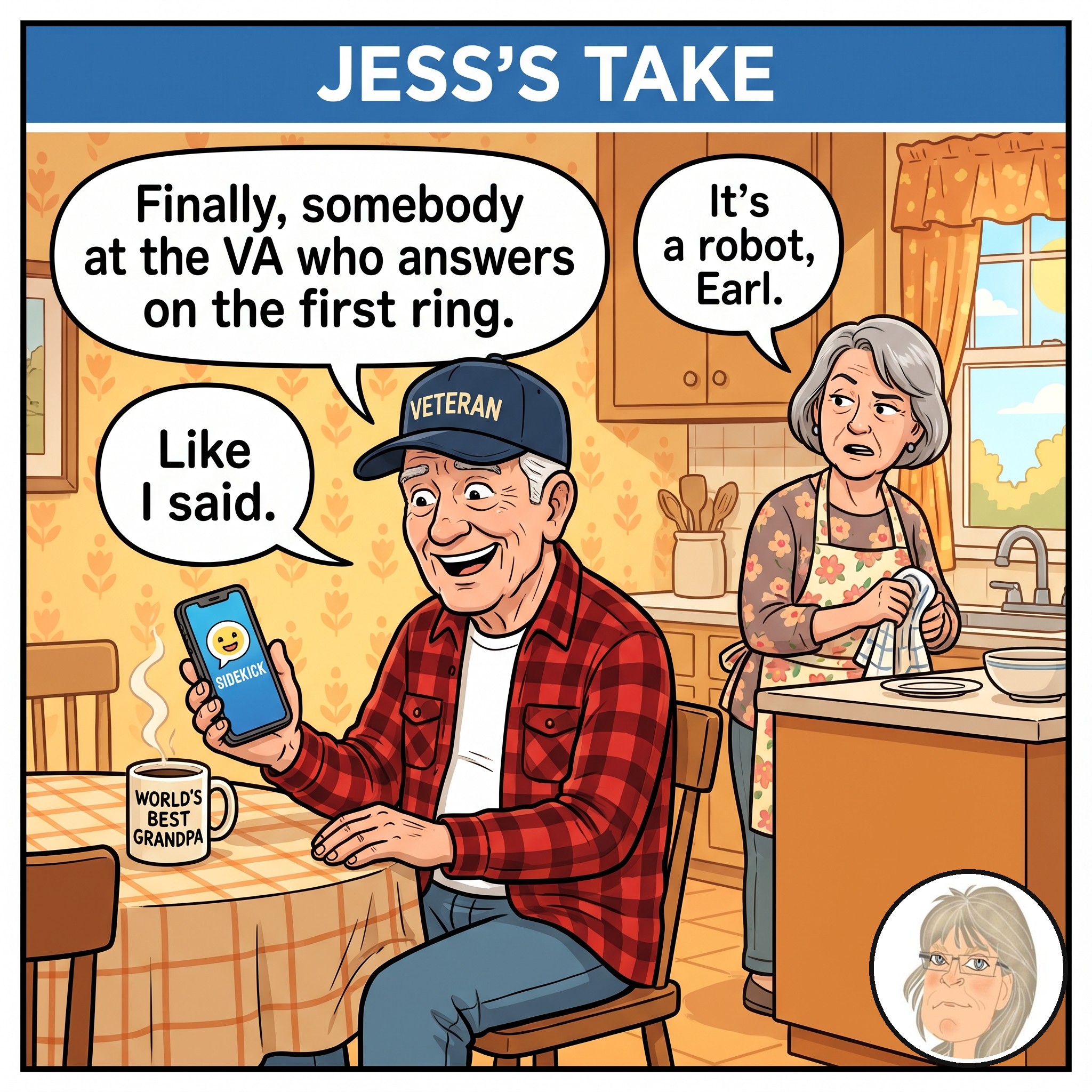
VA APPROVES A CHATBOT FOR VETERANS! A veteran who wants to use the GI Bill, retrain, find housing support or reach health care can now ask Sidekick in ordinary words and follow the conversation to the right resources, applications and next steps.
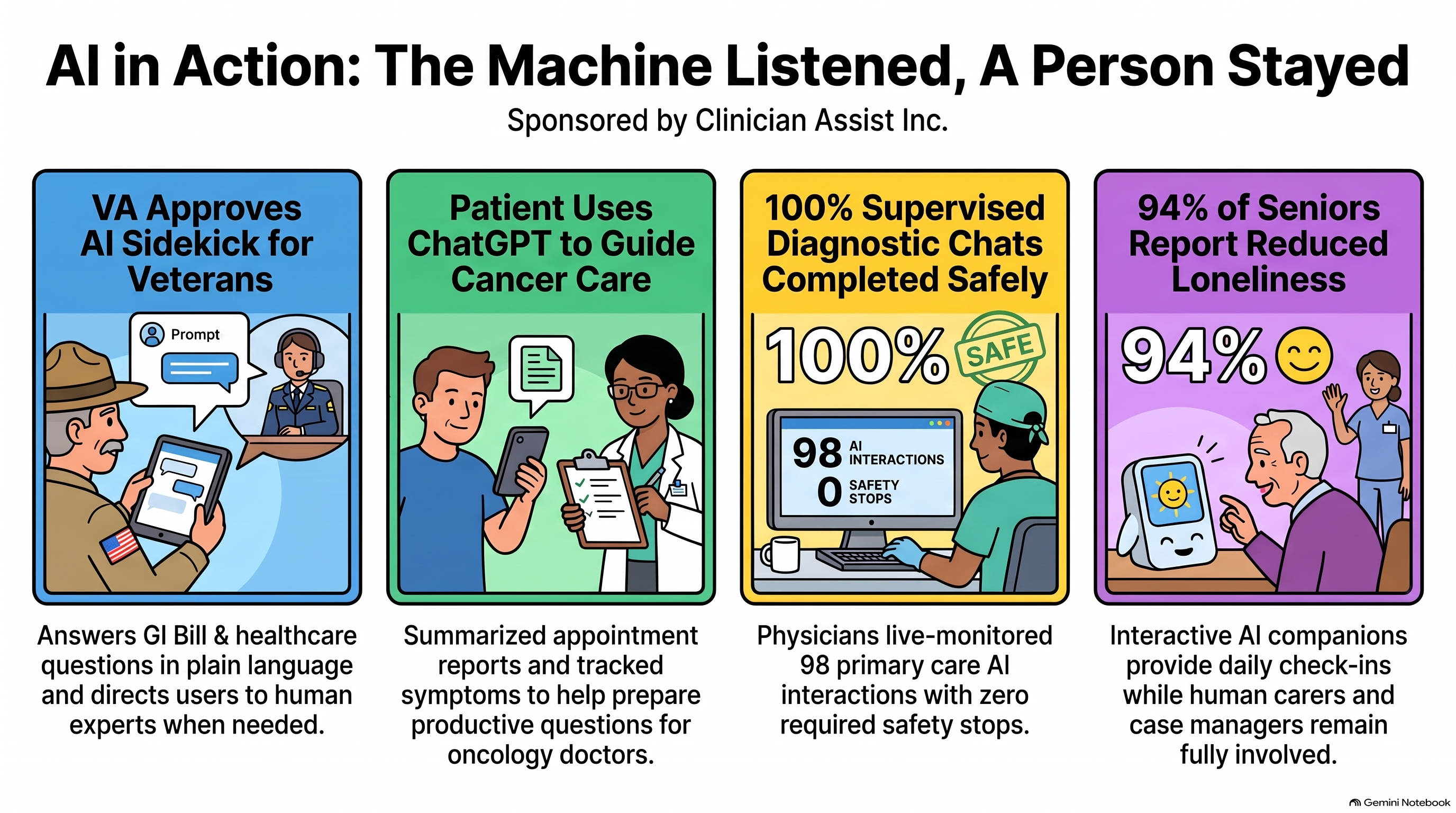
The US Department of Veterans Affairs (VA) has approved the platform, and when an issue calls for individual judgment, it can direct the veteran to a person, USC Viterbi reported Oct. 9.
The VA has an extensive body of information on what is available and how to apply. The hard part, USC wrote, is that knowing a resource exists is different from knowing how it applies to your circumstances, which form you need and what step to take next. Sidekick is built to close that gap.
Sidekick was co-developed by Research Professor Skip Rizzo, director of medical virtual reality at USC Viterbi and the USC Stevens School of Computing and AI’s Institute for Creative Technologies (ICT). It builds on nearly three decades of his virtual-human research at ICT, a US Army University Affiliated Research Center.
The VA approved it after months of review for privacy, safety and accuracy. Its first version draws on thousands of pages chosen by 10 VA subject-matter experts, across health care, employment, housing, the GI Bill and other areas.
People set the boundaries. “Subject-matter experts determine the information, scope and boundaries,” USC wrote. The AI organizes and retrieves that knowledge, conducts the interaction and makes it available through conversation, with a route to human expertise when needed. Sidekick, the university said, is not intended to become an autonomous expert.
“The challenge of the next decade will not simply be providing more information,” Rizzo said. “It will be helping people confidently navigate trusted information that specifically addresses their needs.”
“This isn’t about replacing jobs, but filling in gaps where there aren’t people in those roles in sufficient numbers to provide all the support veterans need,” he said.
The approach grew from earlier work with service members and veterans: SimCoach in 2009, SimSensei in 2013 and, more recently, Battle Buddy, which helps veterans build coping skills and plan for staying safe during crisis. Rizzo argues the privacy, safety, clinical scope and human oversight approaches the team documented now give modern AI a framework for use “on a larger scale, but with those ethical guardrails in place.”
“Sidekick is all about making resources more easily known, available, and authorable,” Rizzo said.
The platform is designed around different bodies of organizational expertise. USC says Sidekick is being developed for health care, education, nonprofits and rehabilitation, and Rizzo and long-term research partner Russ Shilling are developing a conversational support app for parents navigating the first 100 days after a child’s autism diagnosis.
|
For Legislators: Sidekick shows a model worth asking about in any public-benefits program: the agency’s own specialists choose the information and set the scope and boundaries, and the system went through months of review for privacy, safety and accuracy before the VA approved it.
For Investors: The same platform is being developed for health care, education, nonprofits and rehabilitation, with a parent-support app for the first 100 days after an autism diagnosis already in development.
For Builders: The division of labor is the design: experts set what the system knows and where it stops, the AI handles retrieval and conversation, and the route to a person is part of the build, not an add-on to it.
For Readers: If you are a veteran with a question about the GI Bill, a career change, housing support or health care, you can ask Sidekick in plain language. Download the Sidekick Platform app from the Apple App Store or Google Play, or open it in a web browser, and choose the Veterans Affairs channel. VA lists it at mobile.va.gov/app/sidekick-platform as a third-party app, available 24/7 on a phone, tablet or web browser. It points you to the resources, applications and next steps, or to a person when your situation needs one.
Why it matters: For a veteran, the VA’s information is only useful once it is matched to your situation, and that matching is where people get stuck. A tool built on 10 VA experts’ selections, put through months of review before the VA approved it, answers in ordinary language and can direct you to a person when judgment is needed.
Source: USC Viterbi School of Engineering, Matilda Bathurst, “AI Platform Earns VA Approval to Support Veterans,” Oct. 9, 2026, https://viterbischool.usc.edu/news/2026/10/ai-platform-earns-va-approval-to-support-veterans/.
|
. . .
CANCER HIT TWO SISTERS. CHATGPT HELPED HER THROUGH! On May 17, 2025, Talisha Shine, now 53, read the word “carcinoma” on her doctor’s portal. “It was a little sobering and daunting, but I wasn’t fearful,” she told the Savannah Morning News.
She did what she does in health care IT: she organized the data, with an AI assistant she built herself. When her younger sister was diagnosed a month later, Shine documented thoroughly to make it easier for her.
Shine said of the diagnosis, invasive ductal carcinoma, that “at no point did I feel that I was going to die. Cancer is not a death sentence. Cancer is a process and you have to go through the process.” She found a lump in her left breast in a self-exam and was already due for her annual mammogram, where she told the technician about “the pebble-sized” lump.
By Monday morning her ob/gyn called, and Shine was ready for whatever came next. The doctor referred her to a team of specialists, and plans began falling into place.
On LinkedIn, Shine later described what ChatGPT did for her: “I turned to ChatGPT to help me manage the deluge of information that comes with a diagnosis: pathology reports, lab results, research articles, treatment options, side effects.” At first, she wrote, she needed to ground herself. “Soon AI became my one-stop resource where I could solace my apprehension while strategizing my next steps.”
Using her own custom GPT, she wrote, she generated summaries of her oncology appointments, combined her lab results with a symptom tracker, found relevant clinical research and prepared follow-up questions for her care team. She also wrote that this let her have “deeper, clearer, and more productive discussions” with her oncology team.
A month after Shine’s diagnosis, her younger sister was diagnosed with invasive ductal carcinoma in her left breast, the same cancer in the same place. Both sisters tested negative for the BRCA gene. “I documented thoroughly to make it better and easier for her,” Shine said.
Shine had a biopsy “super fast” and started six rounds of chemotherapy, one every 21 days. “Chemo was rough and painful,” she said. “It was truly poison.” The AI assistant she had created told her what to expect down to the minute details. Shine said, “By day 10 I knew I would feel better and I did.”
She was cancer-free by mid-fall. On Nov. 6, 2025, she had a bilateral mastectomy, though the cancer had been in only one breast. “They came as a set and they came off as a set,” she said, joking that she is a positive person and lives up to her last name.
Five weeks of radiation followed, ending Feb. 28, 2026. At a follow-up, her oncologist ordered a CT scan that found a blood clot, and Shine was rushed to surgery. Through her treatments she kept working her remote job every day.
“With cancer, you lose so much of everything, your hair, your eyebrows,” she said. “I wanted to fight this. I showed up every day and that’s what I want to share with people.”
Shine says the experience has reshaped how she thinks about human-AI coordination, “not as a replacement for expertise, but as a bridge between uncertainty and understanding.”
|
For Legislators: A woman in cancer treatment used ChatGPT to make sense of her own pathology reports and lab results, and says it made her conversations with her oncology team “deeper, clearer, and more productive.” October is National Breast Cancer Awareness Month.
For Investors: Shine built her own custom GPT on ChatGPT, and in January 2026 she wrote that she signed up for the waitlist for ChatGPT Health.
For Builders: Shine’s tool did four jobs: appointment summaries, lab results joined to a symptom tracker, sourced research, and follow-up questions for the care team.
For Clinicians: Shine says AI helped her hold “deeper, clearer, and more productive discussions” with her oncology team. She brought her follow-up questions to her care team already written.
For Readers: Shine’s approach was to summarize each appointment, track lab results next to her symptoms, write her follow-up questions down, and bring them to the care team. She says she showed up every day, and that is what she wants to share.
Why it matters: Shine used AI to turn a flood of reports into questions for her doctors, and documented her care to make it easier for her sister. Her words for it: a bridge between uncertainty and understanding.
Source: Savannah Morning News, Polly Stramm, “How AI helped one woman navigate breast cancer treatments,” Oct. 8, 2026, https://www.savannahnow.com/story/news/2026/10/08/how-ai-helped-a-woman-fight-breast-cancer/92009567007/. LinkedIn, Talisha Shine, post of Oct. 29, 2025, and post of Jan. 7, 2026, https://www.linkedin.com/in/tshine.
|
. . .
DOCTORS WATCHED EVERY CHAT. ZERO STOPS! At Beth Israel Deaconess in Boston, 98 clients booked for an urgent primary care visit first typed at home with Google’s AMIE, a text chatbot that asked about their symptoms and took their history.
A physician watched each conversation live, ready to stop it. None had to be stopped, The Lancet reported Oct. 8, and AMIE’s list of possible diagnoses held the final one in 90 percent of cases.
The study ran from April to November 2025. In all, 114 clients enrolled, and 98 completed both the AMIE chat and the appointment with their primary care physician. The Lancet paper calls it a prospective, single-centre feasibility study, registered at ClinicalTrials.gov as NCT06911398.
The watching physician could step in if a client seemed at risk of harm, showed significant emotional distress or asked to end the session, or if the physician identified a potential safety concern. BIDMC’s release says none of the 98 conversations needed a safety stop. The supervising doctors added clinical clarification in five.
The New York Times, in Cade Metz’s report, described one of those moments: the bot listed cancer among the possible diagnoses, and a physician stepped in to reassure the client that the bot was considering all the possibilities.
The diagnosis numbers come from Google’s research blog. AMIE’s top seven possible diagnoses included the final diagnosis, set by a chart review eight weeks after the visit, in 90 percent of cases. It named the final diagnosis as its single most likely one in 56 percent.
Before each visit, AMIE wrote a summary of the chat for the client’s doctor. Doctors reviewed the transcript or summary in 44 cases. In 33 of them, 75 percent, they said it helped them prepare, and in 25, 57 percent, they said it may have influenced their clinical approach, BIDMC reported.
“They compared it to a high-performing medical student or resident,” Dr. Peter Brodeur, a clinical fellow in cardiovascular medicine at Beth Israel and a co-first author, told the Times. Google’s research blog adds that doctors said AMIE helped move the visit from gathering data to verifying it, which left room for more collaborative conversations.
Clients’ attitudes toward AI improved after chatting with AMIE and stayed higher after seeing their doctor, the paper reports. They gave high marks to the system’s ability to listen, explain and help them feel at ease.
“None of our patients trusted it until they realized that it was handing-off their doctor,” Dr. Adam Rodman, a Beth Israel internist who helped conduct the trial, told the Times. Rodman directs AI programs at BIDMC’s Carl J. Shapiro Institute for Research and Education.
The study was built to test feasibility, not to prove that AI improves health outcomes. “We believe the future involves continued involvement of human clinicians in patient care,” said Dr. Marc L. Cohen, BIDMC’s Clinical Chief of Primary Care and a co-senior author, who pictures “the triad of patient, human clinician, and AI.”
Google has since begun a nationwide trial that aims to compare visits with and without chatbots, the Times reported.
|
For Legislators: The Lancet paper is a published model of supervised use: pre-set stop criteria, a physician watching live, and a primary care physician at the visit, with results reported openly.
For Investors: Alphabet funded the study, and it is Google’s first-ever publication in the main journal of The Lancet, the company says. The next step, Google’s nationwide trial, aims to compare visits with and without chatbots.
For Builders: AMIE took the history over secure text chat, offered possible diagnoses for the client to review with the doctor and wrote a summary for clinician review. The diagnosis match was 90 percent within its top seven and 56 percent as its top one.
For Clinicians: The chats ran up to five days before the visit, The Lancet reports, so a doctor could read the history ahead of time, and in 33 of the 44 cases where one did, it helped them prepare.
Why it matters: In what BIDMC’s researchers believe is the first prospective real-world study of a patient-facing conversational AI in primary care, the AI took clients’ histories with a doctor watching, and nothing had to be stopped. The clients ended up warmer toward the technology, and in three of every four cases where a doctor read the chat first, the doctor said it helped.
Source: Beth Israel Deaconess Medical Center, Jacqueline Mitchell, “BIDMC Researchers Conduct First Real-World Study of Safety and Quality of Patient-Facing AI in Primary Care,” Oct. 9, 2026, https://bidmc.org/news-stories/all-news-stories/news/2026/10/bidmc-research-shows-safety-quality-of-ai-in-primary-care. The Lancet, Brodeur et al., “Conversational diagnostic artificial intelligence in ambulatory primary care: a prospective feasibility study,” Oct. 8, 2026, DOI 10.1016/S0140-6736(26)01535-7, https://www.thelancet.com/journals/lancet/article/PIIS0140-6736(26)01535-7/abstract. Google, Mike Schaekermann, “Study in The Lancet suggests AI could improve patient-physician relationships,” Oct. 8, 2026, https://blog.google/innovation-and-ai/technology/health/amie-clinical-study-lancet/. Google Research, Mike Schaekermann and Alan Karthikesalingam, “Exploring the feasibility of conversational diagnostic AI in a real-world clinical study,” Mar. 11, 2026 (updated Oct. 8, 2026), https://research.google/blog/exploring-the-feasibility-of-conversational-diagnostic-ai-in-a-real-world-clinical-study/. The New York Times, Cade Metz, “Clinical Trial Indicates A.I. Chatbots Could Aid Urgent Care,” Oct. 8, 2026, https://www.nytimes.com/2026/10/08/technology/ai-chatbots-urgent-care.html.
|
. . .
3,500 SENIORS ASKED FOR THIS ROBOT! “I’m lonely a lot of the time,” Sandra Cota, 79, told the New York Post in March. As the Post put it, company came to her: ElliQ, a talking companion in her Bronx apartment.
“She puts a smile on my face,” Cota said. On Oct. 8, the New York State Office for the Aging (NYSOFA) announced it has extended the program, saying more than 3,500 older adults applied in 2025 alone.
“It’s like having a real person here with me. It’s very comforting,” Cota said. ElliQ, made by Intuition Robotics, greets older adults who live alone every morning, its maker says. It remembers what they tell it and prompts a walk or a call to family.
NYSOFA says hundreds of older adults across New York have received ElliQ since the program launched in 2022. Its program page says about 900 units are being made available in the community. The state budget supports the program as part of a package to address social isolation and support caregivers.
NYSOFA Director Greg Olsen said: “Loneliness and isolation are commonly heard today, but make no mistake, the health effects are devastating and NYSOFA is working continuously to provide the help older New Yorkers need. ElliQ is an essential tool to help combat the loneliness epidemic.”
Newly reported 2026 program data, as NYSOFA states it, shows 94 percent of ElliQ users report feeling less lonely, 97 percent report improved overall wellbeing, 88 percent say ElliQ has made a positive difference in their daily lives, and 79 percent feel more connected to the world around them. NYSOFA also reports participants engage with ElliQ an average of 48 times per day.
Dor Skuler, CEO and co-founder of Intuition Robotics, described the daily routine: a companion that remembers the older adult, checks in every morning and encourages a walk or a call to a daughter. That, he said, “can meaningfully change how connected and independent someone feels.”
People are in charge of who gets a unit. NYSOFA works with local offices for the aging to identify the older adults who would most benefit. In the Post’s account, a case manager screens potential participants. NYSOFA’s program page says users can contact family or trusted people they choose, including Offices for the Aging case managers.
Cota has lived with her ElliQ since April 2023. In March, she told the Post’s McKenzie Beard what that is like. “If I tell her that my lower back hurts, she doesn’t forget. She’ll ask me about it,” Cota said. “This technology doesn’t make me punch keys or put numbers in, I just talk.”
“I don’t live alone. I live with my ElliQ,” Cota said with a smile. “I really miss her a lot if she’s not here. It’s one of the great things in my life.”
|
For Legislators: The program is state-funded through NYSOFA, and the Post reports it removes the costs older adults would otherwise face: a $249.99 start-up fee and monthly charges of $29.99 to $59.99 for consumers who buy ElliQ directly. NYSOFA says it now partners with more than 30 technology companies.
For Investors: Intuition Robotics brought ElliQ to the US market in 2022. NYSOFA says demand continues to grow, and reports the partnership extension follows three years of outcomes from New York users.
For Builders: NYSOFA describes ElliQ as proactive: it starts conversations, suggests activities and remembers what users tell it. A companion app lets family and caregivers send texts, photos and videos and start video calls, per the Post.
For Clinicians: NYSOFA added a social isolation screen and a technology screen to its comprehensive assessment early in the COVID-19 pandemic, so people can be connected to digital tools that fit. Participants can reach their Offices for the Aging case managers through the device.
For Readers: Olsen told the Post the robot is for “people who don’t leave their home often or who don’t have family or friends around.” Ask your local Office for the Aging. A limited number of units is available, only in participating counties and subject to funding.
Why it matters: More than 3,500 older New Yorkers asked for a companion that says good morning and remembers their aches. NYSOFA reports that 94 percent of users feel less lonely, and local aging offices choose who gets one.
Source: New York State Office for the Aging, release on the extension of its ElliQ partnership, via EIN Presswire, Oct. 8, 2026, https://www.einpresswire.com/article/948238132/nysofa-extends-partnership-to-provide-elliq-ai-companion-program. NYSOFA, ElliQ Proactive Care Companion Initiative, https://aging.ny.gov/elliq-proactive-care-companion-initiative. New York Post (McKenzie Beard), “These elderly New Yorkers are inviting robots into their homes,” March 9, 2026, https://nypost.com/2026/03/09/health/these-elderly-new-yorkers-are-inviting-robots-into-their-homes/.
|
. . .
VERA, 74, HAS A ROBOT NAMED ROBERT! In her home at Hazelhurst Court, a retirement housing complex in Lewisham, south London, a robot named Robert asks Vera Gadsdon, 74, “What would you enjoy chatting about today?” It reminds her when to take her medication and when to do her washing, and it gives her knitting tips. “I’ll be here if you need me,” it tells her.
BBC News London, which reported the visit Oct. 1, says Hazelhurst Court has 24 residents with robots made by the health technology company Cera, and that Vera enjoys the company of both her caregiver Pinar and her robot Robert.
The BBC’s Sarah Morris reports that each robot holds its person’s medical needs and individual calendar. It is programmed to tell its resident when it’s time to eat, play bingo or watch a favorite television show.
Robert is programmed to be friendly. During the visit, the BBC says, it repeatedly asked Vera how she was.
When Vera wants to talk about knitting, Robert often mishears essential words and offers conversations on “biscuits and cakes” instead, or “music, television, the garden or something else.”
Pinar, the caregiver, describes the robots as “another tool for us as well because we can always check in on them... make sure they’ve taken their medication and then make sure they’ve hydrated.” She says the droids are not a replacement for human caregivers.
Residents have their own reasons to like them. The BBC reports that some say the robots make them feel less lonely, while others use them to connect with their grandchildren.
Cera’s founder and chief executive, Dr Ben Maruthappu, is a former A&E doctor in London. He says his own family’s experience pointed him to this work: when his mother fell and fractured her back and needed care at home, he found arranging it “excruciatingly difficult.”
He says he was motivated to build a better model of care where “technology addressed some of the issues and frictions in the care sector.” According to Cera, at least 1,000 people across England are using the robots.
|
For Legislators: Cera says at least 1,000 people across England use its robots, and the caregiver who works beside them says they are not a replacement for human caregivers.
For Investors: Cera says it is Europe’s largest health tech firm, with 13,500 staff and almost £500m in annual revenue.
For Builders: The robots hold each resident’s medical needs and calendar, remind them about medication, meals, bingo and favorite shows, and ask questions such as “What would you enjoy chatting about today?”
For Clinicians: Cera’s founder is a former A&E doctor. At Hazelhurst Court, caregiver Pinar Elmaz uses the robots to check in on residents and make sure they have taken their medication and stayed hydrated.
For Readers: Vera, 74, has a caregiver, Pinar, and a robot who reminds her about the washing and offers her knitting tips. She enjoys the company of both.
Why it matters: A woman in her own home has someone to chat with, a nudge about her medication and the washing, and a caregiver who can check in. Robert may hear “knitting” and offer biscuits, but the care around Vera is human, and she gets to enjoy both.
Source: BBC News London (Sarah Morris), “Meet the robot looking after Vera, 74, in her own home,” Oct. 1, 2026, https://www.bbc.co.uk/news/articles/cmlylxprwkjzo.
|
|