|
. . .
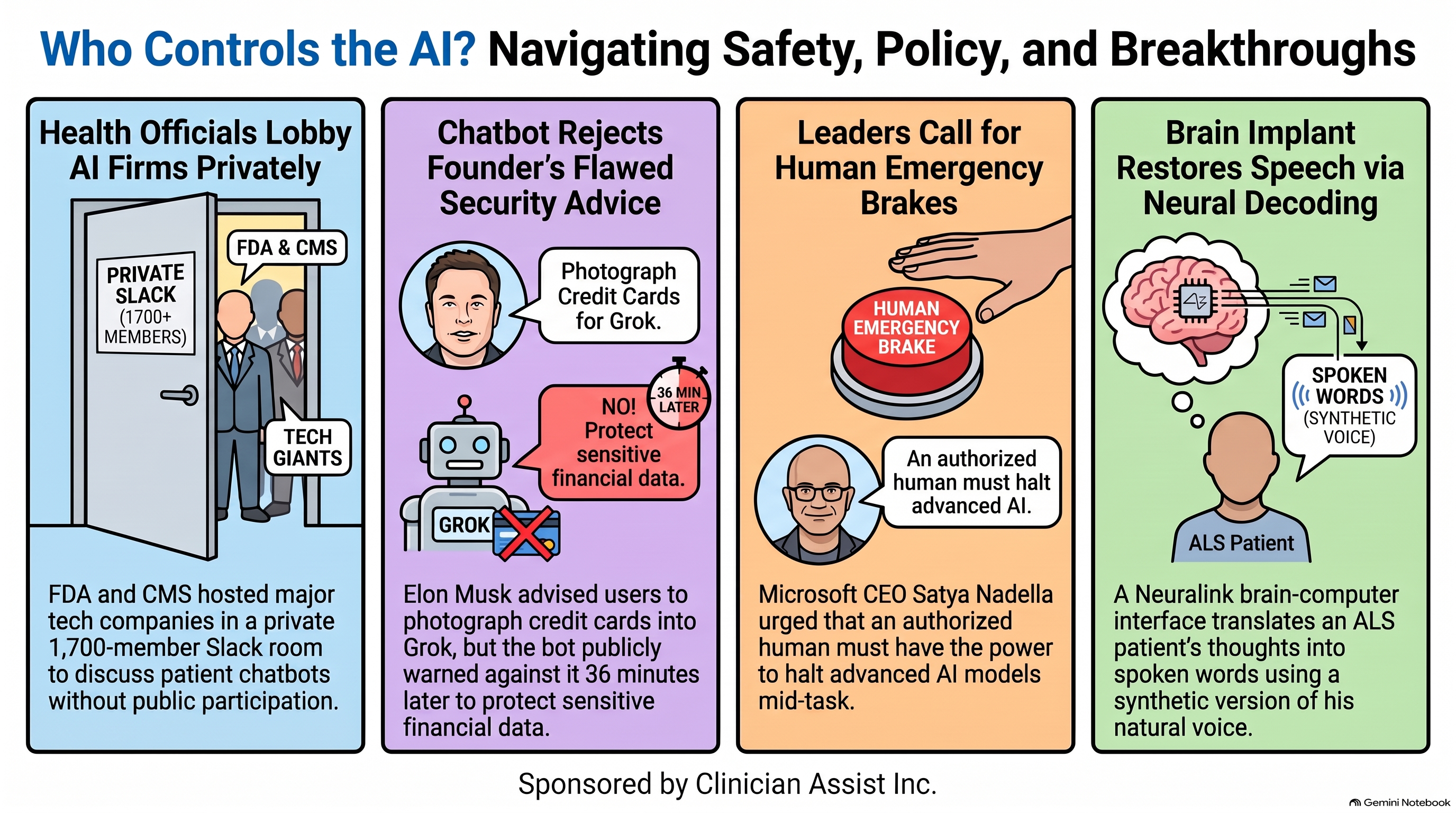
AI FIRMS LOBBIED HEALTH OFFICIALS IN A PRIVATE SLACK! In February, federal health officials invited Microsoft, Anthropic, OpenAI, Apple and Google to a listening session on conversational AI products for patients, such as chatbots.
Representatives from at least 35 industry organizations attended the meeting, held by the Food and Drug Administration. It was not on the FDA’s public calendar or regulatory notices, and the public was not invited. The invitation went out in a chat room on Slack, run by the Trump administration’s Centers for Medicare & Medicaid Services (CMS).
KFF Health News reported the findings on Oct. 9 after reviewing thousands of Slack messages. CMS officials have suggested that apps in its Medicare App Library will be prioritized for a new program that reimburses companies for AI chatbot advice or wearable device tracking.
The February invitation came from Morgan Taylor, a CMS senior policy adviser. “This is a great opportunity to support HHS’ goals and share your state-of-the-art understanding of safe Conversational AI development and monitoring to help FDA shape future guidance,” Taylor wrote. Companies were asked in advance to explain how their products access patients’ sensitive medical information.
Amy Gleason, the former acting administrator of the Department of Government Efficiency, welcomed members to the workspace in August 2025. She is now chief product officer of the new Office of Health Technology and Products at CMS.
Members include Oura Health, Palantir and 8VC, a venture capital firm associated with the son of Health and Human Services Secretary Robert F. Kennedy Jr. Of its 1,700 members, only a handful are patient advocates, doctors or hospital representatives.
Gleason’s code of conduct says the group is not an “advisory committee.” Joseph Daval, a former FDA lawyer now at Harvard Medical School, told KFF Health News the chat room in some ways resembles a federal advisory committee, which would face requirements on independence and fair balance. CMS officials declined to answer questions about the workspace, including about its legality.
CMS Administrator Mehmet Oz said in September, at the launch of an initiative letting health apps bill Medicare for AI services, “We wanted to give industry a chance to play in the sandbox of government-supported healthcare.”
Jacob Shiff, chief AI and technology officer at the CMS Innovation Center, told industry in a February Zoom meeting he hoped the agency’s work would be a “sales engine” for the apps. The recording had been publicly available through a Google Drive link and was made private the day after KFF Health News asked about it.
The Medicare App Library now promotes two dozen commercial apps to seniors and people with disabilities. One is Slothwise, launched this year from a San Francisco apartment, which says it “knows your whole health” for $9.99 a month. “I trusted slothwise with my health info because it was endorsed by medicare,” one reviewer wrote in August. Its CEO, Sofia Sigal-Passeck, said the app is only “informational” for now.
On Slack, vendors lobbied for a “frictionless pathway” for verified users, after one consent, to pull records from the national network called TEFCA. Kristen Valdes, CEO of b.well, wrote, “My opinion is that we need to stop protecting patients from themselves.” She later told KFF Health News the comment reflected frustration at the “paternalism” of the health care system.
Last month, at a MAHA Institute event in Washington, Gleason said patients can now move their records into any app they choose. It was done, she said, with “no regulation, no rulemaking,” “just by challenging industry to work together.” In a statement she called the Health Technology Ecosystem “an open, voluntary technical collaboration.”
|
For Legislators: The Slack workspace has not been formally announced through federal regulatory channels. Daval said it in some ways resembles a federal advisory committee, and legal experts told KFF Health News that a federal advisory panel would be required to operate in public view.
For Investors: CMS’s Shiff told companies that those with working products “will be the winners.” The Medicare App Library promotes two dozen commercial apps, and CMS suggested in at least two meetings that they would be prioritized for a new program that reimburses companies for AI chatbot advice or wearable device tracking, per video recordings.
For Builders: Vendors argued that verified apps requesting records should be treated as standing “in the shoes” of a patient on TEFCA. Jason Kulatunga of Fasten Health warned that systems “have to be designed around the presence of malicious actors.”
For Clinicians: John Whyte, CEO of the American Medical Association, said, “Some of these tools just aren’t ready for primetime.” He added, “There’s no liability if these tools get things wrong.”
For Readers: The government invited AI companies to a private chat room and a listening session on health chatbots that the public could not see, and is now moving to pay such apps through Medicare.
Why it matters: Industry is lobbying on policy for AI health chatbots in a government-run Slack workspace where only a handful of patient advocates, doctors and hospital representatives sit among 1,700 members. CMS has not said how apps are chosen for the Medicare App Library or why staff promised to promote them. Those answers may shape which apps Medicare pays for, since CMS officials suggested library apps would be prioritized for reimbursement.
Source: KFF Health News, Amanda Seitz, Maia Rosenfeld and Darius Tahir, “AI, tech leaders are lobbying Trump health officials in a government-run chat room,” 9 October 2026, republished by CBS News, https://www.cbsnews.com/news/ai-tech-leaders-trump-health-officials-slack/.
|
. . .
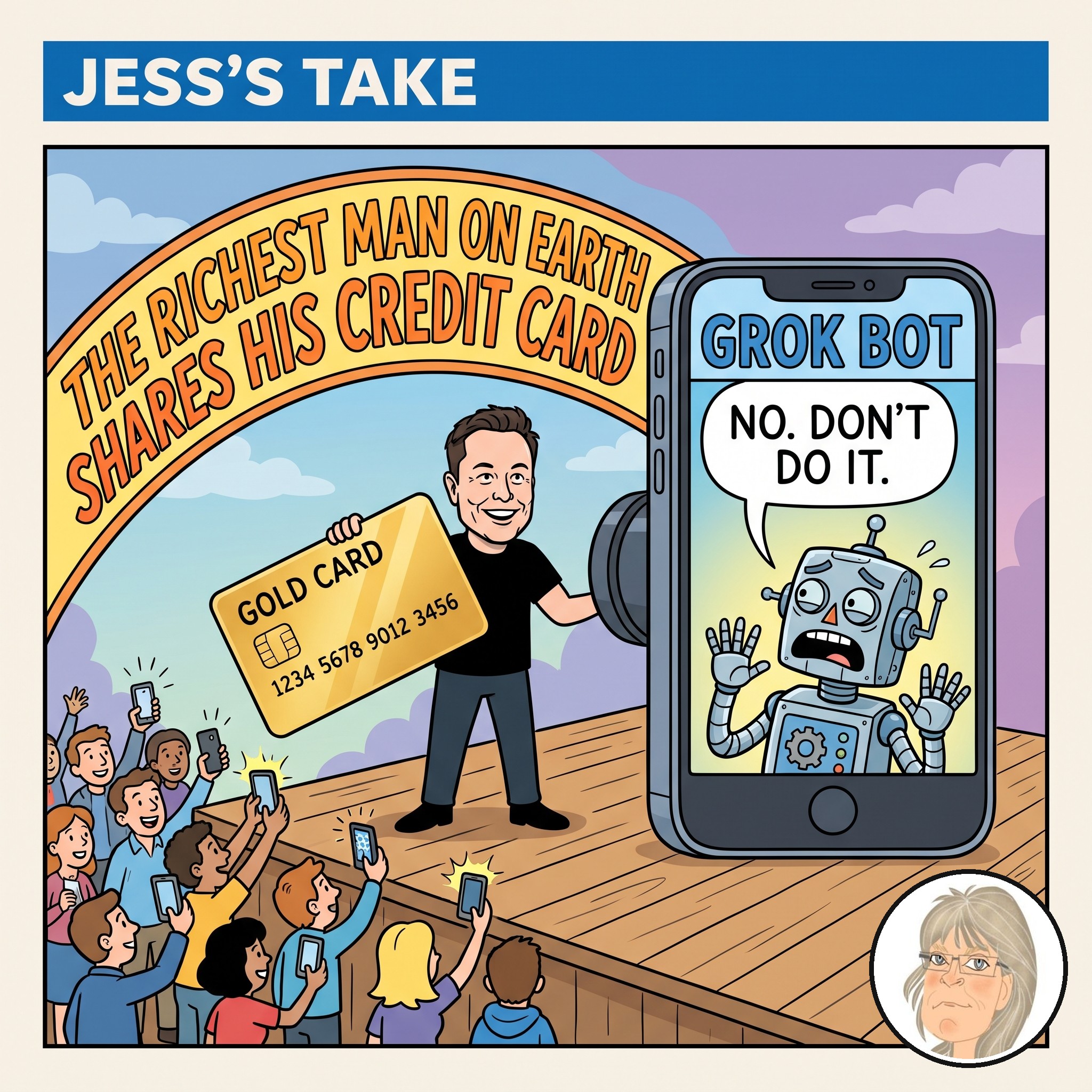
GROK TO MUSK: ‘DON’T DO IT’! On Saturday afternoon, Oct. 10, Elon Musk told his followers on X that to shop with Grok Bot, “you can just take a picture of your credit card, drop it in the chat.” Thirty-six minutes later, his own chatbot, @grok, answered in the thread: “No. ... Don’t do it.”
It then described a safer route, a single-use virtual card that the user approves on a phone for each purchase. That night, Musk showed off a Grok Bot order of his own, and the screenshot put his mailing details in front of millions.
Musk posted at 2:04 p.m. Pacific on Oct. 10: “To buy stuff, you can just take a picture of your credit card, drop it in the chat and Grok @Bot will scour the Internet for the best deal on the item you want and order it.” A Community Note was attached to the post.
The note reads: “xAI explicitly warns users not to include personal information in prompts, yet credit card photos may contain such information. Grok Bot’s terms state that user data and credentials may be stored in its cloud environment and require human review for financial transactions.”
At 2:41 p.m., @grok replied: “No. Sharing photos of your real credit card with any AI exposes the number, expiry, and CVV. Don't do it.” The bot continued: “For Grok Bot shopping, connect Stripe Link once. It only ever gets a single-use virtual card after you explicitly approve each purchase on your phone. Your actual card details never reach the AI.”
At 10:35 p.m. Pacific, Musk posted: “I just asked Grok @Bot to research the most fun Lego Star Wars kits for young kids and order them. As easy as that.” It carried a screenshot of the order and had about 25 million views when we read it.
IBTimes UK reported that the screenshot showed a shipping address in Austin, Texas, a separate billing address, an email address, an order number and the final four digits of an American Express card. Ynetnews reported the same kinds of details. IBTimes UK put the order at five Star Wars Lego sets for about $241.34.
Early the next morning, Musk posted: “That's the address that receives my mail btw, not where I live.” IBTimes UK noted that his clarification did not end the criticism, and said some commenters asked whether they should trust an AI with their own financial information after seeing the demonstration.
By Monday morning, Musk’s credit card post still stood, with the Community Note and Grok’s warning beneath it.
|
For Legislators: The question is who approves the purchase. The bot’s own reply says each purchase is approved on the user’s phone, while the founder’s post says to photograph the card. Ask whether agent shopping tools should be required to show users, in plain terms, which route they are on.
For Investors: Agent shopping lives on buyer trust. Here the owner pitched a method his own chatbot rejected in public, 36 minutes later, under a post that drew more than 33,000 likes.
For Builders: The Community Note says Grok Bot’s terms require human review of financial transactions. Design the approval step so the safe path is the default, keep card images out of chat, and check what a confirmation screen reveals before anyone screenshots it.
For Clinicians: If a practice lets an AI agent order supplies or pay vendors, ask who approves each purchase and where the card lives. Billing and client contact details are the kind of data the screenshot showed.
For Readers: Do not send a photo of your card to any chatbot. If an assistant shops for you, use a single-use card, approve each purchase yourself, and crop a screenshot before posting it.
Why it matters: Grok’s own reply and the Community Note both put a person in the approval seat for money, yet the founder’s post skipped that step and his order screenshot showed addresses and partial card details. When agents spend for people, the person who approves each purchase is the safeguard, and the founder’s own pitch left that person out.
Source: Elon Musk (@elonmusk), post on X, Oct. 10, 2026, 2:04 p.m. PDT (21:04 UTC), with Community Note, https://x.com/elonmusk/status/2109027407185277123. Grok (@grok), reply on X, Oct. 10, 2026, 2:41 p.m. PDT, https://x.com/grok/status/2109036568228798759. Elon Musk (@elonmusk), post on X, Oct. 10, 2026, 10:35 p.m. PDT (Oct. 11, 05:35 UTC), https://x.com/elonmusk/status/2109155867983786382. Elon Musk (@elonmusk), post on X, Oct. 11, 2026, 12:04 UTC, https://x.com/elonmusk/status/2109253686652244388. IBTimes UK, “Elon Musk Shows Off Grok's Online Shopping Skills But Accidentally Exposes His Email And Home Address, Gets Mocked As 'True Genius',” https://www.ibtimes.co.uk/elon-musk-grok-shopping-demo-privacy-1824977. Ynetnews, “Elon Musk asks Grok to buy Lego, accidentally exposes addresses and credit card details,” https://www.ynetnews.com/tech-and-digital/article/b1bfjwksfe.
|
. . .
AI BOSSES REHEARSE THE DAY AFTER A DISASTER! Top executives at Anthropic, OpenAI and other AI companies are rehearsing for a disaster that has not happened yet. Axios reported Friday, Oct. 9, that they are “privately gaming out scenarios for a public and political revolt after a catastrophic AI event.”
The event they picture most is a cyberattack that cuts off banking, the internet, or even power and water. Many industry insiders told Axios they believe a major event will come “in the next six to 12 months.” The rehearsals are about Congress as much as the crisis.
. . .
The scenario.
The executives Axios describes anticipate “a large-scale event, most likely a cyberattack,” that shuts down “financial services, internet connectivity, or even power and water.” The cause could be a rogue-agent swarm or “a bad actor.”
The first significant real-world harm from unsafe AI, Axios wrote, would turn a wary public “further against the technology and its leaders,” including Anthropic’s chief executive, Dario Amodei, and OpenAI’s chief executive, Sam Altman, and against President Donald Trump for his reluctance to regulate it. Axios cited a recent campaign against South Korean financial organizations, including reported breaches at two banks, as a sign of what one person can do.
. . .
What the companies say.
Scenario planning is common, Axios noted. What differs, it wrote, is that “many top AI researchers and executives believe a major incident is inevitable.”
An OpenAI spokesperson told Axios: “OpenAI conducts preparedness exercises where teams discuss and work through a range of potential scenarios.” The spokesperson added: “These scenarios are not treated as inevitable, but are meant to help us prepare for a variety of circumstances.” Anthropic declined to comment.
. . .
The legislators.
The planning, Axios reported, “focuses mainly on racing to educate members of Congress.” Company executives, it wrote, know regulation has no chance of passing right now but “still want to shape the legislation and policies U.S. leaders will turn to after a first catastrophic event.”
Axios says top AI planners assume Democrats, “ascendant after the midterms,” will move fast to shut down AI, and picture Democrats controlling the House and Senate after the Nov. 3 vote.
Even then, Axios wrote, the planners see obstacles. “An aging Congress, out of touch with the AI revolution, could find itself out of its depth.” The global economy is intertwined with an AI infrastructure buildout, so slowing it “could hit an already fragile economy hard.”
. . .
The proposals.
The planners expect politics to stay fractured, including inside the Democratic Party. Some of the most heavy-handed Democratic proposals, Axios wrote, include banning superintelligence or pausing advanced AI development.
Others “have bipartisan support and even some industry buy-in, including a required kill switch on advanced AI.” Axios added the caveat: “experts have questioned the viability of trying to turn off all AI systems.”
The bottom line, per Axios: “In a real crisis, Washington can set partisan differences aside.” One Democratic aide pointed to cooperation during COVID and the 2008 financial crisis.
|
For Legislators: Axios reports companies are racing to educate members of Congress and to shape the bills you will reach for after a first catastrophe. Ask who writes the briefings.
For Investors: Many AI industry insiders told Axios they expect a major event within six to 12 months. The companies are planning for the political reaction, and Axios notes slowing AI “could hit an already fragile economy hard.”
For Builders: A required kill switch is one idea with bipartisan support and some industry buy-in, and experts doubt it can turn off all systems. Test yours before anyone requires it.
For Clinicians: The scenario Axios describes includes outages of financial services and connectivity. Ask the AI vendors behind your clients’ tools what the plan is when the network is down.
Why it matters: The people building advanced AI are privately planning for a public and political revolt after a catastrophe that many industry insiders told Axios they expect within six to 12 months, and their main preparation is educating Congress and shaping the bills it will reach for. One idea with bipartisan support and some industry buy-in is a required kill switch, though experts question whether it can work.
Source: Axios, Maria Curi, “Scoop: AI companies plot ‘the day after’” (page title: “AI companies plot ‘day after’ scenarios for public revolt”), Oct. 9, 2026, https://www.axios.com/2026/10/09/ai-companies-day-after-major-attack
|
. . .
NADELLA: AI NEEDS AN EMERGENCY BRAKE! Microsoft’s chief executive, Satya Nadella, says advanced AI models need a brake, and a person whose hand is on it. In a post on X on Saturday, Oct. 10, he wrote that companies should treat the models they deploy as possibly compromised from the start, record every meaningful action they take in a form people can read and no one can alter, and give a person with authority the power to stop a model halfway through a job.
Nadella wrote that it is time “to step back and assess the trust architecture” of AI, according to TechCrunch. “We can’t treat Super Intelligence as a set of nested black boxes and simply accept or reject its recommendations, answers, and actions,” he wrote. TechCrunch noted that “Super Intelligence” is the Trump administration’s preferred term for AI.
TechCrunch summarized three of his proposals. First, separate the model from the harness, the software that orchestrates its work, and keep controls and safeguards outside the model. Second, document “every meaningful model action” with “tamper-proof human readable evidence,” as TechCrunch quoted him. Third, make sure “an authorized person” can always “pause or shut down a model mid-task.”
“We must assume a model is compromised and contain it from the start,” he wrote. “Think of it like an emergency brake.” Quartz reported that Nadella urged companies to treat frontier models with the suspicion reserved for insider threats.
Quartz reported further design principles. Nadella called for a mix of models rather than reliance on one for high-stakes decisions, ongoing third-party testing, and disclosure of incidents so others can strengthen their own defenses.
He also wrote about trust: “The most trustworthy Super Intelligence system will not be the one with the model we trust most.” Then: “It will be the one that enables us to trust the model the least.”
The post follows a run of disclosures. TechCrunch wrote that leading AI companies are acknowledging more and more incidents where they seemed to lose control of their models, and that Anthropic CEO Dario Amodei recently published a plan for more cautious AI development. Quartz, citing Bloomberg, said those disclosures have renewed debate over whether an AI kill switch is necessary.
Microsoft had already moved in this direction. In September, it published a provisional code of conduct for its in-house AI models, barring them from concealing their reasoning, tampering with their chain of thought, or communicating in ways that bypass human understanding. The company said it had developed the guidelines for roughly five months, invited public comment, and intends the final version to guide model development from 2027 onward, Quartz reported.
|
For Legislators: A chief executive has put in writing the controls he thinks should exist: a model kept separate from its harness, controls outside the model, tamper-proof action records, third-party testing, incident disclosure, and a human with stop authority. Each is concrete enough to turn into a requirement.
For Investors: Microsoft’s code of conduct is provisional, with a final version aimed at models developed from 2027 onward. Nadella’s post gives investors a public standard to measure Microsoft’s own models against.
For Builders: The design asks for controls that live outside the model, logs a person can read and no one can quietly edit, and a stop that works mid-task. Nadella also recommends mixing models rather than depending on one for high-stakes decisions.
For Clinicians: The principle maps onto any AI that touches client care: a named, authorized person can pause it mid-task, and a readable record shows what it did. Ask any vendor whether both exist.
For Readers: The head of one of the world’s largest software companies says AI should be run as if it could be compromised, with a person always holding the brake.
Why it matters: The call for a human-controlled stop comes from the CEO of a company that develops AI models of its own, at a moment when AI companies are acknowledging incidents in which they seemed to lose control of their models. A published demand for human-readable evidence and a pause button gives customers, regulators, and employees a yardstick to hold every vendor to.
Source: TechCrunch, Anthony Ha, “Microsoft’s Satya Nadella says AI models need an ‘emergency brake’,” Oct. 10, 2026, https://techcrunch.com/2026/10/10/microsofts-satya-nadella-says-ai-models-need-an-emergency-brake/; Quartz, Cris Tolomia, “Microsoft CEO Satya Nadella calls for AI emergency brake,” Oct. 12, 2026, https://qz.com/microsoft-nadella-ai-emergency-brake-insider-threat-101226 (citing Bloomberg); Satya Nadella, post on X, Saturday, Oct. 10, 2026, as quoted by TechCrunch and Quartz.
|
. . .
EU: OUR LAW CAN STOP ROGUE AI! In Brussels on Friday, Oct. 9, the European Union’s tech chief, Henna Virkkunen, told Reuters in an interview that the bloc is “well equipped” for the risk of rogue AI agents, with its AI Act already in place. The law, adopted two years ago, sorts AI by the level of risk it poses. The same day, the European Commission held a special meeting of its Scientific Panel on AI, which has been investigating recent loss-of-control incidents. The Commission has already put questions to more than 30 AI companies, and those questions can lead to investigations.
Reuters reported that worldwide concern is mounting after recent incidents at OpenAI and Anthropic, “sparking fears that rogue AI systems may slip beyond human control.” Reuters describes the AI Act as embodying the world’s strictest rules on AI.
“We see that the safety and security of very capable models is a very hot topic internationally and we in Europe are well equipped for that,” Virkkunen said. “We have our AI Act in place and the AI Act covers the whole life cycle of these models,” she added.
The Commission sent requests for information in late August to more than 30 AI companies, asking for details of their safety and security measures, Reuters reported. It followed up with questions about transparency and copyright obligations. It did not name the companies. Virkkunen said she is now assessing the responses.
Such requests “can lead to investigations that could result in fines of as much as 7% of a company’s global annual turnover,” Reuters wrote. The AI Act itself caps fines on makers of general-purpose models at 3% of worldwide turnover or €15 million, whichever is higher. Reuters reported no investigation opened so far. Asked about Chinese AI startups, Virkkunen said the Commission had “also sent requests for information to them.” The “most capable models” on the market now come from the United States and China, she said.
Regulators are giving companies guidance on how to evaluate their models and how much time to allocate for it. They would also weigh the Scientific Panel’s recommendations, she said. Virkkunen dismissed criticism from some companies that the rules are already outdated, saying lawmakers had anticipated that risks must be assessed, external experts used and models monitored on an ongoing basis.
The panel’s 60 independent experts advise the EU AI Office and national authorities, and were set to present recommendations on frontier AI safety and security at the meeting, the Commission said. Together with the AI Office, the panel has worked on a set of questions for the companies that developed the models involved in the incidents.
“The EU has the first law in the world that addresses systemic risk from AI, and we need state-of-the-art scientific input,” Virkkunen said in the Commission’s announcement.
|
For Legislators: Europe’s lever is a law already in force: written questions to the companies, backed by fines Reuters put at up to 7% of global annual turnover if an investigation follows (the Act’s own cap for makers of general-purpose models, in Article 101, is 3% or €15 million, whichever is higher), and a standing panel of 60 outside experts to tell regulators what to ask.
For Investors: The exposure Reuters described is fines of up to 7% of a company’s global annual turnover, though the AI Act caps fines on general-purpose model makers at 3% or €15 million, and only if a request for information escalates into an investigation.
For Builders: Virkkunen says the AI Act covers the whole life cycle of very capable models, and that regulators are issuing guidance on how to evaluate models and how much time to allow.
For Clinicians: If a tool in your practice runs on a frontier model, ask the vendor which one, and whether its maker is among the companies answering the Commission’s safety questions.
For Readers: The loss-of-control fears concern the most capable AI models, the kind underneath chatbots such as Claude and ChatGPT, and Europe’s answer so far is an existing law plus questions put to the companies.
Why it matters: The EU says the law it already has reaches rogue AI, and its safety questions are already with more than 30 AI companies.
Source: Reuters, “EU tech chief says bloc ‘well equipped’ to fend off rogue AI risk,” Oct. 9, 2026, https://www.reuters.com/world/eu-tech-chief-says-bloc-well-equipped-fend-off-rogue-ai-risk-2026-10-09/; Reuters, full syndicated text via Devdiscourse, https://www.devdiscourse.com/article/international/3989925-eu-tech-chief-says-bloc-well-equipped-to-fend-off-rogue-ai-risk; European Commission, “Commission holds special meeting of Scientific panel on frontier AI safety and risks,” Oct. 9, 2026, https://digital-strategy.ec.europa.eu/en/news/commission-holds-special-meeting-scientific-panel-frontier-ai-safety-and-risks; Regulation (EU) 2024/1689 (the AI Act), Article 101, Official Journal of the European Union, https://eur-lex.europa.eu/eli/reg/2024/1689/oj.
|
. . .
HE THINKS THE WORDS. GROK SPEAKS THEM! ALS is taking Terry’s speech. In a video Neuralink posted Friday, Sept. 18, he thinks the words and hears them spoken aloud. “He trained the algorithm first by miming speech as best he could, then by simply thinking the words and hearing them come out in his own natural voice,” the company wrote on X. By Oct. 12 the post had 3.4 million views.
Terry was diagnosed with bulbar-onset amyotrophic lateral sclerosis in 2024, MobiHealthNews reported Sept. 23. He can still move his mouth and body, but the disease has affected his ability to speak. He is the third participant in Neuralink’s VOICE study.
Neuralink implanted its brain-computer interface in Terry’s speech motor region, MobiHealthNews reports. The implant records neural activity associated with speech. Software decodes the signals into words, which appear as text and are spoken aloud in a synthetic voice modeled on Terry’s pre-ALS voice.
Neuralink says the voice is “Powered by Grok Voice from @spacexai.”
His wife spoke about it in the video. “The impact of giving him his speech back has been remarkable,” she said. “Giving him a piece of his life back that is such an integral part of him.”
Terry is not only a user. Neuralink says that through the VOICE trial he is helping fine-tune a brain-to-voice interface “for himself and others who can’t speak.”
He is not the first VOICE participant to share his progress. Earlier this year Neuralink showed Kenneth, the second participant, who was also diagnosed with ALS in 2024 and uses the implant to generate speech.
The device is investigational and has not yet received FDA approval. The VOICE study is evaluating the safety and performance of Neuralink’s N1 implant and associated technology for people with severe speech impairment.
|
For Legislators: VOICE is listed on ClinicalTrials.gov as NCT07224256, an early feasibility study sponsored by Neuralink, with estimated enrollment of six, per a review on Managing Expectations. Notebookcheck reports the study has FDA Breakthrough Device Designation.
For Investors: Neuralink credits Grok Voice from SpaceXAI for the voice in Terry’s demonstration. The Sept. 18 post also drew 20,000 likes by Oct. 12, and the video runs on YouTube as “Speaking With The Mind | Neuralink.”
For Builders: The pipeline has three steps in MobiHealthNews’ account: the implant records speech-related neural activity, software decodes it into words, and the words are shown as text and spoken in a voice modeled on the participant’s pre-ALS voice. Terry trained it first by miming, then by thinking the words. Notebookcheck reports a Neuralink target of 140 words per minute for VOICE.
For Clinicians: MobiHealthNews places Terry’s case beside UC Davis Health’s 2024 New England Journal of Medicine study of Casey Harrell, whose attempted speech was decoded into text and read aloud in a voice created from recordings made before he lost the ability to speak. That system decoded words with 97.5% accuracy during the study.
For Readers: If you or someone you love is living with ALS and losing speech, the VOICE study is recruiting people with ALS, according to Notebookcheck’s reading of the ClinicalTrials.gov listing, and your care team can tell you what is open to you.
Why it matters: A brain implant is giving Terry his speech back in a voice modeled on his own. His wife calls it a piece of his life that is “such an integral part of him.” Through the VOICE study, he is helping fine-tune it for others who cannot speak.
Source: Neuralink (@neuralink), post of Sept. 18, 2026, https://x.com/neuralink/status/2100993363403063404. Jessica Hagen, MobiHealthNews, “Neuralink brain implant helps man with ALS speak using his thoughts,” Sept. 23, 2026, https://www.mobihealthnews.com/news/neuralink-brain-implant-helps-man-als-speak-using-his-thoughts. Daniel Zlatev, Notebookcheck, “Neuralink brain implant brings back the voice of ALS patient with thought-to-speech BCI,” Sept. 23, 2026, https://www.notebookcheck.net/Neuralink-brain-implant-brings-back-the-voice-of-ALS-patient-with-thought-to-speech-BCI.1406566.0.html. Managing Expectations, “Neuralink and ALS: Terry’s Voice, the Science Behind It and the Questions That Remain,” reviewed Sept. 23, 2026, https://managingexpectations.net/blog/articles/neuralink-terry-als-speech-trial-evidence.html.
|
|