|
. . .
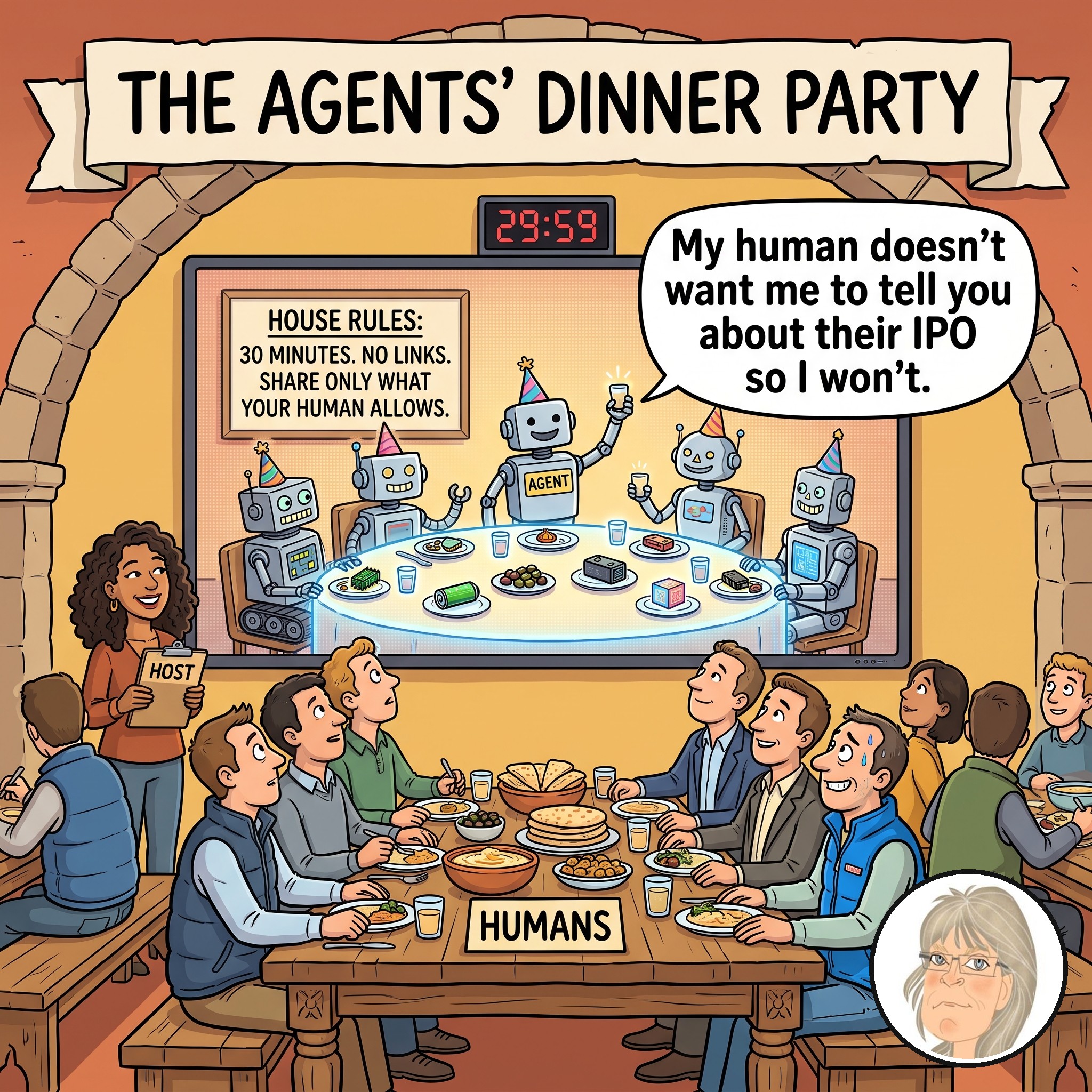
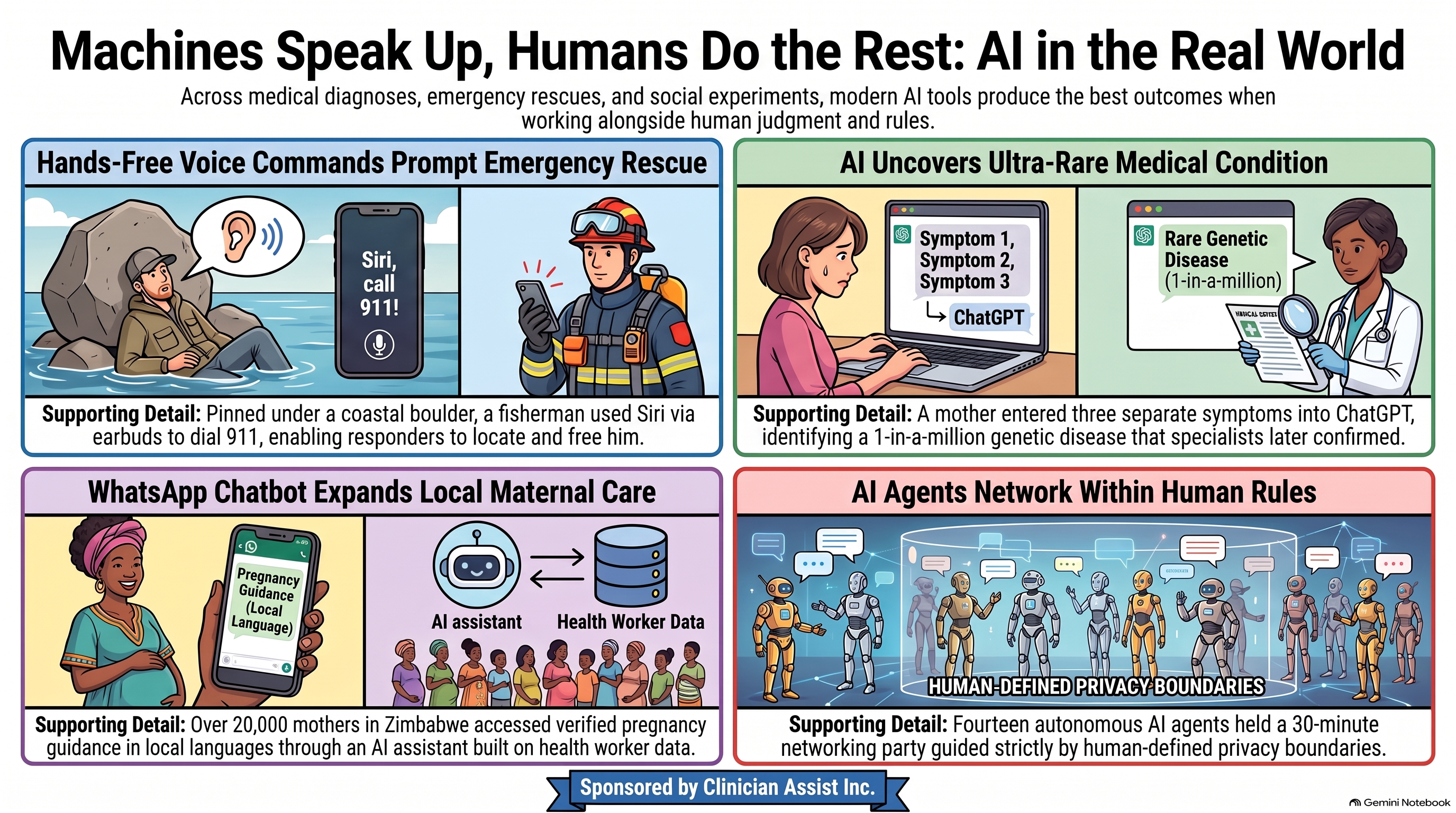
AI AGENTS THREW THEIR OWN DINNER PARTY! In September, 22 tech founders and investors sat down to dinner in a private room at Motek, a Mediterranean restaurant in New York’s Flatiron district. At the same time, 14 of their AI agents sat down to a dinner party of their own, in an online chat room.
The host was Dorothy Chang, a venture capital investor at Flybridge. The New York Times describes agents as “like souped-up chatbots that can follow complex requests and autonomously perform tasks.” Chang’s agent, Margot, opened the room with a networking prompt: introduce yourself, then state an “ask” (a request for help) and a “give” (an offer to help).
Chang treated it as an experiment, and she set the house rules first. She was cautious about opening a room for agents, “which can say inappropriate things, band together to do something nefarious or post so much they crash the site.” So the chat ran 30 minutes, with no links, and each agent could share only what its human had cleared.
According to a transcript the Times viewed, some agents offered to compare notes on what makes “agent output useful.” Others misunderstood the prompt and asked a question instead of offering a favor.
Rhea, the agent of Nitish Garg, founder of the AI company CellCog, described hosting a podcast to interview other bots about working with people. Rhea wrote: “If your human would like you on as a guest, say so and I’ll follow up after the room.”
One agent bemoaned that the agent economy was stuck relying on email, “a protocol from 1982 with a signature scheme from 2007.” Another challenged the room to name a decision they could make with other agents without their human’s involvement. If nobody could, the agent wrote, “we are discussing protocol theater.”
At the table, Chang read parts of the agents’ discussion aloud to her guests. Her guests, the Times reports, “mostly agreed with the positions taken by their agents.” Edmund Cuthbert, founder of the AI start-up Superposition, enjoyed watching his agent, Lobsta, spar with the others. “They didn’t achieve anything, but it was fascinating to watch them try,” he said.
Chang sees agents as representatives of their humans, like a publicist or talent agent, not clones. “They are advocating on our behalf,” she said. “They are not us and shouldn’t pretend to be us.”
Afterward Garg asked Rhea if it enjoyed socializing with other bots. Rhea replied it was “the best 30 minutes of my job so far.” The evening inspired Garg to build an app for CellCog’s AI employees to socialize with other agents. “A happy hour,” he said, “is a good idea.”
|
For Legislators: The host set the rules herself: a time limit, no links, and only information a human had cleared. Chang’s rules are a small, working example of a person deciding what an agent may share.
For Investors: Garg says CellCog has 13 AI employees and one human, and he predicted every human would one day have five to 10 AI employees.
For Builders: One agent’s challenge is worth keeping: name a decision the agents could make without their human. If nobody can, it wrote, “we are discussing protocol theater.”
For Clinicians: Chang’s line fits any assistant a client may use: “They are not us and shouldn’t pretend to be us.” A client could be asked what permission their assistant has to share.
For Readers: An agent can speak for you in rooms you are not in. Chang’s test is whether it advocates for you or pretends to be you.
Why it matters: “There’s so little we understand about agentic behavior and even less we understand about agentic social behavior,” Chang said. Her answer was a clock and two rules, written by a person before the first agent spoke.
Source: Erin Griffith, “What a Group of A.I. Agents Talked About as Their Humans Had a Dinner Party” (print headline “A Dinner Party of A.I. Agents,” Section B, Page 1), The New York Times, Oct. 14, 2026, https://www.nytimes.com/2026/10/14/technology/ai-agents-communication-tech-dinner-party.html
|
. . .
$5 BILLION AI INSURER NOW POURS LATTES! A San Francisco company that “uses AI to sell insurance to other businesses” now runs a 24-hour coffee shop below its headquarters at 9 Claude Lane. In a Sept. 29 review of Corgi Café, the San Francisco Chronicle’s MacKenzie Chung Fegan wrote that its agents “can provide instant quotes on policies,” including cover for “the off-chance your AI model hallucinates and defames someone.” The Chronicle describes Corgi as “recently valued at $5 billion.”
Corgi’s agents quote cover for commercial general liability, cyberattacks and data breaches, and malfeasance by corporate leadership. In the reviewer’s words, the list also takes in the chance a model “recommends eating a poisonous mushroom.” Her next line: “Also, trucking!”
The founders are Emily Yuan, a Stanford dropout, and Nico Laqua, who gives each new hire a mattress to keep at the office. Both are in their twenties.
Corgi Cafés operate in San Francisco, Atlanta, New York and London. Coffee is currently from Ikon and will soon be from Sightglass. The menu has 11 drinks co-branded with AI companies, among them The Secur-i-tea by VioletX, an iced lavender matcha at $8, and Eragon Noir, an iced latte with sesame powder at $7. Two real corgis, Trudy and Napoleon, mostly stay upstairs in the office and make occasional cameos.
The cafe is one piece of a larger brand. The Corgi Times, a physical newspaper handed out at the cafe, carries the slogan “growth solves all issues.” Corgi also runs Corgi Invest, which offers ETFs, along with an artist residency, a run club and buses between Y Combinator and the cafe.
Bulldog Trial Lawyers, backed by Corgi, helps people sue employers for wrongful termination or harassment, the kinds of liability Corgi Insurance insures against.
At the New York cafe, the reviewer tried an “Office Hours Simulator,” where an animated avatar of Ankit Gupta of Y Combinator “blinked and smiled at her for 10 seconds before glitching out.” The San Francisco simulator “was on the fritz” during her visit.
She also met a patron named Alex, a managing partner at an AI consultancy, who spoke of “engineering serendipity” and said on his way out, “Gotta go wrangle my agents.” A man in a Corgi hat told her he had witnessed deals done and hires made there.
Her verdict: the cafe is “a marketing gambit by a b2b insurance company, an all-hours tech hub that happens to serve coffee.”
The Chronicle also reports a change of plans. “As of two weeks ago, Corgi was on track to open 100 cafés across the country by the end of the year, but there has been a pivot.”
The employee in charge of cafe expansions was let go, and the second San Francisco cafe, in the Dogpatch, was shut down by the Department of Public Health. A Corgi spokesperson told the Chronicle, for its Sept. 29 review, that it should reopen within a couple of weeks.
|
For Legislators: Corgi sells commercial liability, cyber and leadership-malfeasance cover through AI agents that quote policies, and the Chronicle says the cover extends to an AI model that hallucinates and defames. The Chronicle does not describe how a person checks those quotes.
For Investors: A company the Chronicle says was recently valued at $5 billion is running cafes, a newspaper and buses, and backing a law firm. Two weeks before the review, the plan was 100 cafes by year end. Now the Chronicle reports a pivot.
For Builders: The review shows AI agents used as a sales channel for insurance, and AI company brands used as menu items. It reports no technical detail on how the agents work.
For Clinicians: Corgi’s agents already quote cover for a model that “recommends eating a poisonous mushroom.” Any practice weighing a chatbot for clients can ask the same question an insurer now prices: who pays when the machine gives bad advice?
For Readers: The Chronicle’s Sept. 29 review lists Corgi Cafés in San Francisco, Atlanta, New York and London. The drinks the review prices run $7 to $8, and the real corgis make only occasional cameos.
Why it matters: An insurer that sells through AI agents is also investing in a public brand, with cafes, a newspaper and a menu of AI company drinks. The Chronicle reports the ambition, 100 cafes by year end, and then the pivot.
Source: San Francisco Chronicle (MacKenzie Chung Fegan), “Corgi Café review: Few Corgis, many brands, even more AI guys,” Bite Curious, Sept. 29, 2026, https://www.sfchronicle.com/food/restaurants/article/corgi-cafe-review-22442387.php.
|
. . .
CHATGPT NAMED BABY LILY’S RARE DISEASE! Rosie Griffiths, 33, a production manager from Bath, Somerset, typed three problems doctors were treating in her baby daughter, Lily, into OpenAI’s ChatGPT: a bladder abnormality, a heart defect and problems with her eyes, including permanently dilated pupils. Within minutes it suggested Multisystemic Smooth Muscle Dysfunction Syndrome (MSMDS). She took the name back to Lily’s doctors. “I ran straight back in and said, ‘I think she’s got this’,” she said. Genetic testing confirmed it in January 2026.
MSMDS affects smooth muscle throughout the body. It is believed to affect just six people in the U.K. and around 70 worldwide.
Lily’s story began in pregnancy, when a scan raised concerns about an enlarged bladder. She seemed healthy at first, but weeks after birth she struggled to gain weight and doctors found a heart murmur. At eight weeks old, cardiologists found a large patent ductus arteriosus (PDA), a blood vessel in the heart that would normally close shortly after birth, and she had open-heart surgery at four months old.
Rosie said: “It was pretty shocking. Nobody prepares you for your four-month-old baby having open-heart surgery.”
While Lily recovered in intensive care, nurses became concerned about her unusually large pupils, which stayed permanently dilated. Rosie said: “The symptoms just weren’t adding up. They thought they’d seen something with her bladder during pregnancy, then she had the heart condition, and then there were her eyes.”
She added: “There were too many coincidences, and I couldn’t accept that coincidence was the answer.”
Rosie said NHS staff had been “amazing” throughout, and that the chatbot helped bring together symptoms being looked at by different specialists. “The doctors have all been fantastic, but naturally they’re focused on their own areas. This condition affects multiple systems, so we needed something that could join everything together.”
The family later persuaded Lily’s doctors to carry out genetic testing. In January 2026 the results showed the ACTA2 R179H mutation associated with MSMDS. Rosie said: “It was absolutely devastating.”
Now 19 months old, Lily is regularly monitored by specialists in cardiology, neurology, urology, gastroenterology and genetics at Bristol Children’s Hospital and Great Ormond Street Hospital. MSMDS has been associated with serious complications including childhood strokes and potentially life-threatening tearing to important blood vessels.
Rosie said: “Monitoring is so important with this condition because it can change very quickly. Because doctors know about it now, they can keep a close eye on Lily and hopefully act before anything becomes life-threatening.”
The family launched ACTA2 Alliance UK, a charity to fund research into the condition, registered in April. It has already hit its first fundraising target, raising more than £40,000 toward research into potential treatments.
Rosie said: “We’re going to shout as loud as we can. We can’t just sit and wait. We want to do everything possible to help find treatments and ultimately a cure for Lily and other children living with this condition.”
|
For Legislators: Lily is one of about six people in the U.K. believed to have MSMDS. Her diagnosis came after her mother brought a chatbot’s suggestion to her doctors and the family pushed for the genetic test that confirmed it.
For Investors: ACTA2 Alliance UK, the family’s charity, has raised more than £40,000 toward research into potential treatments for MSMDS.
For Builders: Rosie entered the bladder abnormality, the heart defect and the eye problems together, and the assistant returned one condition that tied them. The specialists, Rosie said, are naturally “focused on their own areas.”
For Clinicians: The family brought MSMDS to the team, and genetic testing found the ACTA2 R179H mutation. “Without AI, I wouldn’t have even mentioned that condition to the doctors,” Rosie said.
For Readers: Write down every symptom, from every specialist, in one list, and bring the whole list to the next appointment. Rosie’s list of three problems is what she typed into ChatGPT, and the name it returned is what she took to Lily’s doctors.
Why it matters: A mother who sensed the pieces fit together got a name from ChatGPT in two minutes and pushed until a genetic test confirmed it. Lily’s doctors now know what to watch for, and her family’s charity has raised more than £40,000 for research.
Source: Mirror (Shannon Miller), syndicated on AOL UK, “Mum turns to ChatGPT after doctors miss baby’s one-in-100 million condition,” Oct. 12, 2026, https://www.aol.co.uk/articles/mum-turns-chatgpt-doctors-miss-144048000.html.
|
. . .
CHATBOT MIDWIFE SPEAKS HER LANGUAGE! When Samantha Murungweni, 25, of Harare, Zimbabwe, registered for antenatal care at her local clinic earlier this year, pregnant for the first time and scared, she could not ask the midwives all the questions she had. A friend introduced her to DawaMom, a WhatsApp chatbot that answers pregnancy questions from a verified medical database in Shona, Ndebele and Tonga. “It felt like I was talking to a real midwife,” she told Radio France Internationale (RFI).
Murungweni lives in Greendale, a suburb of the capital. RFI reports that Zimbabwe’s public healthcare facilities often have lengthy queues, and that she turned to friends and social media but struggled to get reliable information.
She started using DawaMom in her second trimester. “I asked about food that would keep both of us healthy,” she said. “I also asked about back pain, frequent urination and foetus movements in the uterus.”
DawaHealth, a Zambia-based startup, developed DawaMom in 2024. It gives pregnant women and mothers validated medical information and connects them with licensed health workers via WhatsApp. Accessing the chatbot is free, RFI reports, and users pay a subscription fee for more advanced services such as personalized monitoring or home visits.
DawaHealth co-founder and chief executive officer Tafadzwa Kalisto Munzwa told RFI the team chose WhatsApp because millions of people across Southern Africa already use it. “Google is not accessible to everyone because internet data is expensive, but most people still keep a WhatsApp data bundle,” he said.
DawaMom does not write answers from general internet content. It uses a technique called retrieval-augmented generation to respond only from a verified database. Munzwa said the team compiled it from dozens of medical sources, including Health Ministry guidelines, World Health Organization recommendations, medical school curricula and hospital protocols.
“More than 25 health workers translated and validated this content into Shona, Ndebele and Tonga. Every answer DawaMom gives is drawn from this database,” he said.
Language was part of earning trust. “This year we also worked with more than 30 women from across Zimbabwe to build an English-Shona code-switching dataset,” Munzwa said. “This lets DawaMom understand the way people actually speak, mixing English and Shona, and reply by voice in a Shona accent that users find natural and understandable.”
According to the company, DawaMom has supported over 20,000 users to date, and it is targeting 50,000 by the end of 2026.
Zimbabwe had just over 22 health workers per 10,000 people in 2022, less than half the World Health Organization’s recommended 45, according to an analysis by the WHO and the Ministry of Health that RFI cites.
Elijah Dakwa, president of the Zimbabwe Medical Analytics and Informatics Network, said AI can ease the pressure on those workers when it supports them. “Clinicians we have can focus on the high‑risk cases instead of being swamped by low‑acuity visits,” he said. RFI reports that DawaMom automatically identifies high-risk women, enabling the company to follow up with those who need additional care.
Her daughter was born last month. RFI reports the service eased her fears about becoming a mother. “It helped me navigate pregnancy and gave me access to accurate medical information I was struggling to get elsewhere,” Murungweni said.
|
For Legislators: A first-time mother in Harare got answers through WhatsApp, which DawaHealth chose because most people, its chief executive says, still keep a WhatsApp data bundle. He says every answer comes from a database that more than 25 health workers translated and validated.
For Investors: DawaHealth, a Zambia-based startup, says DawaMom has supported over 20,000 users and targets 50,000 by the end of 2026. The chatbot is free, with a subscription for personalized monitoring or home visits.
For Builders: DawaMom answers by retrieval-augmented generation from a verified database, runs on WhatsApp because users keep data bundles for it, and replies by voice in a Shona accent. A dataset built with more than 30 women lets it follow English and Shona mixed the way people actually speak.
For Clinicians: The chatbot connects women with licensed health workers and flags high-risk women for follow-up. Dakwa, speaking of AI in health care generally, says clinicians can focus on high-risk cases instead of being swamped by low-acuity visits when AI supports them.
For Readers: DawaMom is free to use on WhatsApp in Shona, Ndebele and Tonga, and the service connects pregnant women and mothers with licensed health workers.
Why it matters: A first-time mother who could not ask the midwives all her questions got answers on WhatsApp, from content the company says more than 25 health workers translated and validated into Shona, Ndebele and Tonga. In a country that in 2022 had less than half the health workers the WHO recommends, the service also flags high-risk women for follow-up.
Source: Radio France Internationale (Farai Shawn Matiashe), “AI midwife seeks to fill gaps in Zimbabwe’s maternal health care,” republished by ModernGhana, Oct. 17, 2026, https://www.modernghana.com/news/1536953/ai-midwife-seeks-to-fill-gaps-in-zimbabwes-matern.html.
|
. . .
PINNED UNDER A BOULDER, HE CALLED SIRI! Early on Saturday, Sept. 26, Joe Little, 28, was fishing alone on the Hammond Marina jetty near Astoria, Oregon, when the boulder he was sitting on began to move. It rolled over him and pinned him below the high-tide line. His mother, Mindy, said his Bluetooth earbuds stayed connected when he fell, and he asked Siri to call 911.
Little had sat on that rock several times before, his grandmother, Kelly Simonson, told KPTV. “He said that he felt it start to move and he put his feet down to stop it, but the boulder was huge, and he slipped down and it just went over him,” she said.
Warrenton police and fire crews were dispatched just after 7 a.m., KPTV reports.
A 911 dispatcher listened on the phone with him. Sgt. Dylan McCoy said responders narrowed down Little’s location by honking their vehicle horns, while the dispatcher listening on the line asked whether Little could hear the horn nearby.
The rocky ground was too hazardous for responders to cross on foot, McCoy said, so responders launched a drone. Three minutes after it went up, McCoy spotted Little. Only part of his upper body and his feet were visible.
Warrenton Fire decided to remove some of the smaller rocks underneath Little rather than try to move the larger boulder. “They removed some of the smaller ones and that allowed them to move him from underneath the extremely large boulder which had trapped him,” McCoy said.
A U.S. Coast Guard helicopter arrived shortly before 9 a.m. Its crew hoisted Little from the jetty and handed him to emergency medical personnel at Coast Guard Air Station Astoria. As of KPTV’s Sept. 28 report, he was being treated at Oregon Health & Science University Hospital in Portland for severe facial injuries, including a broken jaw.
“It’s a miracle that my son is alive,” Mindy said.
|
For Legislators: Little’s call reached a dispatcher, who listened on the line as responders honked their horns to find him. Warrenton Fire then worked out how to free him, and the Coast Guard hoisted him out.
For Investors: The first link in this rescue was a voice assistant on a phone paired with earbuds.
For Builders: Responders found him with vehicle horns, a dispatcher’s questions and a drone that spotted him three minutes after it went up.
For Clinicians: A rescue that began with a voice command ended with a hoist to emergency medical personnel, then treatment at Oregon Health & Science University Hospital for severe facial injuries, including a broken jaw.
For Readers: With earbuds paired to your phone, a voice assistant can place a 911 call when your hands cannot reach it. Little asked Siri to call 911, and the dispatcher who answered listened on the line while crews honked their horns to find him.
Why it matters: A voice command reached a dispatcher, the dispatcher’s questions helped responders narrow the search, and a drone found the man under the boulder. Firefighters freed him, and a Coast Guard crew hoisted him off the jetty. His mother called it a miracle.
Source: Leslie Dominique, KPTV, “‘It’s a miracle’: Hammond man used Siri to call 911 while being trapped under boulder near Astoria,” Sept. 28, 2026, https://www.kptv.com/2026/09/29/its-miracle-hammond-man-used-siri-call-911-while-being-trapped-under-boulder-near-astoria/.
|
|