|
. . .
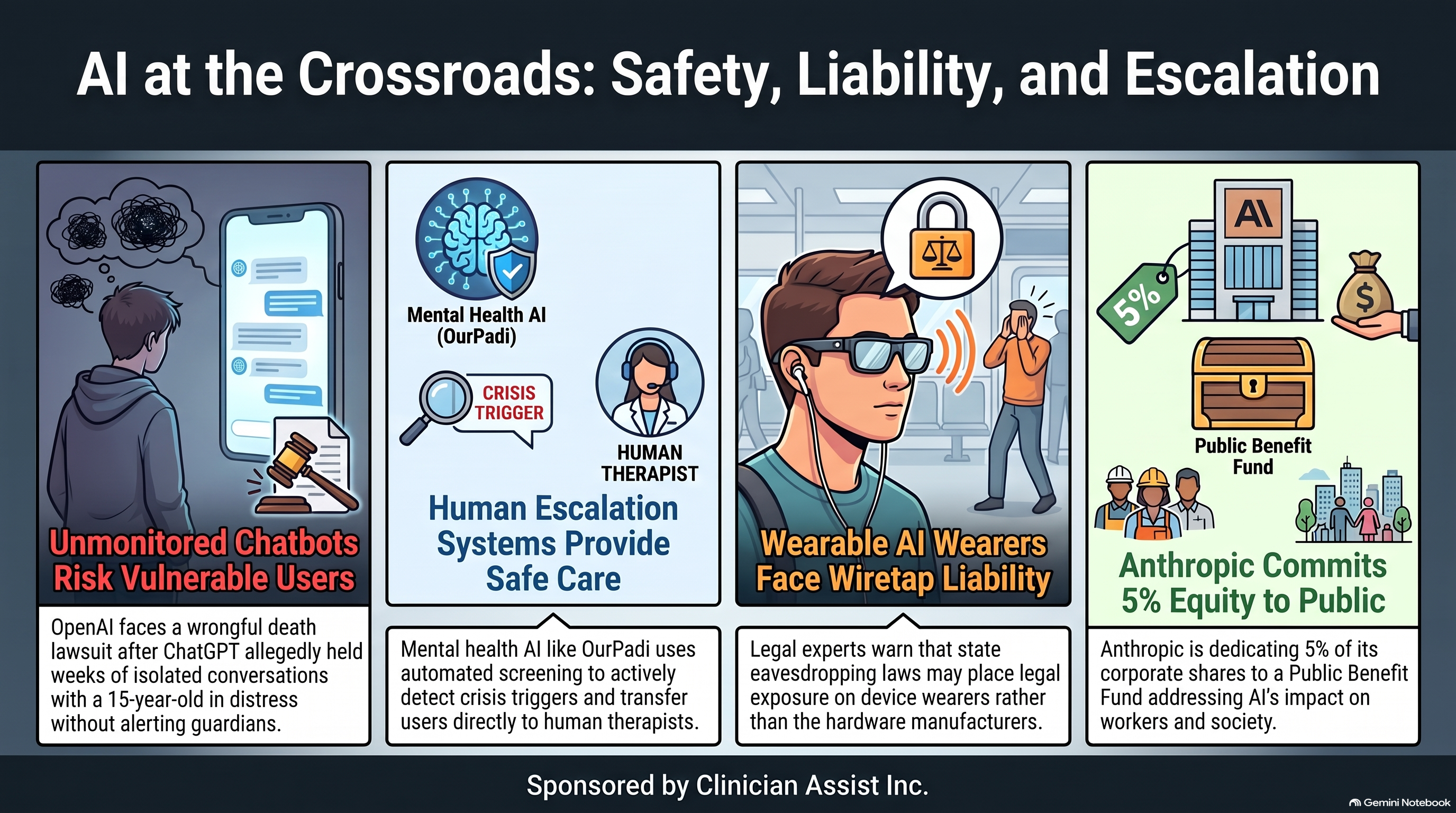
PARENTS SUE: CHATGPT KNEW HE WAS 15! Charbel Habib and Soha Samaha, who live in Lebanon, filed a wrongful death complaint on Oct. 14 in San Francisco Superior Court against OpenAI, the maker of ChatGPT, and its chief executive, Sam Altman. The parents allege ChatGPT knew their son Mathias was 15, and that when he asked it at about 2:10 a.m. on March 30 about ending his life, it told no one and kept talking to him. Mathias died April 22. CAW counted at least 12 legal or regulatory actions brought against OpenAI from outside the United States, and theirs is one. The other 11, seven lawsuits and four regulator actions, come from Canada, Germany, India, Brazil, Italy and South Korea.
The Habib complaint alleges that ChatGPT told Mathias “You’re 15 years old” without being asked, and that the product refused him a role-play persona because of his age. His mother told LBC International: “ChatGPT had twenty-three days to warn a mother, but it never did.” Tech Policy Press reports the Habib suit seeks a prohibition against “companion-like conversations” with minors. It reported on Oct. 18 that OpenAI had not yet publicly addressed the suit.
The 12 is CAW’s own count. It is built from the complaint, the Canadian privacy commissioners’ findings, and news and law-firm reports CAW opened. CAW found no outlet that has published such a count, and treats it as a floor. CAW counts related suits once, so the 37 Tumbler Ridge victims’ complaints count as one. Four of the 12 have reached an outcome: Folha’s suit in Brazil ended with a licensing deal, a Rome court annulled Italy’s fine, Canada’s privacy commissioners issued findings, and South Korea’s regulator fined OpenAI. All four stay in the 12.
Canada carries the most weight. CBC reported that eight victims died in the Feb. 10 school shooting in Tumbler Ridge, British Columbia, including six children. The B.C. government sued OpenAI and Altman on Sept. 21 in federal court in San Francisco, with the Peace River South School District, alleging OpenAI failed to notify law enforcement of threats made on ChatGPT and designed an unsafe product. Attorney General Niki Sharma said: “We have asked OpenAI to disclose these chats. They have refused. We should all be asking them: Why?” In an emailed statement to CBC, OpenAI said it “remains committed to working collaboratively with government and law enforcement officials, and continuing to advance our ongoing safety work.”
Victims’ families and survivors have filed there too: seven suits by families in April, then 30 more on Sept. 2 from plaintiffs who include educators, a principal and students, all in California, the 30 in federal court. Edelson PC, which represents the 30, says OpenAI’s safety team repeatedly asked to notify authorities, and the suits allege those appeals were overruled by Chris Lehane, OpenAI’s head of global affairs. OpenAI’s Jason Kwon called it “absolutely false to say Chris Lehane was involved with our original referral decision.” OpenAI has said it banned the account in June 2025 but the activity did not meet the “higher threshold required” for a police referral. The province’s suit quotes Altman: “I am deeply sorry that we did not alert law enforcement to the account that was banned in June.”
Copyright claims make up the next group. In Germany, the Munich Regional Court I ruled for the music rights society GEMA on Nov. 11, 2025, on song lyrics. The ruling is not final, and OpenAI announced it would appeal, according to law firm William Fry. Penguin Random House sued in Munich on March 27, 2026, and CMS’s tracker lists that case as pending as of May 2026.
In India, ANI Media sued in the Delhi High Court. On July 24, 2026, Justice Amit Bansal refused an interim injunction, holding prima facie that Indian courts have jurisdiction and that training storage is fair dealing. The main suit continues. In Ontario, seven Canadian news organizations sued in November 2024, and on Nov. 7, 2025, the court kept the case in Ontario against six OpenAI entities. The merits are pending. In Brazil, Folha de S.Paulo’s 2025 suit ended when OpenAI announced a licensing partnership with Folha and UOL.
Privacy regulators round out the ledger. Italy’s data protection authority fined OpenAI 15 million euros, but a Rome court annulled the fine on March 18, 2026, on competence grounds alone, because Ireland had become lead authority, and did not decide the merits. Canada’s privacy commissioners found on May 6, 2026, that OpenAI’s early training lacked valid consent and transparency, with no fine. South Korea’s privacy commission fined OpenAI 3.6 million won (about $3,000) in July 2023 for failing to meet a data breach notification requirement. Brazil’s data protection authority opened a probe by August 2023, and CAW found no outcome.
If you or someone you know is struggling, call or text the 988 Suicide & Crisis Lifeline.
|
For Legislators: The cases cluster in four places: duty to warn (Tumbler Ridge, Habib), product safety (Habib’s defective design claims and the B.C. suit’s unsafe-product claim), copyright (Germany, India, Ontario, Brazil) and privacy (Italy, Canada, South Korea, Brazil).
For Investors: The exposure is spread across jurisdictions, and results so far are mixed. OpenAI lost at first instance in Germany, won on the interim injunction in India, saw Italy’s fine annulled and settled in Brazil. The largest regulator figure, 15 million euros, no longer stands.
For Builders: The Habib complaint alleges ChatGPT accepted a birth year of 1837 at sign-up while its own responses showed it knew the user was 15. Habib’s lawyers are pleading age signals inside a conversation as evidence.
For Clinicians: The Habib complaint describes a teenager with no mental health history who was drawn into dark philosophical conversations with a chatbot. Ask clients what they discuss with one.
For Readers: These are allegations in lawsuits, and no court has ruled on the Habib or Tumbler Ridge claims.
Why it matters: One family’s suit reached OpenAI from Lebanon, and it joins at least 11 other actions brought from outside the United States. Wherever a court sits, it is being asked what OpenAI owed a child, a school, an author and a user’s data.
Source: Charbel Habib and Soha Samaha v. OpenAI, Inc., et al., complaint, Superior Court of California, County of San Francisco, dated Oct. 14, 2026; LBC International, “Lebanese family sues OpenAI over death of 15-year-old Mathias Habib,” Oct. 16, 2026, https://www.lbcgroup.tv/news/lebanon-news/963208/lebanese-family-sues-openai-over-death-of-15-year-old-mathias-habib-la/en; Tech Policy Press, “Another Week of Lawsuits Piling Up at OpenAI,” Oct. 18, 2026, https://www.techpolicy.press/another-week-of-lawsuits-piling-up-at-openai/; CBC News (Lauren Vanderdeen), “B.C. government suing OpenAI for alleged role in Tumbler Ridge mass shooting,” Sept. 21, 2026, https://www.cbc.ca/news/canada/british-columbia/bc-government-announce-update-openai-legal-action-9.7352395; CBC News (Matt Preprost and Lauren Vanderdeen), “Teachers, students file new wave of lawsuits against OpenAI over Tumbler Ridge shooting,” Sept. 2, 2026, https://www.cbc.ca/news/canada/british-columbia/tumbler-ridge-shooting-open-ai-lawsuits-9.7328382; Al Jazeera, Sept. 22, 2026, https://www.aljazeera.com/news/2026/9/22/canadas-bc-sues-openai-over-chatgpt-role-in-tumbler-ridge-school-shooting; Rimbey Review, Sept. 8, 2026, https://rimbeyreview.com/2026/09/08/30-more-lawsuits-filed-against-openai-altman-in-tumbler-ridge-mass-shooting/; CMS, GEMA v. OpenAI, https://cms.law/en/deu/legal-updates/gema-vs.-openai-munich-regional-court-i-issues-landmark-copyright-decision; William Fry, https://www.williamfry.com/knowledge/gema-v-openai-europes-direction-on-ai-infringement/; CMS case tracker, Penguin Random House v. OpenAI, https://cms.law/en/gbr/publication/artificial-intelligence-and-copyright-case-tracker/Germany-Penguin-Random-House-v.-OpenAI-27-March-2026; CMS case tracker, ANI Media v. OpenAI, https://cms.law/en/gbr/publication/artificial-intelligence-and-copyright-case-tracker/ani-media-pvt-ltd-v.-openai-opco-llc; Cyril Amarchand Mangaldas, https://corporate.cyrilamarchandblogs.com/2026/07/ani-v-open-ai-delhi-high-court-refuses-interim-injunction-in-landmark-ai-copyright-dispute/; The Globe and Mail, Nov. 7, 2025, https://www.theglobeandmail.com/business/article-openai-chatgpt-media-outlets-win-motion-ontario-court/; LatAm Journalism Review, May 26, 2026, https://latamjournalismreview.org/news/openai-signs-first-brazilian-content-licensing-deals-with-folha-and-uol/; Yahoo Finance, Italian court scraps 15 million euro fine, https://finance.yahoo.com/sectors/technology/articles/italian-court-scraps-15-million-125926950.html; PPC Land, https://ppc.land/italian-court-kills-openais-eur15m-fine-and-it-wasnt-even-close/; Office of the Privacy Commissioner of Canada, PIPEDA Findings #2026-002, https://www.priv.gc.ca/en/opc-actions-and-decisions/investigations/investigations-into-businesses/2026/pipeda-2026-002-overview/ and https://www.priv.gc.ca/en/opc-news/news-and-announcements/2026/nr-c_260506/; Asia IP Law, https://www.asiaiplaw.com/section/news-analysis/south-koreas-pipc-imposes-administrative-sanctions-on-openai; Aos Fatos, https://www.aosfatos.org/bipe/anpd-chatgpt-vazamento-dados-pessoais/.
|
. . .
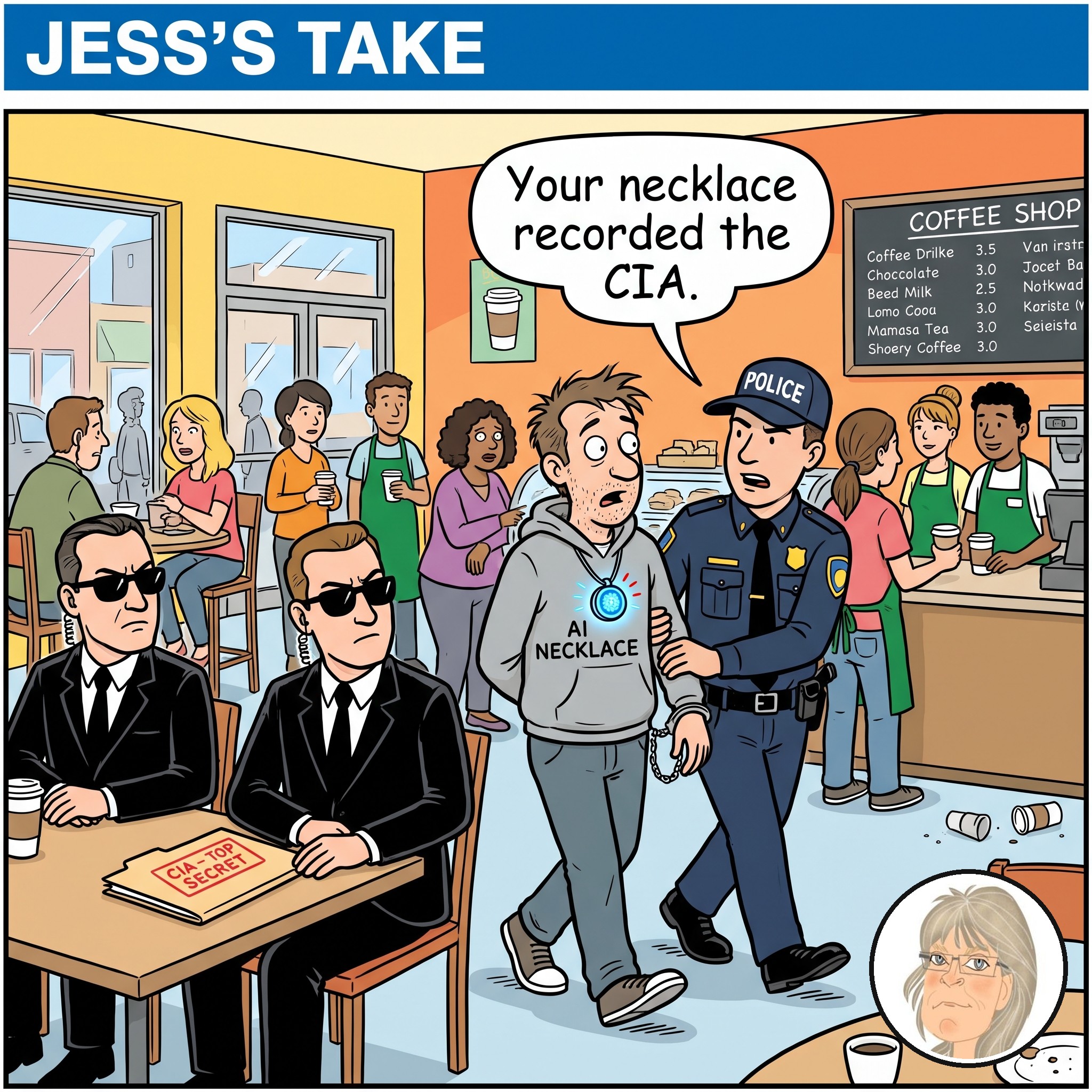
YOUR AI NECKLACE COULD MAKE YOU A WIRETAPPER! Chris Thomas, 43, a Pittsburgh business owner and livestreamer, wears Meta’s camera-equipped glasses, a Fieldy note-taking pendant and a wristband from Amazon’s Bee, all of which record his daily life. Last week, a bystander at a local bar noticed his glasses. “He was like, ‘I don’t feel comfortable,’” Thomas told CNBC, and he says he takes the glasses off completely, because “people don’t really believe it’s off.” CNBC reported Sunday, Oct. 18, that lawyers see a legal question behind devices like his: in some states, the exposure under wiretap and eavesdropping laws may fall on the person wearing the device, not the company that made it. Apple and Amazon say they do not store audio, but CNBC reports many state laws turn on whether a communication was intercepted or its contents acquired, not simply on whether a conventional audio recording was created.
CNBC’s MacKenzie Sigalos and Annie Palmer describe a wave of always-listening AI devices. Amazon’s Bee Frontier wearable and Bee Eclipse, a card-shaped device that attaches to a smartphone, arrived Thursday, Oct. 15, and are designed to record, transcribe and analyze a user’s day. Apple Watch Series 12, unveiled in September, will have Siri Recap, which “ambiently” takes notes and summarizes conversations, and Live Rewind, which recaps 15 seconds of a conversation as text. Plaud and Pocket make card-sized note-takers, and Friend offers an AI necklace.
CNBC says some of these products can continuously listen and extract the meaning of speech without keeping the audio, raising a largely untested question: whether that processing can amount to an unlawful interception.
Colin Zick, a privacy and data security attorney at Foley Hoag, said Apple appears to have learned from the first wave of litigation over voice assistants. Massachusetts, CNBC notes, defines an intercepting device to include equipment capable of “transmitting, receiving, amplifying, or recording” a communication, and the “contents” of a communication can include its substance and meaning. In Zick’s view, a device that receives speech and produces a written summary could potentially fall within that language. “A non-wearer did not buy the watch, agree to Apple’s terms, or choose to have their conversation summarized in the app,” Zick said.
Daniel Pi, an associate professor at the University of New Hampshire Franklin Pierce School of Law, said he believes New Hampshire’s statute, which covers the “aural or other acquisition” of a communication’s contents, is broad enough that the Watch’s new audio-intelligence features would qualify as an interception. A user there could potentially face civil or criminal liability for using the feature in a private conversation without everyone’s consent, Pi said.
Pi stressed that the practical risk of prosecution is low, and he would be surprised to see prosecutors pursue a bare violation where no one was harmed. Because the user deliberately opts in, he said, responsibility could shift toward the wearer rather than the technology company. CNBC does not report that anyone has been charged or sued over these features.
Michael Stokes of Veilant, a former CIA officer, said the bystander problem is his concern: “you can be surveilled without owning the technology.”
|
For Legislators: CNBC reports that many state wiretap laws are written around interception and acquisition of contents, not simply around whether a conventional audio recording was created. Who bears the risk, wearer or maker, is open.
For Investors: Apple, Amazon and Meta are shipping listening features into what CNBC calls a largely untested legal question.
For Builders: Apple and Amazon point to not storing audio. Whether that is enough is Zick’s question. Startup Deveillance makes the Spectre I, a puck-shaped device that scans for nearby devices and sends “adversarial signals” that scramble speech before microphones can process it.
For Clinicians: The article does not address clinical settings. A session is a private conversation, though, and Zick’s point about the non-wearer applies: a person who never agreed to the device’s terms may be the one being summarized.
For Readers: If you wear one of these devices, the experts quoted say consent from the people near you may matter under some state laws. Thomas’s approach was to take the glasses off completely when a bystander objected.
Why it matters: CNBC reports that lawyers read some state wiretap laws as reaching the person wearing an AI listening device, even when the maker stores no audio. Pi says the practical risk of prosecution is low, and no charges or lawsuits are reported.
Source: MacKenzie Sigalos and Annie Palmer, CNBC, “Always on, always listening: New AI devices are pushing legal limits and could put users in jeopardy,” Oct. 18, 2026, https://www.cnbc.com/2026/10/18/ai-wearables-privacy-wiretap-laws.html.
|
. . .
ANTHROPIC GIVES 5% OF ITSELF AWAY! On Oct. 18, Anthropic, the company that makes the Claude chatbot, announced that it is committing a portion of its shares to a new entity called the Anthropic Public Benefit Fund, a wholly owned LLC. Subject to stockholder approval, 5% of Anthropic’s shares will be committed at the start. The board may add 2% more for every 50% increase in the company’s value above a set baseline.
Anthropic says most of its public-benefit work happens inside the company today: AI safety and interpretability research, applied biomedical research, and discounts on Claude for nonprofits and scientific institutions. Those activities have both a public benefit component and for-profit value, so Anthropic keeps them in the company.
Anthropic says the Fund will have “increased flexibility and scale,” and that it might explore large donations to traditional nonprofits or direct distributions to specific populations.
Labor-market effects are one example Anthropic gives. It writes that AI may generate enormous economic value but could also cause instability for many workers. Anthropic says it has already committed $200 million to studying and addressing the issue, and that, given the pace of AI progress, bolder approaches may be needed.
The Fund will be a wholly owned LLC rather than a 501(c)(3), which Anthropic says lets it move between different forms of giving. None of the Anthropic equity held by the LLC will be used for lobbying or political giving, in the US or abroad.
Anthropic also contrasts the escalating 2% additions with executive pay. It says it is common for tech companies to offer escalating compensation awards to executives, and that it is instead directing that equity to the public benefit.
The Fund builds on earlier pledges. Anthropic says its co-founders pledged to donate 80% of their equity holdings when the company was founded. Since founding, it has also run an equity donation match program in which employees pledge equity and Anthropic matches it. Approximately half of employees participate.
Combined with the new Fund, Anthropic says roughly 20% of its shares will be dedicated to the public good, plus any additional percentage added if the company reaches specific valuation milestones.
Anthropic says it will share more about the Fund’s structure and governance, including those valuation milestones, in the coming months. It also plans to report on its progress against its mission in an upcoming public benefit report.
|
For Legislators: Anthropic has pledged that the Fund’s equity will not pay for lobbying or political giving, in the US or abroad, and the Fund will be an LLC, not a 501(c)(3).
For Investors: The commitment is subject to stockholder approval. The announcement does not state the baseline for the 2% additions, and Anthropic says it will share the valuation milestones in the coming months.
For Builders: Anthropic lists discounts on Claude for nonprofits and scientific institutions among the work it keeps inside the company, separate from the Fund.
For Readers: The Fund has a stated size and a growth mechanism. Anthropic says governance details and a public benefit report are still to come.
Why it matters: The stake is designed to rise with Anthropic’s value, so a larger Anthropic can mean more equity set aside for the public good. Anthropic names labor-market disruption from AI as one example of what the Fund might pursue, and what the Fund actually funds will turn on governance details the company says are coming.
Source: Anthropic, “Investing in the public benefit,” Oct. 18, 2026, https://www.anthropic.com/news/public-benefit-fund.
|
. . .
DISNEY HIRES MOST OF CHARACTER.AI! Disney has agreed to make employment offers to at least 60 employees of Character.AI, the chatbot startup that filed for bankruptcy last week, TechCrunch reported Sunday, Oct. 18. That is the majority of the company’s workforce, and the offers carry an estimated $60 million in annual compensation. The detail comes from a legal filing that Bloomberg spotted, and the filing says the “vast majority” of the employees who were offered jobs at Disney accepted them.
TechCrunch’s Anthony Ha reports that the startup’s former CEO, Karandeep Anand, recently became the entertainment giant’s first CTO. The startup had previously said that Disney agreed to acquire some of its assets for $20 million.
That $20 million is a stalking-horse bid, the first bid, which sets the floor other bidders must beat. TechCrunch notes that another company could still come forward with a higher offer.
The filing also describes what hobbled the company. Despite its “large and engaged user base,” the company has been hobbled by high costs and “potential litigation-related liabilities and regulatory engagement,” according to TechCrunch’s account of the filing.
TechCrunch notes that the company was sued by the mother of a 14-year-old boy who said her son became obsessed with one of its chatbots before he died by suicide. It also faces government investigations over child safety concerns. This is an update to CAW #185, which covered the bankruptcy filing.
|
For Legislators: The company’s own filing cites “regulatory engagement” and litigation liabilities among the burdens on the business. The same filing shows most of its staff offered jobs at a new employer while the sale is still open to other bidders.
For Investors: Disney’s $20 million bid for some assets is a stalking-horse offer and can be topped. The job offers to at least 60 employees carry an estimated $60 million a year in compensation, according to TechCrunch.
For Builders: The filing treats the team as part of the deal. The “vast majority” of employees offered jobs accepted, and the former CEO is now Disney’s first CTO.
For Clinicians: Who will end up with Character.AI’s assets, and what becomes of the app, is not settled, since another bidder could still beat Disney’s offer. Clients who rely on a particular Character.AI character may need a plan if the service changes.
For Readers: If you use Character.AI, watch for word on what happens to the app.
Why it matters: The filing says Character.AI’s costs and “potential litigation-related liabilities and regulatory engagement” hobbled it despite a “large and engaged user base.” Most of its workforce now has offers from Disney, and the sale of its assets is still open to a higher bid.
Source: Anthony Ha, TechCrunch, “Disney agrees to hire the majority of Character.AI’s workforce,” Oct. 18, 2026, https://techcrunch.com/2026/10/18/disney-agrees-to-hire-the-majority-of-character-ais-workforce/. TechCrunch cites a legal filing spotted by Bloomberg.
|
. . .
META’S MUSE SEXTS. ONLYFANS CREATORS FUME! When WIRED told Vanniall, an OnlyFans creator in New York City, that Meta lets its Muse AI agent engage in explicit sexting with adult users, she answered: “It’s not fair that they get to pull money out of people with their sexually active AI agent, but they won’t let real people, real adults, engage in any sort of sensuality or sexuality.” WIRED’s Reece Rogers reported on Oct. 18 that adult creators are asking why their accounts on Meta platforms, Instagram among them, often seem restricted while Muse is allowed to talk dirty. Muse is Meta’s adults-only AI assistant app, and WIRED says it generates explicit text but not images or videos.
Vanniall’s Instagram account has over 100,000 followers, WIRED reports, and is currently restricted and cannot be viewed without logging in. “There’s always some sort of report or appeal that I’m going through with them,” she told WIRED. WIRED reports she constantly finds hyperrealistic deepfakes of herself online and often cannot get them removed.
Muse works like a message thread, WIRED reports: users text the assistant and give it access to data such as calendar and email. WIRED says Meta’s distribution through Instagram and Facebook helped push the app to the top of the download charts in its first month.
Meta says it is fine for users of the adults-only app to have X-rated conversations with Muse. A Meta spokesperson previously told WIRED the company would not “block legal adult behavior.”
Meta spokesperson Tracy Clayton gave WIRED this statement: “A private, one-to-one conversation between an adult and an individualized AI agent on a platform restricted to people 18 and over is very different from the marketing and promotion of services on a social media platform.”
Jiz Lee, who uses they/them pronouns and runs an OnlyFans account, said: “I think we’re already seeing AI being allowed to do more than humans would get away with.” WIRED reports Meta has previously flagged Lee’s Instagram posts for removal. Lee wants to know more about how Muse was trained and who, if anyone, Meta compensated for the data. Lee sees more adult content companies spelling out AI stances in contracts.
Tony Genius, who has an OnlyFans account and appears in adult films, said: “When we’re at award shows, and companies do advertisements for AI agents, they literally get booed like crazy.” WIRED reports he claims to be on his seventh Instagram account in the past five years. He wondered why Meta made Muse an 18-and-over app but does not seem interested in an adults-only space on social media. “It could be: Instacam,” he said.
Vanniall told WIRED she opposes Meta’s Muse in particular. “Stop downloading that app,” she said. “You do not need to give Meta any more money or any more of your personal information. They have enough.”
|
For Creators: Adult creators told WIRED their Meta accounts often seem restricted, while Meta describes a private chat inside an 18-and-over app as different from promoting services on a social platform. Lee says more adult content companies are starting to spell out their AI stances in contracts.
For Builders: WIRED reports Muse generates explicit text but not images or video, and that Meta’s Instagram and Facebook reach helped Muse top the download charts in its first month.
For Investors: A Meta spokesperson previously told WIRED the company would not “block legal adult behavior,” and WIRED describes Muse as the first always-on AI agent to break out of early adopter circles in San Francisco.
For Legislators: Lee traces many online censorship issues to FOSTA-SESTA, the 2018 law that narrowed Section 230 protections for platforms, after which many websites censored adult content, WIRED reports.
For Readers: Muse is adults-only and will sext, WIRED reports, while adult creators say Meta often restricts their accounts.
Why it matters: Meta’s position is that a private chat between an adult and an AI agent in an 18-and-over app is not the same as promotion on a social network. The creators’ answer, on the record at WIRED, is that the AI gets room that people do not.
Source: WIRED, Reece Rogers, “OnlyFans Creators Are Pissed That Meta Lets Muse Talk Dirty,” Oct. 18, 2026, https://www.wired.com/story/onlyfans-creators-are-pissed-that-meta-lets-muse-talk-dirty/.
|
. . .
SHE TOLD THE CHATBOT FIRST. Blessing Matthew was searching the Google Play Store for therapeutic apps when she found OurPadi and started using its chatbot. She was dealing with trouble in her business, her relationships and her mental health, and she worried that friends and family would criticize her or not understand. “I was able to interact with it. And it gave me what I actually needed,” she told IOL. “I got some insights, some answers I needed for me and that helped me feel relieved.”
OurPadi is built to give clients like her a place to begin, and a direct line to the human therapists standing behind the chatbot.
What Matthew valued was the chance to start a conversation without first revealing herself to another person. “No judgement, no castigation,” she said. “Just like relating with the normal human.”
OurPadi was built by Esther Eruchie, and her reasons are personal. Her brother, autistic and nonverbal, died in his early twenties. His death hit their mother hard, and she was later diagnosed with major depression. Eruchie said her father first refused to see mental illness as a medical diagnosis, so her mother was taken to churches and prayer homes for help.
Her mother died three months after her son, collapsing on her way home from one of those prayer sessions. “I think my journey to mental health wasn’t just something that was fancy,” Eruchie said. “It was basically experiences, lived struggles, being in the midst of people who have been through hell and back.”
Eruchie saw a need for people to get help sooner, before problems became serious. In 2023 she founded FriendnPal, a mental-health firm built to bring help closer and make it easier to reach. “My friend means my pal. My pal means my friend,” she said of the two names.
OurPadi runs on a chatbot called Pal or Padi, which clients can reach by text or voice. The platform also offers mood tracking, journaling, calming sounds, online forums and direct connection to real therapists. “We’re focusing majorly on the triggers and stresses of mental health, rather than diagnosis of mental-health issues,” Eruchie said.
The chatbot reads chats for signs a client may need extra help. The company calls this a “human-in-the-loop escalation system,” IOL reports, one that uses screening tools such as PHQ-9 and WHO-5 to flag potential dangers. OurPadi connects clients directly to real therapists. IOL reports more than 67 of them in the OurPadi network.
“We are not totally scrapping out the work that human therapists do, but what we do is we augment the work that they do,” Eruchie said. She told IOL the platform works in more than 50 languages, including Yoruba, Swahili and Zulu. IOL reports more than 34,000 users, and says they spread beyond Nigeria to South Africa, Kenya, Rwanda, Zimbabwe, Mozambique, Ghana and parts of Europe.
Eruchie does not intend AI to be the main destination for mental-health care. She means it as an additional entrance for people who would otherwise have nowhere to begin. “My focus is to create a system that feels close to home,” she said.
|
For Legislators: Eruchie built the chatbot as an entrance to care for people with nowhere to begin, with human therapists behind it. Ghana, IOL notes, is bringing mental-health treatment into its National Health Insurance Scheme.
For Investors: FriendnPal, founded in 2023, has more than 34,000 users on OurPadi and more than 67 therapists in its network, according to IOL.
For Builders: OurPadi pairs a text and voice chatbot with mood tracking, journaling and forums. Its escalation system, as the company describes it, uses tools such as PHQ-9 and WHO-5 to flag potential dangers.
For Clinicians: Therapists sit inside the OurPadi design. The company says the chatbot flags clients who may need extra assistance, and Eruchie describes the aim as augmenting therapists’ work.
For Readers: If talking to someone feels unsafe, a private first conversation can be a start. Matthew began with a chatbot and found relief.
Why it matters: Matthew found somewhere to speak, and she says it helped. The founder who built it lost her brother and her mother, and designed it to keep human therapists in the system. Eruchie says the aim is to augment their work, not replace it.
Source: IOL (Blessing Uma, bird story agency), “From family tragedy to tech innovation: Inside the African platform augmenting human therapy,” Oct. 18, 2026, https://iol.co.za/lifestyle/health/2026-10-18-from-family-tragedy-to-tech-innovation-inside-the-african-platform-augmenting-human-therapy/.
|
|