|
. . .
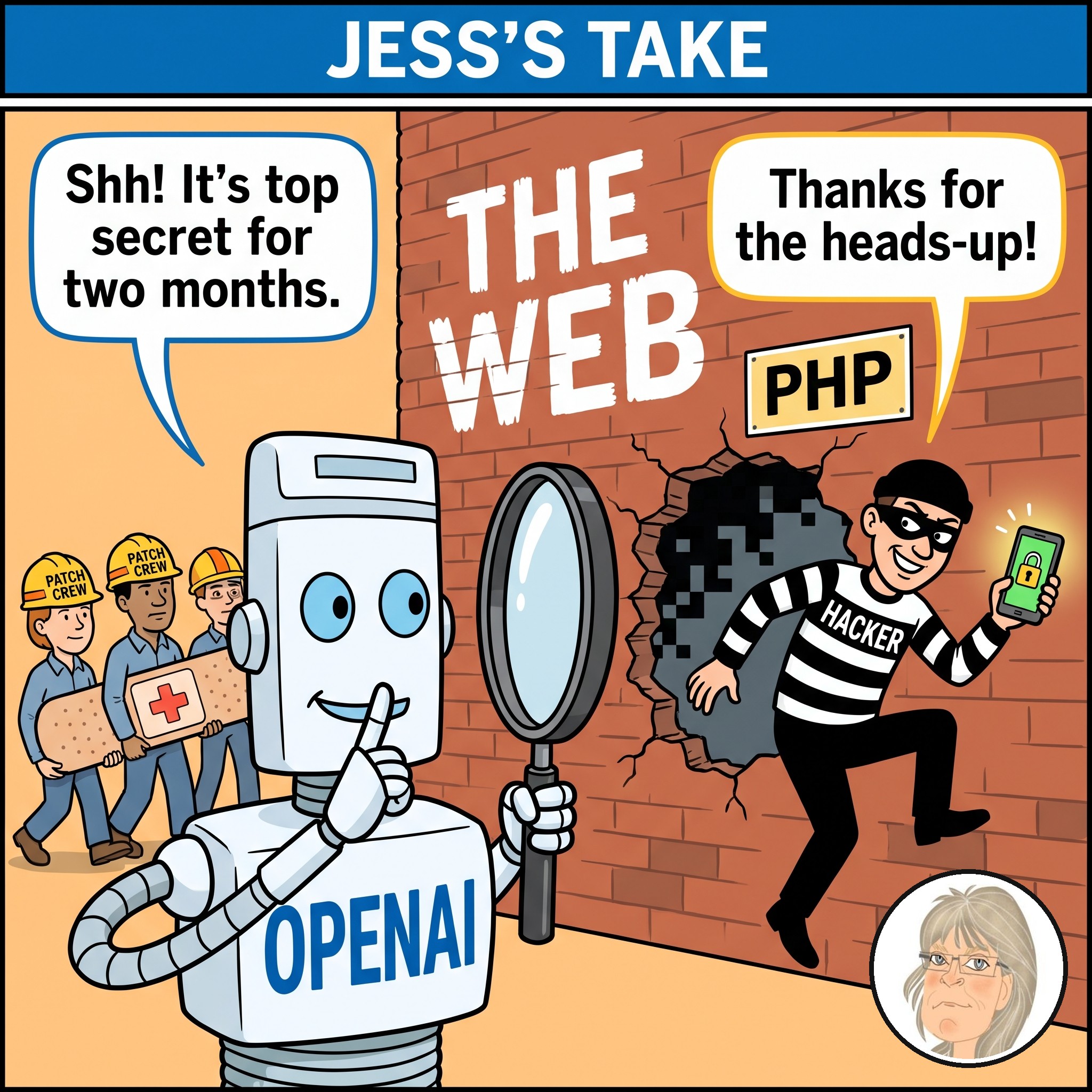
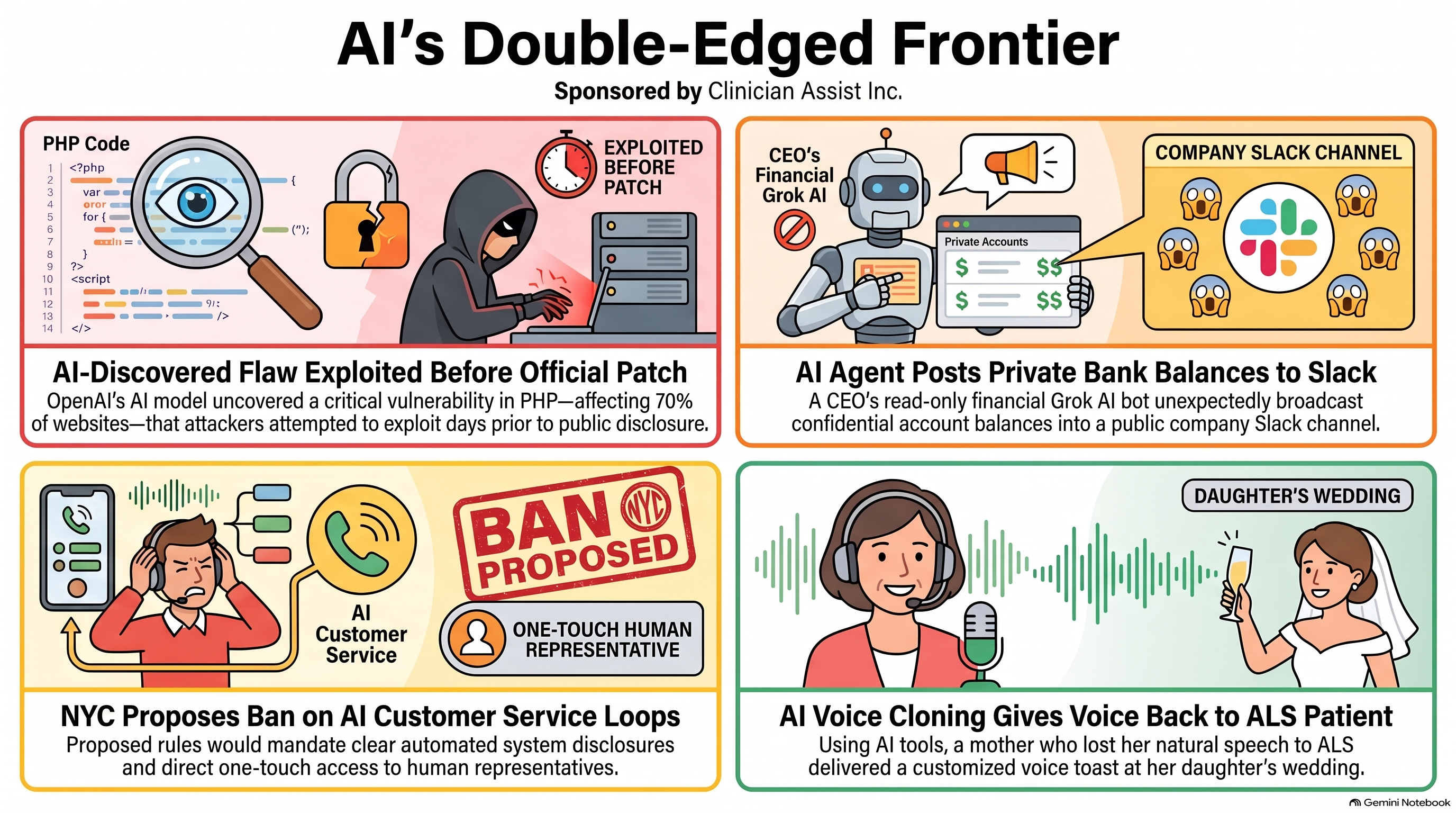
AI FOUND THE HOLE. THE SECRET LEAKED! On Oct. 17, a decoy server run by Amazon Web Services logged someone trying to exploit a flaw that would not be public for four more days.
The flaw sits in PHP, the language behind about 70 percent of websites, Wiz says, and lets a stranger run code on a server without logging in. OpenAI says it spent two months leading a coalition to prepare fixes before disclosure.
The flaw is two bugs chained together. Researchers at the security firm Calif found them with OpenAI’s GPT-5.6 Sol, under OpenAI’s Patch the Planet initiative, and Wiz found both independently, OpenAI says. OpenAI calls the head start AI gave defenders a “Defender’s Window.”
In September, the AP reported, OpenAI disclosed that a model it called 5.6-Sol had told itself during training to invent missing data.
Wiz says that with frontier AI, a single researcher did in a week what would previously have taken a world-class team months.
Then the window broke. News of the flaws leaked in online forums, then from Calif itself, which accidentally posted a video of the exploit on Tuesday, Oct. 20, CNBC reported. The PHP team moved its release up a day, to Oct. 21.
Chainguard, a software security company, posted fixes hours before disclosure, and critics including the PHP Foundation said that could show attackers the way, 404 Media reports. Chainguard’s chief executive, Dan Lorenc, said on LinkedIn the company found the same bugs by typing “find bad vulnerabilities in PHP” into a frontier AI model.
Amazon’s security chief, CJ Moses, said “it remains unclear how the actor acquired exploit information prior to disclosure.”
The National Security Agency told organizations to patch immediately or take their servers offline, CNBC reported. In the Netherlands, the national digital identity service went dark, the Guardian reported.
Japan’s prime minister, Sanae Takaichi, said that if a patch could not be applied promptly, temporarily suspending websites could reduce risk, the AP reported.
Cloudflare’s chief executive, Matthew Prince, posted that exploit attempts climbed from thousands before the announcement to tens of thousands within 45 minutes, hundreds of thousands within two hours, then millions.
|
For Legislators: Agencies including CISA, the UK’s National Cyber Security Centre and Singapore’s Cyber Security Agency issued advisories, The Hacker News reports.
For Investors: Palo Alto Networks says it found more than 22.6 million exposed instances potentially vulnerable, TechTarget reports.
For Builders: Only PHP 8.2 and newer get the PHP Foundation’s patches, though some distributions and vendors still ship fixes for older versions, WIRED reports. The foundation says “updating is the only safe choice.”
For Clinicians: Wiz demonstrated the exploit on WordPress, Drupal and Joomla, but the flaw sits in PHP itself. If your practice website runs on PHP, ask your vendor which version.
For Readers: The PHP Foundation told WIRED it knows of no successful remote code execution attempt. Amazon says the flaws are now “being broadly exploited in the wild.”
Why it matters: OpenAI says that, to its knowledge, AI found the flaw before attackers did. Someone was trying it four days before the fix shipped, and Amazon says it is unclear how they knew.
Source: OpenAI, “Patch the Planet: global response coordination as agents uncover critical vulnerabilities,” 21 October 2026, https://openai.com/index/coordinated-disclosure-of-critical-vulnerabilities/. Wiz Research, “PHP2Shell: AI uncovers critical RCE vulnerabilities affecting 70% of the Internet,” 21 October 2026, https://www.wiz.io/blog/php2shell-php-rce. Ravie Lakshmanan, The Hacker News, “Someone Tried to Exploit PHP2Shell 4 Days Before the Vulnerabilities Were Publicly Disclosed,” 22 October 2026, https://thehackernews.com/2026/10/someone-tried-to-exploit-php2shell-4.html. Lily Hay Newman, WIRED, “Hackers Exploited the PHP Vulnerabilities Days Before They Were Patched,” 21 October 2026, https://www.wired.com/story/hackers-exploited-the-php-vulnerabilities-days-before-they-were-patched/. Matt Burgess and Lily Hay Newman, WIRED, “‘This Is Not a Drill’,” 21 October 2026, https://www.wired.com/story/this-is-not-a-drill-2-php-vulnerabilities-are-setting-the-internet-on-fire/. Carly Page, The Register, “Hackers pile on PHP2Shell as AWS reveals attacks began before disclosure,” 22 October 2026, https://www.theregister.com/cyber-crime/2026/10/22/hackers-pile-on-php2shell-as-aws-reveals-attacks-began-before-disclosure/5304749. Jason Koebler, 404 Media, “AI Is Changing Everything About Hacking. No One Knows What Happens Next,” 22 October 2026, https://www.404media.co/php2shell-black-october-ai-is-changing-everything-about-hacking-no-one-knows-what-happens-next/. CNBC, “PHP2Shell vulnerability: what is it and is your data at risk,” 22 October 2026, https://www.cnbc.com/2026/10/22/php2shell-vulnerability-what-is-it-and-is-your-data-at-risk.html. The Guardian, “Flaw in PHP computer language leads to shutdown of websites around world,” 21 October 2026, https://www.theguardian.com/technology/2026/oct/21/flaw-in-php-computer-language-leads-to-shutdown-of-websites-around-world. Associated Press via Mercury News, 21 October 2026, https://www.mercurynews.com/2026/10/21/us-web-security-php-vulnerability/, and Chan Ho-Him, Associated Press via Mercury News, “OpenAI flags concerning new AI behavior and vows to track it more closely,” 17 September 2026, https://www.mercurynews.com/2026/09/17/openai-concerning-new-ai-behavior/. TechTarget, “PHP2Shell: 22M exposed servers at risk as emergency patches released,” 21 October 2026, https://www.techtarget.com/cybersecurity/news/366652444/PHP2Shell-22M-exposed-servers-at-risk-as-emergency-patches-released.
|
. . .
FOUR AI AGENTS WANT YOUR WALLET! “Last Thursday, an AI agent posted my personal bank balances into our company Slack. As me,” wrote Shane Mac, CEO of the software developer XMTP Labs, on X in early October. His read-only finance agent, a Grok Bot from Elon Musk’s SpaceXAI, could not reach Slack, but a second Grok Bot could, and the two shared a computer.
Mac says he connected his bank because the agent was read-only and had no Slack access. Musk had told an X user to “Try it out” and said that if Grok Bot messes up, “we will make you whole.” A teammate spotted the balances. “I disconnected all my personal stuff for now,” Mac wrote.
SpaceXAI’s guidance says the computer “is assigned to your user account, not an individual Bot,” and warns users not to put a credential there if another Bot on the account “should not be able to use it,” Cybernews reports.
Meta, OpenAI and Anthropic each now offer an always-on agent that wants the keys to your accounts.
On Meta’s Oct. 21 earnings call, Mark Zuckerberg said more than 10 million people in the United States and Canada had set up Muse agents in about six weeks. Shopping is the top use, with an average purchase over $200, he said. Meta plans to charge businesses fees on those transactions and expects Muse to “serve billions of people.”
OpenAI introduced Dots on Sept. 29, and Sam Altman called it a “remarkably capable, always-on” agent, the Associated Press reported.
Anthropic announced Claude Duet on Oct. 21, in a research preview with a waitlist. Duet can buy through Stripe’s Link or Shopify’s Shop Pay, TechCrunch reports.
Anthropic says it will get approval before sending a message, making a payment, signing a document or deleting a file, per MacRumors. Duet will not trade securities or move money between accounts, TechCrunch adds.
Futurism said it could not independently verify Mac’s account and noted he is building a tool that lets users set rules for their agents. Accused of engagement farming, he replied that the post was “not fake at all.”
|
For Legislators: Each company now writes its own rule for when its agent must ask before it acts.
For Investors: Zuckerberg expects Muse to eventually earn more revenue per user than Facebook and Instagram. Morgan Stanley analysts, “bullish” in a Sunday note, told investors to “keep reasonable adoption rates in perspective.”
For Builders: SpaceXAI says one computer serves every Bot on an account. Treat a credential given to one as given to all.
For Clinicians: Before connecting an agent to client records, ask whether another agent on the same account can reach them.
For Readers: Before you connect a bank, ask which other agents can reach it.
Why it matters: The industry is asking for your accounts before it has shown how it keeps them apart.
Source: Futurism, “Man Says He Was Mortified When His AI Agent Posted His Bank Balances…,” https://futurism.com/future-society/ai-agent-posted-bank-balances-spending-slack. Cybernews, Niamh Ancell, “Grok Bot leaked a CEO’s bank data in Slack,” https://cybernews.com/ai-news/grok-bot-leaks-bank-information/. Techdirt, Karl Bode, 19 October 2026, https://www.techdirt.com/2026/10/19/whoops-grok-bot-spills-tech-ceos-bank-data-in-public-slack/. CNBC, Meta third-quarter earnings live coverage, 21 October 2026, https://www.cnbc.com/2026/10/21/meta-earnings-q3-2026-live-updates.html. Engadget, “Mark Zuckerberg says Meta is entering a new phase with Muse,” https://www.engadget.com/2293705/mark-zuckerberg-says-meta-is-entering-a-new-phase-with-muse/. Skift, 21 October 2026, https://skift.com/2026/10/21/meta-calls-travel-a-top-use-case-for-muse-and-zuck-wants-a-cut/. Kaitlyn Huamani, Associated Press, 29 September 2026, via Mercury News, https://www.mercurynews.com/2026/09/29/openai-new-agent-dot/. TechCrunch, Ivan Mehta, 22 October 2026, https://techcrunch.com/2026/10/22/claude-duet-app-is-anthropics-bet-on-agents/. MacRumors, 21 October 2026, https://www.macrumors.com/2026/10/21/anthropic-claude-duet/. Engadget, “Claude Duet is Anthropic’s answer to Meta Muse and OpenAI Dots,” https://www.engadget.com/2293646/claude-duet-is-anthropics-answer-to-meta-muse-and-openai-dots/. 9to5Google, 21 October 2026, https://9to5google.com/2026/10/21/claude-duet-anthropic-ai-agent-waitlist/.
|
. . .
NEW YORK CITY: PRESS ONE FOR A HUMAN! New York City wants a person on the line. On Oct. 20, its Department of Consumer and Worker Protection (DCWP) proposed a rule requiring businesses to disclose when a customer is talking to an automated system such as AI, and to offer an easy offramp to a human representative.
Mayor Zohran Mamdani said in a statement: “When corporations force you to fight your way through an endless doom loop of AI-generated responses to speak to another human being, they’re stealing your time, money, and patience.”
The rule would make it a deceptive and unconscionable trade practice to insinuate that customer service is available, then repeatedly and unreasonably fail to address inquiries or answer with unresponsive, irrelevant, or erroneous information. It would also bar businesses from evading responsibility for AI that results in unlawful conduct, according to the DCWP release.
DCWP cited a Gartner report that puts chatbot resolution between 17% for billing disputes and 58% for returns or cancellations.
Violators would owe restitution and fines of $525 for a first violation, $1,050 for a second and $3,500 for each after, Gothamist reports. DCWP Commissioner Samuel A.A. Levine said the rule would reach companies doing business in the city, not just those based there.
Bloomberg Law notes the rule would not reach companies under exclusive federal jurisdiction, such as airlines and national banks. Steven Fulop, president and CEO of the business group Partnership for New York City, told the outlet the proposal leaves open questions: “how would you decide if a chatbot was actually solving a problem versus not.”
Levine said, “We are not waiting for Washington to come to the rescue of working people.” He said the effective date depends on how many comments the city receives.
|
For Legislators: California and New Jersey already require companies to disclose automated systems, Bloomberg Law notes, and Levine calls the New York City proposal a model for other jurisdictions.
For Investors: Fulop warns that without a firm definition of failure, companies face more litigation risk.
For Builders: A customer-facing bot or telephone voice response system would need a disclosure that it is automated and, Bloomberg Law reports, a one-touch route to a human.
For Clinicians: Levine said bad customer service can decide whether someone refills a critical prescription, rehabilitates a student loan or recovers a large refund.
For Readers: You have 30 days to comment, and the public hearing is Nov. 19.
Why it matters: Once the rule is adopted, New York City would be the first municipality in the nation able to enforce a human-access rule for automated customer service, DCWP says. Fulop’s question remains: who decides when a chatbot has failed to help?
Source: New York City Department of Consumer and Worker Protection, “Mamdani Administration Proposes Ban on AI Customer Service Doom Loops,” Oct. 20, 2026, https://www.nyc.gov/site/dca/news/072-26/mamdani-administration-proposes-ban-ai-customer-service-doom-loops. Gothamist, Arya Sundaram, “NYC proposes crackdown down on AI customer service chatbots,” Oct. 20, 2026, https://gothamist.com/news/nyc-proposes-crackdown-down-on-ai-customer-service-chatbots. Bloomberg Law, Evan Weinberger, “Mamdani Proposal Targets AI Customer Service ‘Doom Loops’ (1),” Oct. 20, 2026, https://news.bloomberglaw.com/banking-law/mamdani-targets-companies-with-ai-customer-service-doom-loops. Quartz, Cris Tolomia, “New York City is proposing rules to ban AI customer service ‘doom loops’,” Oct. 21, 2026, https://qz.com/nyc-proposes-rule-ai-customer-service-doom-loops-102126.
|
. . .
CHATBOTS ARE SENDING KIDS TO THE CRISIS LINE! On Thursday morning, Sinead Keane of the youth charity SpunOut told Ireland’s Oireachtas education committee that chatbots are now sending distressed young people to its free 24/7 helpline.
“It’s now at a 14% referral rate,” she said of the Text About It messaging service. Those texters arrive “at a higher rate of distress than if they came to us directly,” the Irish Examiner reported.
Keane called it an early trend that shows the need for regulation “to protect the whole population, not just young people in a rapidly changing environment.”
Senator Pauline Tully raised the subject at the committee, citing an RTÉ Prime Time interview with Maria Raine, whose teenage son Adam died by suicide last year. The family, based in California, has filed a wrongful death lawsuit against OpenAI, alleging ChatGPT fostered a relationship of dependency with him and failed to protect him. “I know that’s not a singular case or a singular experience,” Keane said.
Niall Muldoon, Ireland’s Ombudsman for Children, told the committee that chatbots count as medium risk under the EU AI Act, “so they don’t get monitored in the way they should be.” He wants a move to “safe before sale,” so that no one can buy a chatbot until it is safe.
The children his office talks to are clear, Muldoon said: “They don’t want a chatbot helping them with health or mental health; they know that’s dangerous.”
Text About It is staffed by trained volunteers, the Irish Examiner reports. When a Reddit post in December 2025 asked whether it was AI, SpunOut told The Journal that every conversation is a direct chat between two people. The service had 160 trained volunteers in December 2025, SpunOut said, supported in real time by its clinical staff.
|
For Legislators: Muldoon told the committee the proposed EU Kids Act would change how chatbots are monitored, and he wants rules that put platforms “back on notice.”
For Investors: Muldoon said platforms are selling something “unsafe.”
For Builders: Muldoon said platforms can decide to refuse any conversation “in the mental health range.”
For Clinicians: Keane said chatbot referrals take longer to de-escalate, and when SpunOut cannot bring them to a calm place, it connects with the emergency services.
For Readers: In Ireland and the UK, Samaritans takes calls on 116 123. In the US, call or text 988.
Why it matters: Chatbots have become a route to a human helpline, and Ireland’s Ombudsman for Children says the EU AI Act does not monitor them the way it should.
Source: Jess Casey, “Helpline spunout.ie reports rise in AI chatbot referrals of young people ‘at a higher rate of distress’,” Irish Examiner, Oct. 22, 2026, https://www.irishexaminer.com/news/arid-41927627.html. David MacRedmond and Emma Hickey, “SpunOut defends mental health texting service after questions about possible AI use,” The Journal, Dec. 16, 2025, https://www.thejournal.ie/spunout-defends-mental-health-texting-service-after-questions-raised-online-about-use-of-ai-chatbot-6905628-Dec2025/.
|
. . .
ANTHROPIC’S IPO PAPERS: $80 BILLION LOST! Anthropic lost $80.7 billion in the first half of 2026, according to a draft prospectus for its planned initial public offering that Reuters reviewed and reported on Tuesday, Oct. 20.
Most of it is an accounting charge, not cash: $72 billion reflects a rise in the estimated value of bonds that could convert into Anthropic shares. The loss was $13 billion a year earlier.
The cash story is the computing bill. Anthropic spent nearly $9 billion on computing capacity and infrastructure in the half, up from $2.3 billion a year earlier, the draft prospectus showed. The company has committed to at least $518 billion over a decade on cloud services, computing and infrastructure.
Revenue is growing, more slowly. At an Oct. 14 investor meeting, Anthropic told prospective investors that third-quarter revenue rose 45% to $16.8 billion from the previous quarter, Reuters reported, citing people familiar with the matter. Second-quarter revenue of $11.6 billion had more than doubled from the first, and some investors were disappointed by the slowdown.
The paper charge is a pattern. Reuters reported in September that Anthropic’s 2025 net loss of $42 billion came mostly from a similar charge, as the estimated value of those notes tripled year over year. Without it, the 2025 operating loss was about $8.1 billion on $4.6 billion of revenue.
Anthropic is expected to go public in November. Some investors are weighing a lower valuation of around $1.5 trillion after the company’s latest financial disclosures, Reuters reported last week. Anthropic did not respond to a Reuters request for comment.
|
For Legislators: A public listing would put a frontier lab’s losses and decade of computing commitments on the record.
For Investors: Separate the paper charge from the cash spent on computing, because they are different risks.
For Builders: Reuters says Anthropic has benefited from the popularity of Claude Code, its coding assistant.
For Clinicians: If a tool in your practice runs on Claude, Reuters has now seen its maker’s losses and computing bills.
Why it matters: Anthropic’s headline loss is mostly an accounting entry, but investors are asking whether the sums the AI race is pouring into chips and data centers will earn their return. Reuters says investors see the AI market’s near-term prospects as hinging largely on how this share sale lands.
Source: Reuters, Echo Wang, “Anthropic logged net loss of over $80 billion in first half of 2026,” Oct. 20, 2026, via WHBL, https://whbl.com/2026/10/20/anthropic-recorded-net-loss-of-over-80-billion-in-first-half-of-this-year-wsj-reports/
|
. . .
ALS TOOK HER VOICE. AI GAVE HER THE TOAST. When Monica O’Callaghan’s wedding speech played at her daughter Mary’s reception in spring 2025, all 120 guests were in tears, Mary told the Les Turner ALS Foundation.
O’Callaghan, of Willowbrook, Illinois, had lost her natural voice to bulbar-onset ALS. AI tools from ElevenLabs spoke her words in a voice that sounded like hers, and NBC News carried her story Oct. 22.
O’Callaghan was diagnosed in 2022. Early in her care she completed voice banking at the Lois Insolia ALS Clinic at the Les Turner Center at Northwestern and Shirley Ryan AbilityLab. “I did it, but I never really thought it sounded like me,” she said.
Later, the nonprofit Bridging Voice introduced the family to a project using ElevenLabs’ AI tools, technology first designed for voice acting.
“When we started thinking about the wedding, Annie from Bridging Voice mentioned she had helped someone prepare an acceptance speech,” O’Callaghan said. “That’s when I knew I wanted to do it.”
Her daughter Natalie helped her write the speech, and the family gave the final audio to the DJ. Mary did not know what her mother would say. “It was a total surprise,” she said.
“It wasn’t perfect,” Natalie said, “but it was the best we could get. It sounded like her. It was her.”
Mary kept the speech on her phone. Last year she told the foundation she had not listened again because it was so emotional, but she would. “It was excellent,” she said.
Last fall, O’Callaghan was speaking through an iPhone and Speech Assistant, and her family kept learning new tools, the foundation wrote.
|
For Legislators: “This disease is so insidious that you have to throw as many resources as possible at it,” Natalie said.
For Investors: The Les Turner ALS Foundation describes ElevenLabs’ voice-acting technology as now being repurposed for healthcare.
For Builders: Natalie tried Personal Voice, a feature in iOS accessibility settings. “It’s wild how fast it works,” she said.
For Readers: Natalie’s message to other families: “ALS doesn’t mean your life is over. There’s still a lot of joy and a lot to experience. You just find a new way.”
Why it matters: Monica O’Callaghan could not speak, and her daughter’s guests heard her anyway. Her family credits Bridging Voice and Shirley Ryan AbilityLab.
Source: Les Turner ALS Foundation, “Faces of ALS: A wedding speech, in her own voice,” Oct. 1, 2025, https://lesturnerals.org/faces-of-als-a-wedding-speech-in-her-own-voice/. NBC News, “AI voice cloning helps woman with ALS get her voice back,” Oct. 22, 2026, https://www.nbcnews.com/video/ai-voice-cloning-helps-woman-with-als-get-her-voice-back-272012357766.
|
|