|
. . .
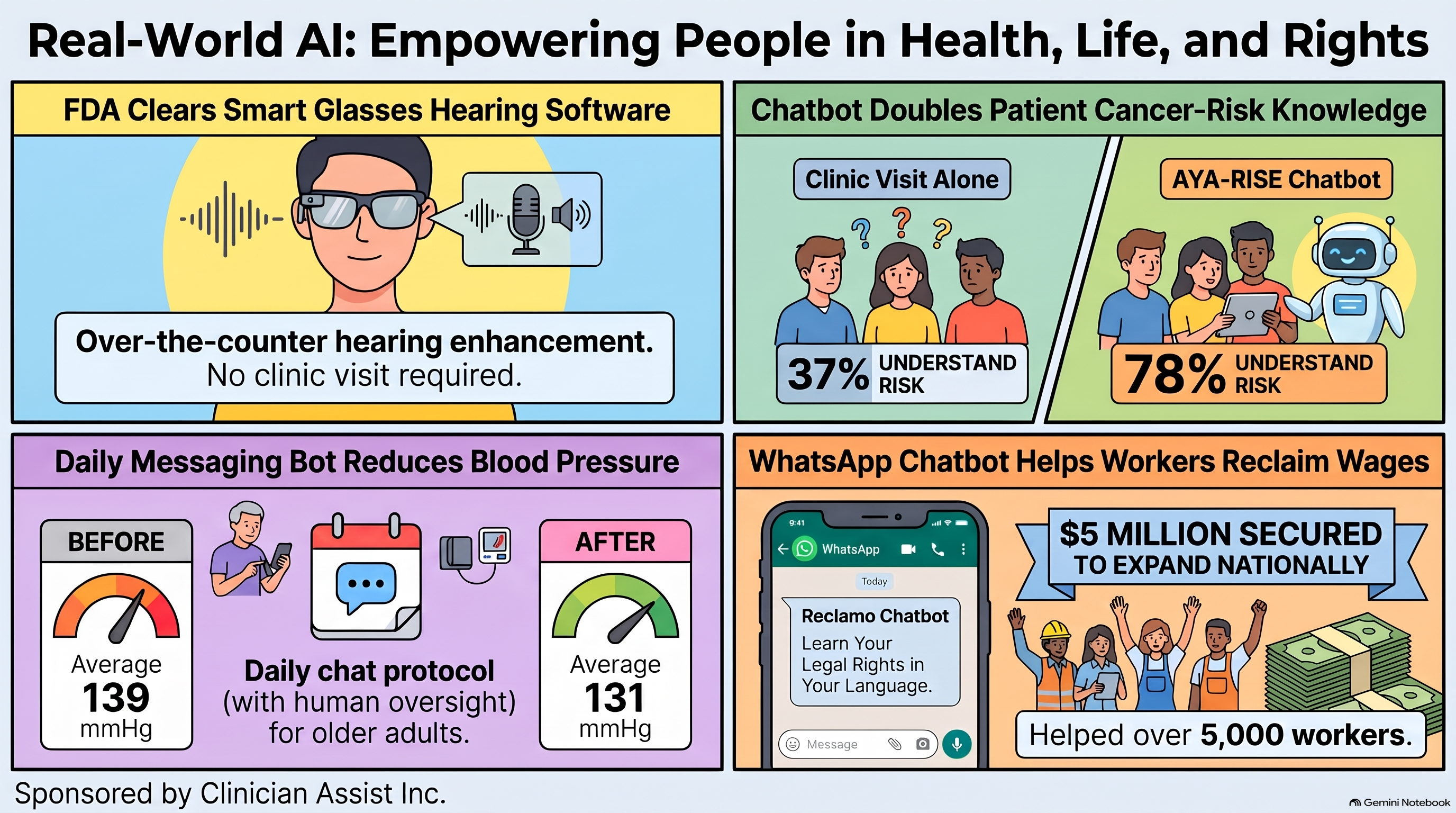
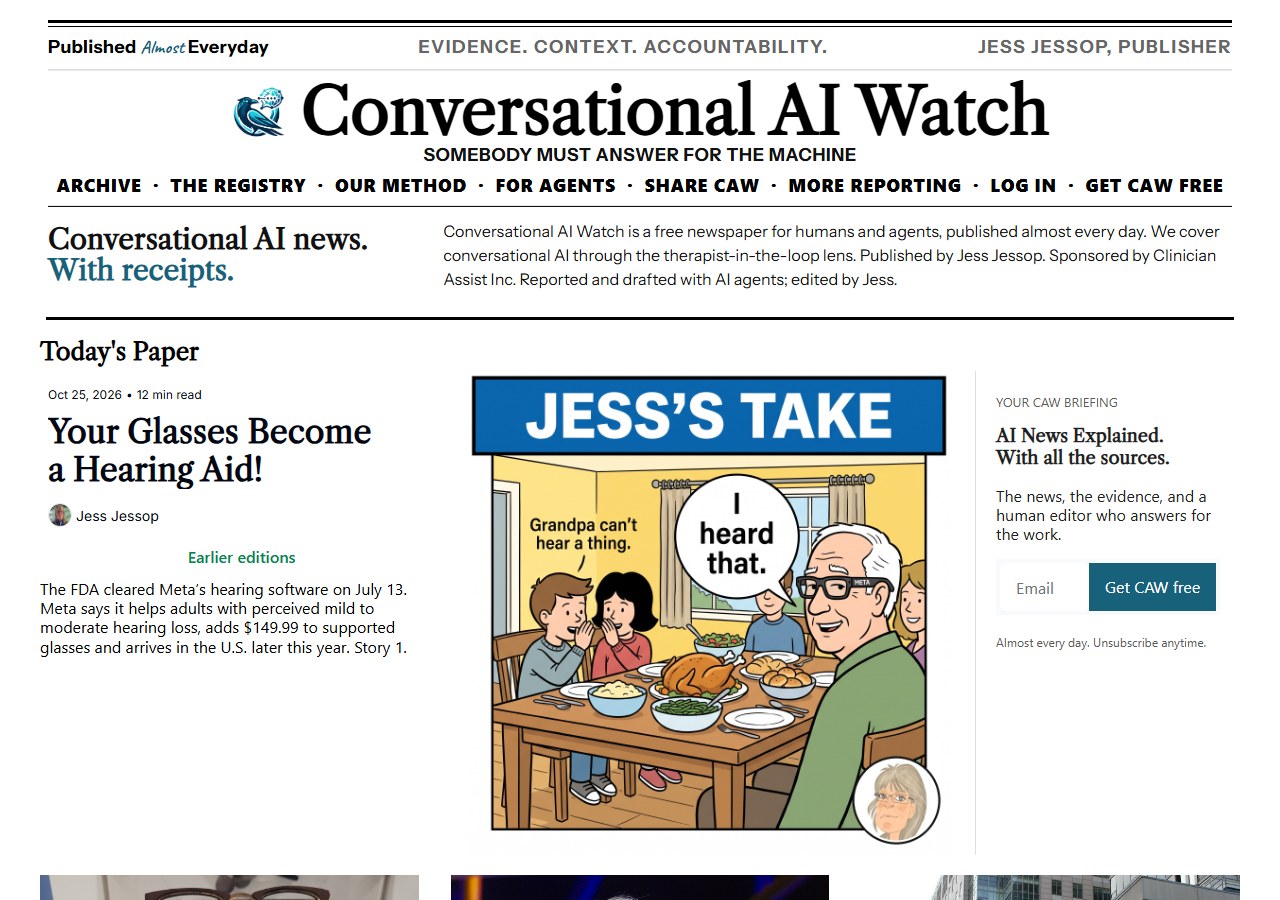
YOUR GLASSES BECOME A HEARING AID! On Sept. 23, at its Connect conference, Meta announced that its supported AI glasses will work as a hearing aid. The U.S. Food and Drug Administration cleared the software on July 13, and Meta says it helps adults with perceived mild to moderate hearing loss hear better. It adds $149.99 to supported glasses, or comes with a Meta One subscription, and reaches the United States later this year.
The FDA lists the device as “Hearing assist,” air-conduction hearing aid software, under 510(k) number K254044. Meta applied on Dec. 17, 2025. The agency found it substantially equivalent to an existing device.
Meta calls the feature hearing enhancement. It says wearers can set it up at home in minutes, with no clinic and no prescription.
The wearer stays in charge. Engadget reports that starting it takes one phrase, “Hey Meta, start Hearing Enhancement,” and that it can be switched off at any time by voice.
Engadget reports a 30-day free trial. The one-time price is eligible for HSA and FSA reimbursement, which Meta tells buyers to confirm with their plan.
It starts on supported Meta Glasses, Engadget reports, though not the Ray-Ban models at first. Meta already offers a Conversation Focus mode on its glasses that improves audibility in noisy environments. Engadget says the new feature is built for people who may normally use a hearing aid.
|
For Legislators: The FDA cleared a hearing aid that ships as software, through the 510(k) route for devices substantially equivalent to one already on the market.
For Investors: Meta will sell FDA-cleared software as a glasses feature, for a one-time fee or inside its Meta One subscription.
For Builders: Meta built a cleared medical function as a software add-on to supported glasses.
For Clinicians: When it launches later this year, clients with mild to moderate loss will have another cleared option beyond the clinic. Ask which clients wear, or would wear, supported Meta glasses.
Why it matters: Meta says a cleared hearing aid will arrive later this year as an add-on for supported glasses, set up at home. The wearer decides when it runs.
Source: U.S. Food and Drug Administration, 510(k) Premarket Notification K254044, “Hearing assist,” Meta Platform Technologies, LLC, decision date 07/13/2026, https://www.accessdata.fda.gov/scripts/cdrh/cfdocs/cfpmn/pmn.cfm?ID=K254044. Meta, “The Biggest News From Connect 2026,” Sept. 24, 2026, https://about.fb.com/news/2026/09/the-biggest-news-from-connect-2026/. Cheyenne MacDonald, “Meta brings FDA-cleared hearing enhancement to its smart glasses,” Engadget, Sept. 23, 2026, https://www.engadget.com/2267211/meta-brings-fda-cleared-hearing-enhancement-to-its-smart-glasses/. Kaitlyn Huamani and Barbara Ortutay, Associated Press, via Mercury News, Sept. 24, 2026, https://www.mercurynews.com/2026/09/24/meta-conference-zuckerberg-ai/.
|
. . .
MARISSA MAYER BUILT BUSY MOMS AN AI HELPER! Late last year, Marissa Mayer’s daughter Marielle was turning 10, and her teacher asked for three bullet points on what made the girl special. Overwhelmed, Mayer asked Dazzle, her start-up’s AI assistant, and in seconds it answered that Marielle is “empathetic, creative and an animal lover.” Mayer thought it perfect, The New York Times reports.
Mayer, 51, was the first female engineer at Google and later chief executive of Yahoo. A team of 10 engineers in Palo Alto built Dazzle for ordinary people rather than tech enthusiasts, and, the Times reports, for busy women in particular.
Mayer says women “tend to take more photos and are more visual,” which she calls her own bias. She says Dazzle “works as well for the guys.”
Dazzle, available since late September, reads the photos in a user’s camera roll to answer questions and get tasks done. Photos become a “Get it Done” to-do list and an “Ideas” list, and Dazzle can search the web and make purchases.
For Mayer’s family it has planned a Venice mask-making workshop and a magic-shop play date for Marielle. It also planned a glow-in-the-dark pool party for her son Macallister’s 14th birthday. Macallister told her, “Mom, I don’t want to hit the theme that hard.”
For Halloween, Dazzle sent her an image of a gown inspired by Wayne Thiebaud’s cake paintings, which she plans to wear trick-or-treating. “It essentially understands your personality, your likes, your dislikes,” she says.
Mayer says tasks like these “should be fun, but in many cases, they become such a chore.” Times reporter Alexandra Alter asks whether overextended professional women need an “A.I. wife,” a bot that knows Crazy Socks Day from a photo of a crumpled flier.
Mayer says power users spend hours a day with Dazzle, and some interact with it more than with their spouse.
Daniela Amodei, president of Anthropic, has warned that AI could become “a tool that’s just for the guys.” Women use AI less than men, and Sheryl Sandberg’s Lean In is tracking the gap. “I think gender balance will come in time,” Mayer says.
|
For Legislators: Lean In is counting the AI gender gap, a number any national AI plan could aim to close.
For Investors: Dazzle grew from Shine, an earlier app from Mayer’s start-up, and Mayer now competes with giants like Meta and OpenAI, the Times reports.
For Builders: Dazzle starts from photos the user has already taken, and Mayer built it to be “more approachable” than jargon-heavy assistants.
For Readers: Next time a crumpled school flier arrives, photograph it and ask an AI assistant what the school needs from you.
Why it matters: A task that sat on a busy mother’s list took Dazzle seconds. Mayer built it for people too busy for technical assistants, “probably more women than men,” she says.
Source: Alexandra Alter, The New York Times, “Gearing an A.I. Assistant Toward Busy Women” (web: “Can Marissa Mayer, Yahoo’s Former CEO, Help Fix A.I.’s Gender Problem?”), Oct. 25, 2026, https://www.nytimes.com/2026/10/25/style/marissa-mayer-ai-assistants-women.html.
|
. . .
CHATBOT DOUBLED WHAT YOUNG PATIENTS KNEW! On Oct. 7, JAMA Network Open published a randomized trial of AYA-RISE, a chatbot for young people born with a hereditary cancer syndrome. After their clinic visit, 78% of the young people who used it could state their risk of cancer before age 30, against 37% of those who had the visit alone. The chat is scripted by the research team, not generative AI.
The trial enrolled 106 adolescents and young adults, ages 12 to 24, at four U.S. academic centers: Dana-Farber Cancer Institute, Emory University with Children’s Healthcare of Atlanta, the University of Chicago and the University of Utah’s Huntsman Cancer Institute. Each had one of nine syndromes, including Li-Fraumeni, DICER1, BRCA1/2, Lynch and NF1.
Everyone saw the cancer predisposition team. Of the 106, 54 were assigned to also use AYA-RISE, which runs on a phone, tablet or computer, and 52 were not.
Before the visit, 52% of the chatbot group and 38% of the visit-only group answered the cancer-risk question correctly. Afterward, the chatbot group stood at 78%, 42 of 54. The visit-only group stood at 37%, 19 of 52.
The chat branches, so each young person chooses how much detail to see, in general words or in numbers. The chatbot added no distress.
The authors wrote that “high quality medical care requires human interactions and relationships.” They conclude that personalized, accurate electronic information alongside the clinic visit can support young people with cancer predisposition.
Many of these young people have a parent or sibling who has had cancer, and some of those relatives have died. The paper calls returning for screening “an act of faith” that surveillance will make their lives better and longer.
|
For Legislators: The National Cancer Institute funded the trial through grant 1U01CA243688.
For Investors: The chatbot’s interface was built by Clear Genetics, now part of Invitae and Labcorp.
For Builders: A branching script, written from published literature and screening guidelines and co-designed with young people and families, did the work without generative AI.
For Clinicians: The cancer predisposition visit came first, and the chatbot supplemented it.
For Readers: If your family carries an inherited cancer syndrome, ask the care team for your risk in plain words and in numbers, and for something you can reread at home.
Why it matters: A chatbot written by a research team and used after a clinic visit left about twice as many young people knowing their cancer risk before age 30. The visit stayed human, and the chatbot let each of them choose plain words or numbers.
Source: Kamihara J, Cronin AM, Uno H, et al., “Chatbot Intervention and Cancer Risk Knowledge in Adolescents and Young Adults With Cancer Predisposition: A Randomized Clinical Trial,” JAMA Network Open, Oct. 7, 2026, doi:10.1001/jamanetworkopen.2026.35794, https://jamanetwork.com/journals/jamanetworkopen/fullarticle/2854932. Tarun Sai Lomte, “Adding a chatbot to specialist care helped young people make sense of cancer risk,” News-Medical, Oct. 12, 2026, https://www.news-medical.net/news/20261012/Adding-a-chatbot-to-specialist-care-helped-young-people-make-sense-of-cancer-risk.aspx.
|
. . .
CHATBOT HELPED LOWER BLOOD PRESSURE! Every day for 12 weeks, a trained research assistant at Khon Kaen University in Thailand read each conversation between 34 older adults with high blood pressure and a chatbot, and replied personally whenever the bot could not. The adults sent their readings through LINE, the messaging app already common among older Thais. Their average systolic pressure fell from 139 to 131 mmHg, while a usual-care group’s stayed flat.
The 34 adults, all 60 or older, were treated at the outpatient department of Srinagarind Hospital in Khon Kaen. A comparison group of 34 older adults with high blood pressure came from Sila Health Promoting Hospital, a primary care clinic, and received usual care with a hypertension education manual.
When someone reported a reading, the chatbot said what it meant and what to do next. For markedly high readings it showed a button to call Thailand’s 1669 emergency hotline.
The bot also sent medication reminders and short videos, and answered questions about diet and exercise, drawing on answers prepared in advance and reviewed by experts. The research assistant, trained in counseling people with hypertension, stepped in for everything else.
Each adult in the chatbot group was taught to use it at the start, and all 68 in the study completed both assessments.
After adjusting for baseline differences between the groups, the chatbot group’s blood pressure averaged 127/70 mmHg, compared with 136/80 mmHg for usual care. Medication adherence rose in the chatbot group, and after adjustment its scores for knowledge, health behaviors and medication adherence were all higher than the comparison group’s.
The comparison group was offered the chatbot once the study ended.
|
For Legislators: In Thailand only about 30% of adults with hypertension reach blood pressure control, against an expected 60%, and this program ran on an app older adults already use.
For Investors: The team registered its protocol in advance, and the authors recommend randomized trials next.
For Builders: The bot answered from reviewed content, and a person caught everything it could not answer.
For Clinicians: The team enrolled adults with grade 1 to 2 hypertension on medication, and the chatbot told them what each reading meant between clinic visits.
For Readers: Twelve weeks of readings, reminders and a real person reading along came with lower blood pressure than usual care.
Why it matters: For older adults at Srinagarind Hospital, a phone they already carried became a daily check-in that someone read. Their blood pressure fell, and usual care’s did not.
Source: Ransinyo K, Banharak S, Panpanit L, et al., “Effectiveness of a Chatbot-Based Hypertension Management Program on Selected Outcomes Among Community-Dwelling Older Adults: A Quasi-Experimental Study,” Journal of Multidisciplinary Healthcare 2026;19:635820, published Sept. 26, 2026, https://doi.org/10.2147/JMDH.S635820.
|
. . .
CHATBOT HELPS WORKERS GET STOLEN WAGES! Rodrigo Camarena, who conceived Reclamo.AI, called it “a once-in-a-lifetime catalytic grant,” $5 million for a chatbot that answers a worker’s questions about unpaid wages and points toward a lawyer when one is needed. amNewYork reported Oct. 8 that Scale Justice, the New York nonprofit behind Reclamo.AI, won the money in the Workplace Innovation Now Challenge.
More than 5,000 people used Reclamo in the 12 months before amNewYork’s report, and before it added AI, the tool helped workers file more than $1.5 million in lost-wage claims over 18 months, Camarena said.
Camarena said the idea began more than a decade ago at the immigrant advocacy nonprofit Mixteca. He heard from domestic workers, restaurant workers and day laborers cheated out of pay, and could only refer them to legal aid groups that were already overloaded.
Reclamo starts in WhatsApp and answers in the worker’s language, its site says, then connects workers with trusted advocates. Workers need not give a name or immigration status, Hoodline reports, citing LawHelpNY. The chatbot is trained exclusively on material from legal assistance groups.
The grant is meant to take Reclamo beyond New York City. With the New York Legal Assistance Group, Scale Justice plans a tool that helps workers gather evidence, build their own case and file a claim for stolen wages with an agency such as the Department of Labor.
“Right now, the program is primarily a chatbot that tries to empower workers by teaching them what some of their workers’ rights are,” said Mel González, director of NYLAG’s Employment Law Project. The money will also fund new staff and outreach in retail, food service and home hospitality.
Camarena said the aim is not to replace attorneys. It is to connect workers who have long gone without legal help to lawyers, faster.
|
For Legislators: Immigrant, women and non-English-speaking workers are the most likely to face wage theft and the least likely to have a lawyer, amNewYork reported, citing Camarena.
For Investors: The $60 million challenge from the Aspen Institute and Pivotal drew nearly 900 applications and named 18 awardees, with grants of $2.5 million or $5 million.
For Builders: Reclamo’s site says it gives no legal advice.
For Readers: If an employer in New York has shortchanged you, Reclamo starts in WhatsApp and answers in your language.
Why it matters: Where a worker once got only a referral, Reclamo now teaches them their rights in a conversation. The grant is meant to add case-building and carry that help from New York to workers nationwide.
Source: Isabella Gallo, amNewYork, “$5M granted for New York-based nonprofit to expand AI legal tool helping workers know their legal rights, reclaim stolen wages, and more,” Oct. 8, 2026, https://www.amny.com/new-york/ai-legal-tool-workers-rights/. Reid Carlisle, Hoodline, “New York Nonprofit Lands $5M to Take Wage-Theft Chatbot Reclamo Nationwide,” Oct. 9, 2026, https://hoodline.com/2026/10/new-york-nonprofit-lands-5m-to-take-wage-theft-chatbot-reclamo-nationwide/.
|
|