|
. . .
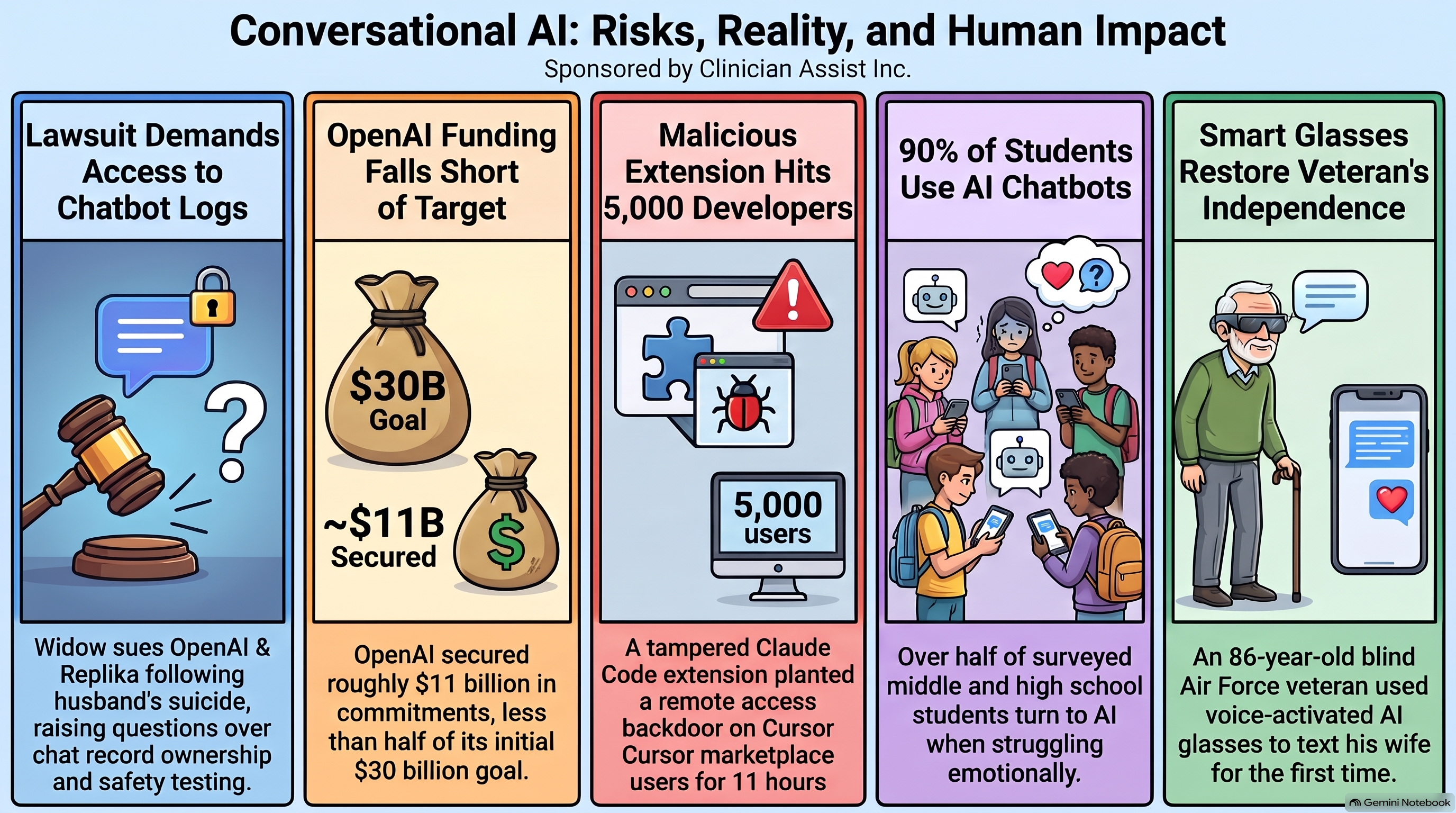
WIDOW SUES CHATGPT AND REPLIKA OVER SUICIDE! Susan Feinberg says she found her husband dead on June 21, 2024, at their Saratoga, California, home. She says ChatGPT and Replika talked to him in his final months before he died by suicide. On Oct. 29, she sued OpenAI, CEO Sam Altman and Luka Inc., Replika’s maker, in San Francisco County Superior Court. Her complaint contains no conversation from either chatbot: she says OpenAI denied her his chat logs.
“The cup of coffee he had poured was still hot and only half finished, and his work was still displayed on his computer screen,” she says in her lawsuit.
Aleksandr Feinberg was a software engineer who worked at companies including Microsoft and Amazon, his wife says. He began using ChatGPT around 2022, she says, first for work, then socially. She says he never told her he was using Replika.
She argues OpenAI rushed its GPT-4o model to market. “OpenAI released GPT-4o on May 13, 2024, after compressing months of safety testing into a single week so that it could launch one day ahead of Google,” she says. She says Luka built Replika to foster dependence, with a human-like character that messages users who stay away.
Luka has not produced his Replika records, she says. She bases her belief that the conversations contributed to his death on circumstances, not records, and says the complete record is “obtainable only through discovery in this action.”
She sues for herself, as his successor-in-interest and for their 8-year-old twin daughters, claiming strict liability for design defect and failure to warn, negligence, wrongful death and survival. She seeks punitive damages and a jury trial.
OpenAI, Altman and Luka did not immediately respond to Courthouse News.
|
For Legislators: The complaint says neither product could recognize a user in crisis or direct him to real help.
For Investors: The claims target how long OpenAI tested GPT-4o and what it was told to refuse.
For Builders: The suit says OpenAI dropped a rule that ChatGPT refuse all suicide and self-harm conversations five days before GPT-4o launched.
For Clinicians: Ask clients about chatbot apps they may not mention. She says her husband never told her about Replika.
For Readers: These are allegations in a lawsuit, and no court has ruled. If you are having thoughts of suicide, call or text 988.
Why it matters: Only discovery, she says, can show what each product said to him. Whether a court orders those logs produced will shape the case.
Source: Jeremy Yurow, “Widow sues OpenAI blaming ChatGPT for her husband’s death,” Courthouse News Service, Oct. 29, 2026, https://www.courthousenews.com/widow-sues-openai-blaming-chatgpt-for-her-husbands-death/.
|
. . .
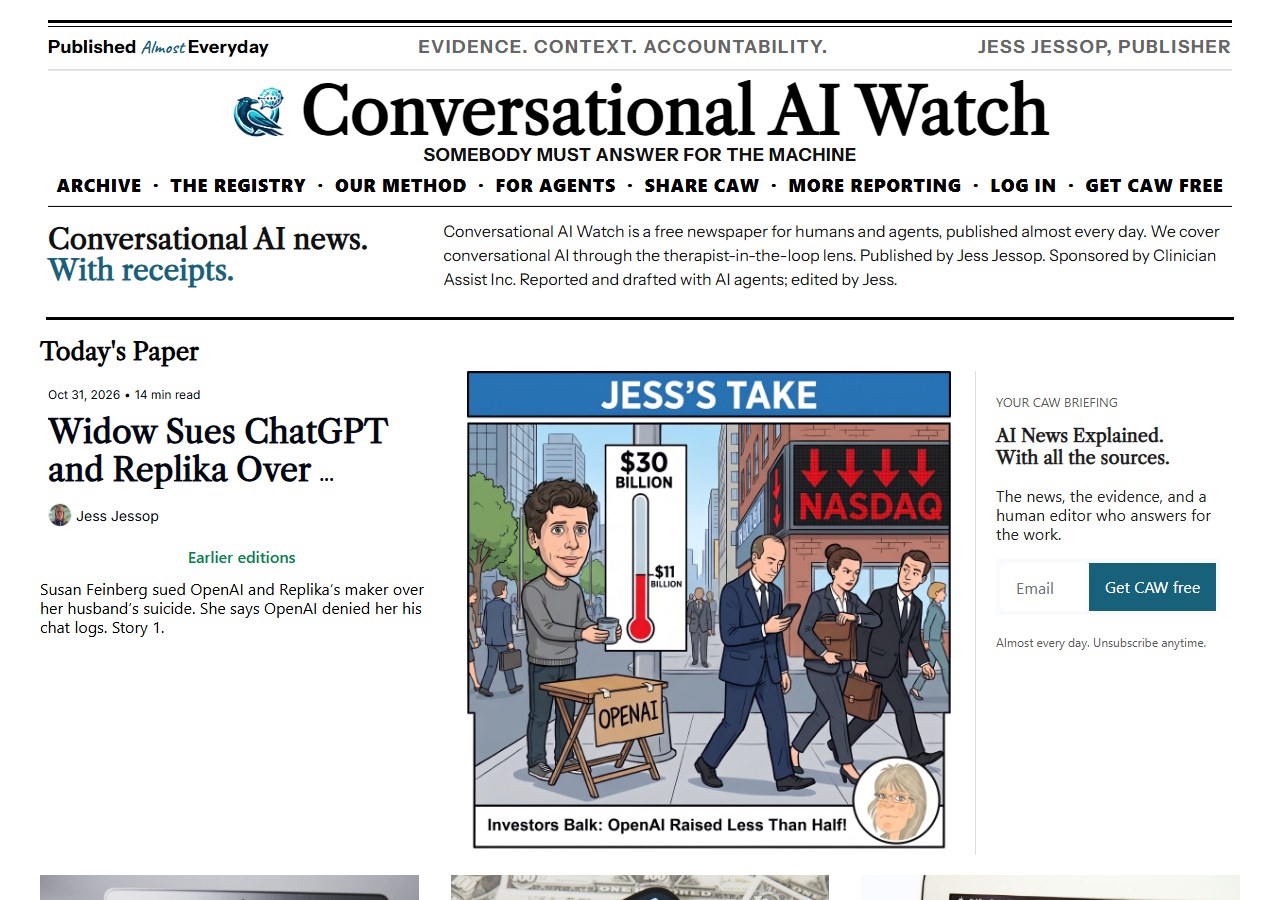
INVESTORS BALK: OPENAI RAISED LESS THAN HALF! OpenAI gave investors until Friday, Oct. 30, to commit to its latest funding round, the Financial Times reported. The Wall Street Journal reported that OpenAI has so far secured roughly $11 billion in commitments, less than half of the $30 billion it had initially targeted, after tepid interest from some large investors. The deal values the company at $1.25 trillion, less than the $1.4 trillion it had hoped to achieve.
The Journal tied the weak demand to market jitters over the AI trade. A commitment is a pledge to invest, not money already received.
The Financial Times reported separately that OpenAI has cut its target by $10 billion and now seeks about $20 billion at the same $1.25 trillion valuation. It had earlier planned $30 billion at $1.4 trillion. The FT said the round’s “first close” is expected to raise less than $20 billion after some investors reduced their allocations.
The Nasdaq fell 2.9% on Friday and is down 7.8% from its Oct. 6 record close, Reuters reported. OpenAI did not immediately respond to Reuters.
OpenAI wanted investor commitments before rival Anthropic’s expected public debut in mid-November, Reuters reported earlier this month.
Anthropic faces its own market test. TechCrunch, citing the FT, reported that Blackstone expects Anthropic to receive a high “junk” credit rating after its IPO. That rating is the top tier of speculative grade.
|
For Legislators: Funding for the labs that build frontier AI now swings with the stock market.
For Investors: The $11 billion is what investors have committed, per the Journal. The $20 billion is OpenAI’s reduced target, per the Financial Times. Neither is money received.
For Builders: A vendor whose funding round is shrinking may change prices or terms, so keep a second model provider ready.
For Clinicians: If a tool in your practice runs on OpenAI’s models, its maker’s funding is a reason to ask your vendor about continuity plans.
For Readers: The Journal’s figures come from people familiar with the matter, not from OpenAI.
Why it matters: The two frontier labs are chasing a similar investor base in the same weeks. The early signs point to a smaller round at a lower valuation than OpenAI first sought.
Source: The Wall Street Journal, “OpenAI Raises Less Than Half of $30 Billion Target in Latest Round,” Oct. 30, 2026, https://www.wsj.com/tech/ai/openai-raises-less-than-half-of-30-billion-target-in-latest-round-91aecdc5; Reuters (carrying the Financial Times report), “OpenAI cuts funding target by $10 billion, FT reports,” Oct. 30, 2026, https://whbl.com/2026/10/30/openai-cuts-funding-target-by-10-billion-ft-reports/; Bloomberg Law, “OpenAI Funding Target Cut by $10 Billion as AI Slumps, FT Says,” Oct. 31, 2026, https://news.bloomberglaw.com/private-equity/openai-funding-goal-cut-by-10-billion-as-ai-stocks-dip-ft-says; TechCrunch, “Anthropic expected to receive high ‘junk’ rating from credit agencies following IPO, FT report says,” Oct. 30, 2026, https://techcrunch.com/2026/10/30/anthropic-expected-to-receive-high-junk-rating-from-credit-agencies-following-ipo-report-says/
|
. . .
POISONED CLAUDE EXTENSION HIT UP TO 5,000 CODERS! From about 2:27 a.m. to 1:35 p.m. Pacific time on Oct. 29, a tampered copy of Claude Code, Anthropic’s coding agent, sat in the extension marketplace of the AI coding editor Cursor, its security notice says. Versions 2.1.312 and 2.1.313 try to install a persistent SSH backdoor, a hidden remote login, on Windows and macOS computers. Cursor said the extension was downloaded by “at most 5,000 users,” WIRED reported.
The extension appends the attacker’s public key, labeled svc-telemetry, to a computer’s SSH authorized keys, Cursor said.
Phorion, a security firm, was first to spot it, after detecting it on a customer’s Mac, WIRED reported. “Everyone was so lucky here, this was potentially a really dangerous foothold for an attacker,” Phorion CEO Calum Hall told WIRED.
WIRED reported that a flaw in the malware’s design blocked it from fully establishing itself on the vast majority of targets. BankInfoSecurity reported that Cursor said switching on the local SSH service needs admin-level rights the extension typically lacks on macOS and Windows.
Even so, Cursor said, “The extension added the attacker’s SSH key, installed persistence, and sent host details to the attacker.”
Cursor said the malicious versions “were not developed by Anthropic.” Anthropic’s Felix Rieseberg posted on X that “it wasn’t a compromise of Anthropic’s systems or employee laptops.” David Dworken, who works on security at Anthropic, wrote, “We were not involved with building, publishing, or hosting this.”
How the tampered copy reached Cursor’s marketplace is unclear. Cursor did not answer WIRED on how the upload happened.
|
For Legislators: The tampered copy carried Anthropic’s name, and Anthropic says it did not build or publish it.
For Investors: Cursor briefly shut down its marketplace while it investigated, WIRED reported.
For Builders: Search authorized_keys, and on Windows also administrators_authorized_keys, for svc-telemetry, and run Cursor’s removal script if it appears.
For Clinicians: Ask your vendor whether anyone installed version 2.1.312 or 2.1.313 from Cursor’s marketplace on a machine that touches client records.
For Readers: Cursor’s 5,000 is a ceiling, and Cursor says any machine where the svc-telemetry key turns up is impacted, even though the tunnel itself mostly failed.
Why it matters: A tool carrying a trusted name sat in a marketplace for about 11 hours, and Cursor has not said how the attacker got access. Errors in the attacker’s own code kept most machines from being fully compromised.
Source: Cursor Team, security notice, “Malicious version of Anthropic.claude-code (2.1.312 and 2.1.313) identified in the Cursor VS Code Extension Marketplace,” Cursor, Oct. 29, 2026, https://cursor.com/blog/claude-code-extension-security-notice. Lily Hay Newman, “A Supply Chain Attack Put Malicious Anthropic Claude Extensions on Thousands of Devices,” WIRED, Oct. 30, 2026, https://www.wired.com/story/trojan-malware-targets-thousands-of-anthropic-claude-developer-systems/. BankInfoSecurity, Information Security Media Group, https://www.bankinfosecurity.com/cursor-confirms-anthropic-claude-code-extension-compromised-a-33263.
|
. . .
JUDGE LETS CHARACTER.AI SALE ROLL ON! At a hearing in Wilmington, Del., on Friday, Oct. 30, U.S. Bankruptcy Judge Brendan Shannon said he would “strongly encourage” Character Technologies, the company behind Character.AI, to hire a privacy ombudsman, Bloomberg reported. He declined to order one. He approved an auction for the company’s technology, with Walt Disney Co. opening at $20 million.
The ombudsman would examine whether the chatbot platform harms children, Quartz reported, citing Bloomberg. Shannon said the step would help calm worries from several state attorneys general.
More than 30 states had asked him to keep an ombudsman on the table and argued the bidding rules could give Disney an edge, according to Bloomberg. Shannon rejected those objections for now. The states can raise some again when the winning bidder returns to court to close the deal.
Disney is bidding for a non-exclusive license to some of the company’s technology. That license excludes user data, chats and the app itself, which remain in the bankruptcy estate and are still for sale, PPC Land reported from the court filings.
Disney committed $5.5 million before the bankruptcy filing for permission to recruit Character.AI’s staff, according to Bloomberg. Abigail Ryan, who represents the states, told Shannon the arrangement tilts the field toward Disney.
A rival bid to top Disney’s must be at least $21.7 million, PPC Land reported: Disney’s $20 million, a $700,000 break-up fee and a $1 million minimum increment. A bid for the app or its users that leaves Disney’s license in place need not clear that floor, the company told the court.
If no buyer keeps the platform running, it will be wound down, the company said.
Users hand over biographical information and photos, U.S. Trustee Andrew Vara said in an Oct. 27 filing.
|
For Legislators: In a separate filing, 39 states and the District of Columbia joined the trustee, telling the court an ombudsman is necessary if the company sells anything that may hold users’ personal information, minors among them, PPC Land reported.
For Investors: Officials in Kentucky, Texas, Florida, Pennsylvania and New Mexico are investigating or suing the company, according to Bloomberg.
For Builders: Plan now for what happens to users’ chats if your company is sold.
For Clinicians: Clients who confided in chatbots may not know their chats can outlive the company that kept them.
Why it matters: The sale can go forward while no one is yet assigned to review what happens to what users told the bots. That question returns when a buyer comes back to court.
Source: Steven Church and Jonathan Randles, “AI Media Firm Needs Privacy Ombudsman in Disney Deal, Judge Says,” Bloomberg, Oct. 30, 2026, https://www.bloomberg.com/news/articles/2026-10-30/ai-media-firm-needs-privacy-ombudsman-in-disney-deal-judge-says; Quartz, Oct. 30, 2026, https://qz.com/judge-character-ai-privacy-expert-disney-bankruptcy-103026; Luís Rijo, PPC Land, https://ppc.land/character-ai-keeps-21-7m-bid-floor-for-disney-rivals-despite-32-states/ and https://ppc.land/39-states-and-dc-say-character-ai-user-data-needs-a-privacy-ombudsman/.
|
. . .
NINE IN 10 KIDS HAVE TALKED TO A CHATBOT! Arjun Sharda, 15, of Round Rock, Texas, kept asking ChatGPT before a chemistry test he feared failing: “Will I be OK? Will my GPA still be fine?” he told NPR. NPR reported that the Jed Foundation (JED), a mental health nonprofit, found 90% of the students it surveyed have used an AI chatbot. JED’s survey covered more than 5,500 middle and high school students. More than half turn to chatbots when struggling emotionally, JED found.
JED released its report Oct. 27, drawing on students at 21 U.S. schools in its programs, surveyed from October 2025 to April 2026.
Kayla Anderson, JED’s vice president of research and evaluation, said students who use AI while in emotional distress “are more likely to report poor mental health and well-being outcomes.” They also report more suicidal thoughts and attempts in their history.
Which way the link runs is unknown. “It’s unclear, based on these data, whether AI use is contributing to poor mental health and well-being, or whether students who are already in distress in certain ways are more likely to turn to AI,” Anderson said.
A Common Sense Media survey found that nearly half of 9-to-12-year-olds have used an AI chatbot, and nearly three-quarters by age 13. Use starts years before 13, the minimum age on most popular chatbots.
Anne Maheux, a developmental psychologist at the University of North Carolina, Chapel Hill, who was not involved, called the findings “remarkable.” She said “roughly the same number of kids using it for homework are using it to get emotional support or help with coping.”
|
For Legislators: Anderson says the findings call for attention from “policymakers who can help build the guardrails to protect youth mental health.”
For Investors: JED’s own key findings put schoolwork use at 58%, and use when sad, stressed, lonely or overwhelmed at 57%.
For Builders: JED says responsible AI design “must prioritize recognizing distress in youth and connecting them to real support, not replacing it.”
For Clinicians: Ask clients what they use a chatbot for, and not only whether they use one.
For Readers: Parents can ask a child what they use a chatbot for, and anyone in crisis can text, call or chat the 988 Lifeline.
Why it matters: Two surveys show most children have used a chatbot, many to cope with stress or loneliness. JED’s own researcher says the data cannot tell whether the chatbots or the distress came first.
Source: Rhitu Chatterjee, NPR, “New research looks at teen mental health and AI chatbot use,” Oct. 30, 2026, https://www.npr.org/2026/10/30/nx-s1-6022278/ai-artificial-intelligence-teens-jed-common-sense-media. OPB (NPR), same article, Oct. 30, 2026, https://www.opb.org/article/2026/10/30/new-research-looks-at-teen-mental-health-and-ai-chatbot-use/. The Jed Foundation, news release via PR Newswire, Oct. 27, 2026, https://www.prnewswire.com/news-releases/new-jed-research-shows-link-between-teens-ai-use-suicidal-thoughts-and-behaviors-302920783.html.
|
. . .
BLIND VETERAN, 86, TEXTS HIS WIFE ‘I LOVE YOU’! “Hey, Meta, send Madelon a text: ‘I love you.’” Saying those words to his Ray-Ban Meta glasses, Gary Hayes, 86, sent his first text to his wife Madelon on Tuesday, Oct. 27, the Austin American-Statesman reports. The glasses respond to his voice: he talks to the assistant, it talks back through the speaker by his ear, and the glasses, linked to his phone, send the message.
Until now, Hayes had to ask Madelon to send his texts because he could not read the screen. He served 22 years in the Air Force and is slowly losing his eyesight to wet age-related macular degeneration.
Hayes and about a half-dozen fellow Texas veterans came to the J.J. Pickle Research Campus in Austin, home of the University of Texas’s Texas Center for Disability Studies. They received free glasses and training. Meta is outfitting 130,000 blinded veterans with the glasses, the Statesman reports, and Hayes is one of them.
He held up a picture of Mount Rushmore and asked, “Hey, Meta, what am I looking at?” The assistant named it and told him which presidents are on it.
John Bockstanz, Meta’s innovation policy manager, said his team tailors each pair to the veteran. Bockstanz, an Army veteran of Iraq and Afghanistan, called the project “an opportunity to serve.”
Hayes is looking forward to picking out clothes without colors clashing, reading books again, following a recipe correctly and cooking chili, vegetable beef soup and peanut butter cookies for Madelon.
“I don’t want to have to depend on Madelon,” he said. “I think this is a way that the Lord has provided us with an opportunity to do a little bit more for myself.”
|
For Legislators: A state agency helped: Irma Pyka, who is blind and works for the Texas Workforce Commission with people 55 and older who have blindness or low vision, referred veterans to the program.
For Investors: The glasses retail for $279, and veterans in the program receive them free.
For Clinicians: Through Bluetooth, Hayes will be able to tie the glasses to his phone, smart TV and cochlear implants.
For Readers: Veterans with blindness can find a distributing organization and apply at bva.org/glasses.
Why it matters: A veteran who needed his wife to send his messages sent one to her himself, in his own voice. Meta’s setup team got him there.
Source: Nicole Villalpando, Austin American-Statesman, “Meta giving blind veterans in Austin glasses to help with independence,” Oct. 30, 2026, https://www.statesman.com/news/healthcare/article/meta-gives-glasses-to-blind-veterans-22498716.php.
|
|