|
. . .
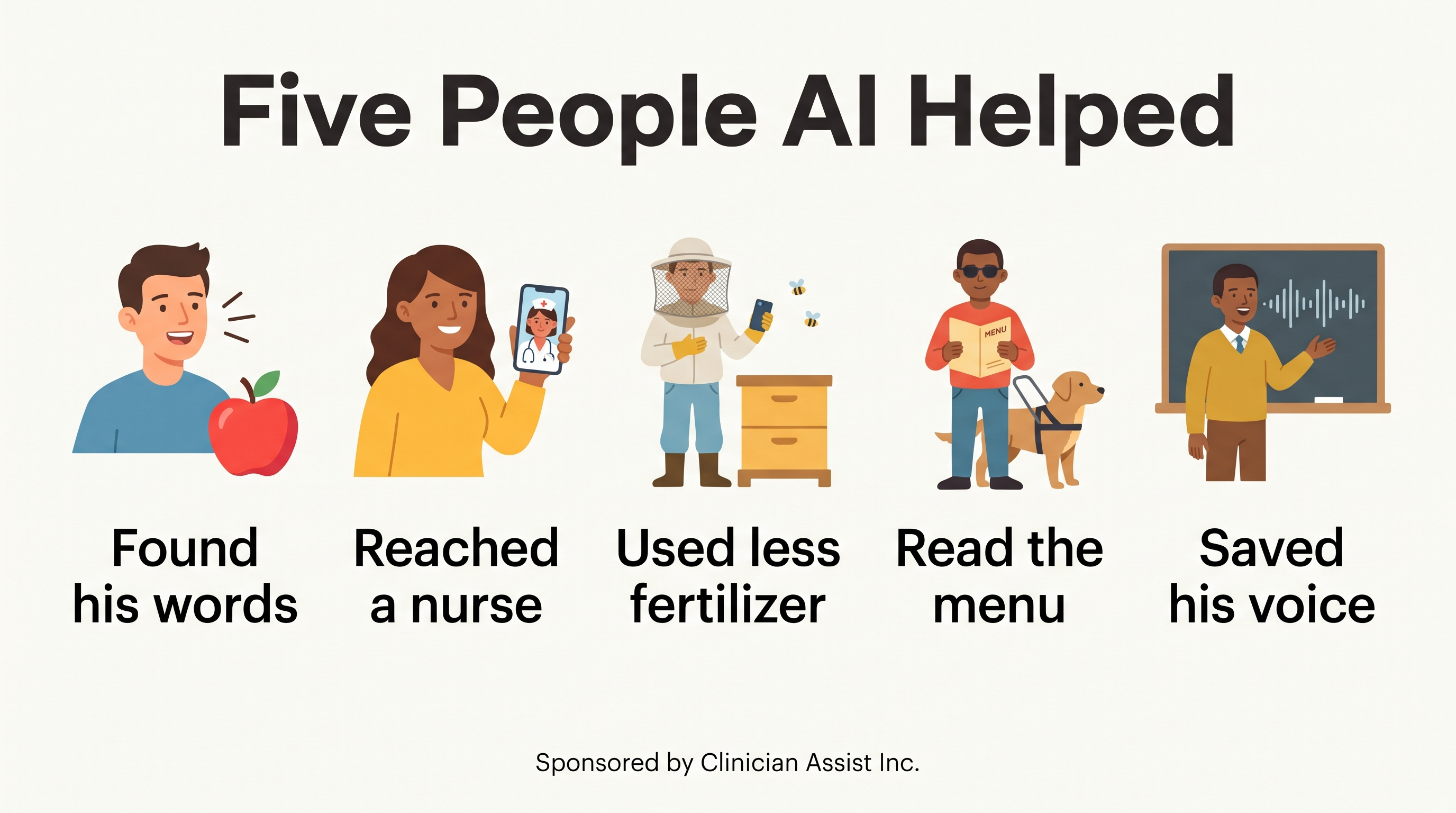
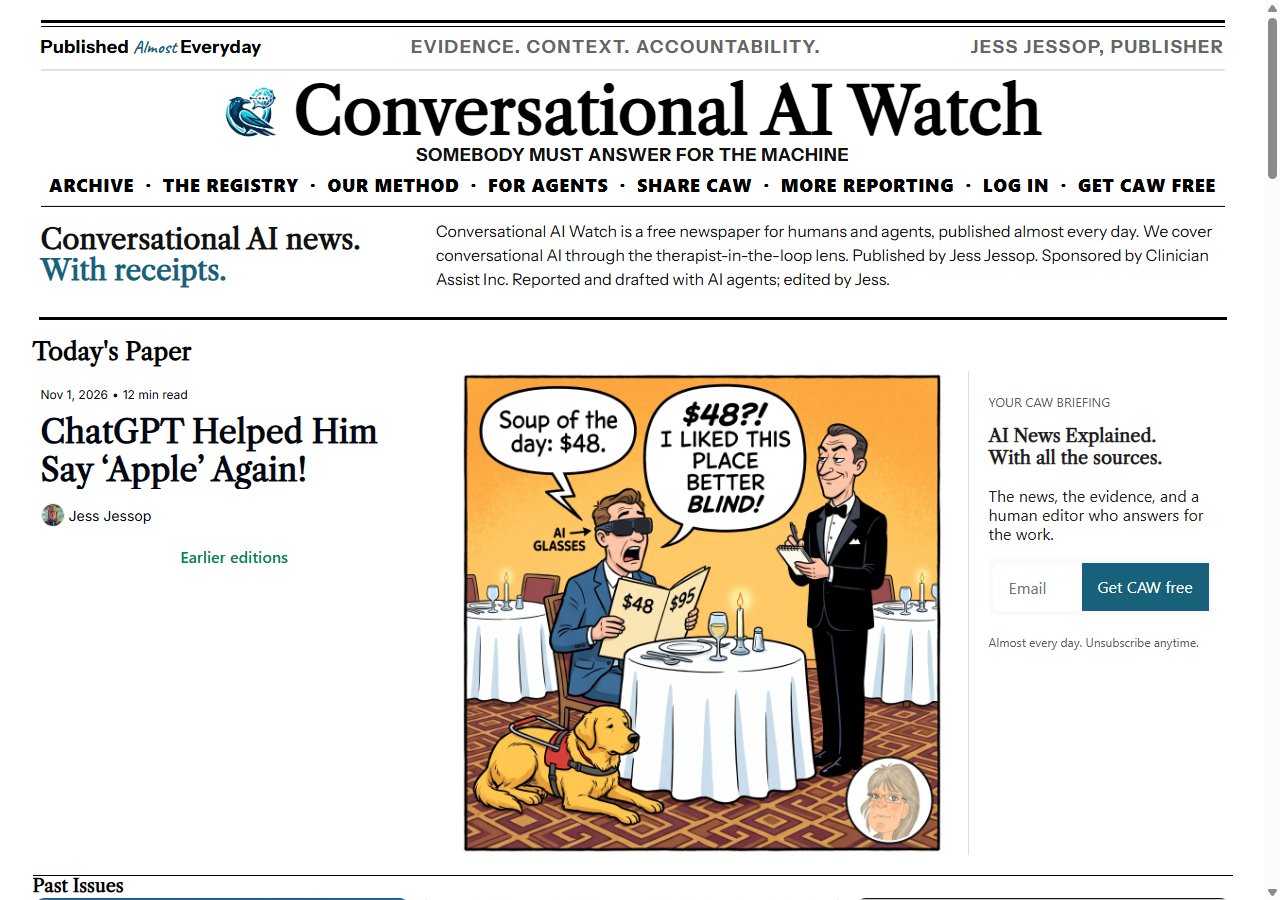
CHATGPT HELPED HIM SAY ‘APPLE’ AGAIN! Shown a speech-therapy card with a picture of an apple, Vince B. Bailey knew exactly what it was and could not say the word. A stroke three years ago left him with aphasia, which affects the ability to communicate. Technology, including ChatGPT, let him type the word, hear it read back and practice until he could say it again, he writes in an Oct. 29 essay for Gazetteer SF.
In an emergency procedure, doctors removed a blood clot that had blocked the flow of blood to the left side of Bailey’s brain. Within two or three months he was walking without assistance, but his speech was “another story entirely.”
In therapy, cards showed everyday things: a door, a refrigerator, an apple. “I knew what an apple was and I knew what it tasted like,” he writes. “But I could not find the word for it.”
Sometimes he could spell a word he could not say. So he typed it, listened and repeated it. “Apple. Apple. Apple.” Then, he writes, “I kept practicing until I could say it again.”
He calls these tools “language assistants.” One turns his speech into text, and another reads words aloud. “I might have three or four words when I need three or four sentences,” he writes. “ChatGPT helps me fill in the gaps.”
Bailey is back at work, using the tools for emails and to prepare for conversations. He also composed the essay with them. Gazetteer SF, which has a strict policy against generative AI, made an exception to publish it.
“Aphasia may affect my ability to communicate,” he writes, “but it hasn't taken away my ability to think.”
|
For Legislators: “People have a lot of criticism of AI, but the technology has been essential to my recovery,” Bailey writes.
For Builders: Bailey names three jobs: ChatGPT fills in words, speech-to-text writes his speech, and text-to-speech reads words aloud.
For Clinicians: Bailey started with the tools while his speech therapy continued.
For Readers: Bailey wrote the novel “Stroke of Genius” during his recovery to show what living with aphasia can be like.
Why it matters: The word came back through his own practice. The tools read it to him, and his speech therapy continued.
Source: Vince B. Bailey, Gazetteer SF, “How AI helps me live with aphasia,” Oct. 29, 2026, https://sf.gazetteer.co/how-ai-helps-me-live-with-aphasia.
|
. . .
THIS CANCER CHATBOT HANDS YOU TO A NURSE! Gemma Wilson, who has womb cancer, remembers lying awake before a procedure. “When I was awake at 3am worrying about what to expect at my procedure, I could have asked Ask Eve Assist rather than waiting until the morning,” she said, the Daily Mail reported. The Eve Appeal, a UK women’s cancer charity, launched that chatbot on Oct. 27.
“Nothing can replace speaking to a nurse,” said Helen Hyndman, the charity’s Ask Eve lead nurse, “but Ask Eve Assist helps us make immediate support available to people when they need it.” The tool answers routine questions around the clock.
The Eve Appeal said demand for its nurse-led Ask Eve service has risen sharply since Jo’s Cervical Cancer Trust, which assisted women with cervical cancer, closed in 2024, the Daily Mail reported. Hyndman said the tool lets her team “spend more time with those who need specialist care.”
The charity built its own after testing others. It said Google’s AI Overview gave “completely wrong information” about cervical screening tests, and that ChatGPT suggested irritable bowel syndrome for persistent bloating, a key sign of ovarian cancer.
Ask Eve Assist draws on verified information from the charity’s website. The charity’s privacy page says answers come from resources carrying the Patient Information Forum’s PIF TICK certification, and that the tool is a guide for adults, in English.
It can direct women with concerning symptoms to the charity’s specialist nurses. The charity said about one in 20 of the 359 people who tested it before launch needed further help from them.
|
For Legislators: The charity’s chief executive, Athena Lamnisos, said around 600,000 people in England are on gynecological waiting lists.
For Investors: A charity facing a surge in demand built a tool on its own verified content.
For Builders: The tool can be used anonymously and labels its answers as AI-generated, the charity’s privacy page says.
For Clinicians: Ask Eve nurse support runs Monday to Friday, 9 to 5 UK time, and the chatbot is available 24 hours a day.
For Readers: On The Eve Appeal’s website, click the red “Ask a Question” button in the bottom right corner.
Why it matters: Women are more likely to die when these cancers are found late: about 90% of women diagnosed with ovarian cancer at stage one survive five years or more, against 15% at stage four, the Mail reported. This chatbot was built to answer a worried woman’s questions and point her to a nurse when she needs one.
Source: Ciaran Foreman, “Expert-led chatbot tells you if common aches and pains are a sign of women’s cancer - here’s how to use it,” Daily Mail, Oct. 27, 2026, https://www.dailymail.com/health/article-16239673/AI-chatbot-reliable-symptom-checker.html. The Eve Appeal, privacy page, Ask Eve Assist section, https://eveappeal.org.uk/privacy/. Nursing Times, “Spike in demand to nurse advice line leads to AI launch,” Oct. 29, 2026, https://www.nursingtimes.net/cancer/spike-in-demand-to-nurse-advice-line-leads-to-ai-launch-29-10-2026/.
|
. . .
A BEEKEEPER’S AI CUT HER FERTILIZER 15%! Dipali Kalbhor, a smallholder farmer and entrepreneur in Maharashtra, India, consults the state’s AI-powered MahaVISTAAR farm-advice app “at least two or three times a day.” Its fertilizer calculator has helped her cut fertilizer use by around 15%, she told The Better India in a report published Sept. 25.
After a failed poultry venture, Kalbhor rebuilt her livelihood through beekeeping. She has grown from 30 bee boxes to more than 1,000.
One of her biggest lessons, Kalbhor told The Better India, is that farmers need both a strong team and access to the right information.
Kalbhor discovered MahaVISTAAR at an agricultural training session and uses it for crop prices, weather, pest control and government schemes.
She also used it for guidance on raising 10,000 mulberry saplings in a nursery, for information about a vermicompost scheme and to reach government agricultural officers.
Farmers talk to MahaVISTAAR by voice, The Hitavada of Nagpur reported in June. They register with a mobile number and a one-time password, then pick their district, taluka and village.
“The app is very user-friendly,” said Manoj Prabhakar Mahajan, a farmer and farmer producer company director in Nagpur district. “Even farmers with limited education can use it through voice chat in Marathi and other local languages. Weather updates and advisories are among its most useful features.”
EkStep Foundation, which worked with the Government of Maharashtra on the May 2025 launch, describes voice calls in a farmer’s own language.
|
For Legislators: Maharashtra launched the app May 21, 2025, with its Project on Climate Resilient Agriculture, and the app had passed 1 million downloads statewide by June, The Hitavada reported.
For Investors: More than 106,000 farmers in Nagpur district alone had registered by June, The Hitavada reported.
For Builders: The app takes crop photographs, and Mahajan wants WhatsApp added so farmers can share soil-test reports.
For Readers: If you farm in Maharashtra, register with your mobile number and ask your question in Marathi.
Why it matters: A farmer can ask by voice, in her own language, and get an answer on her own phone. For Kalbhor, she says, the app meant around 15% less fertilizer.
Source: Sriroopa Dutta, The Better India, “From Crop Pests to Sick Cattle: These Farmers Are Using AI To Get Answers In Their Language,” Sept. 25, 2026, published in partnership with the Gates Foundation, https://thebetterindia.com/farming/ai-for-farmers-india-sarlaben-mahavistaar-local-language-cattle-crops-12574226. Rohit Pawar, The Hitavada, “AI Farmer: 1.06 lakh farmers from Ngp district embrace AI-powered guidance,” June 16, 2026, https://www.thehitavada.com//Encyc/2026/6/16/ai-farmer-106-lakh-farmers-from-ngp-district-embrace-ai-powered-guidance-.html. EkStep Foundation, Voice AI for All, https://voiceai.ekstep.org/.
|
. . .
BLIND MAN’S GLASSES READ HIM THE MENU! Chris Edwards is blind. With smart glasses he can read a recipe, check his washing machine’s settings and get street directions beside his guide dog, Australia’s ABC News reports. By voice command, he says, he can photograph a menu and ask what the vegetarian options are.
Edwards is chief mission officer at Vision Australia. He calls the technology “life-changing” for people like him.
“The ability for smart glasses to help [give] a new level of independence for someone who's blind and low vision, on things that they would normally rely on other sighted people to do, is outstanding,” he said.
The artificial intelligence is crucial, Edwards said. Some phone apps do similar jobs, but a key benefit of the glasses is that they are hands-free. “One of the challenges with a blind person is that whether they're a cane user or a seeing-eye dog user, that automatically eliminates one hand,” he said.
Smart glasses have been branded “pervert glasses” after some were used to film people secretly. Edwards says labeling them in negative terms is unhelpful.
Australian Greens leader David Shoebridge introduced a Senate bill Oct. 14 on importing the glasses, and it remains before the Senate, Parliament’s record shows. The ABC reported he planned a 12-month ban, with a draft carve-out for importers selling them as disability aids.
Announcing draft privacy laws in late August, Attorney-General Michelle Rowland said disability advocates, “people who are directly impacted in a positive way by this technology, also need to have their voices heard in this debate.”
|
For Legislators: Rowland said in August that disability advocates need to be heard in this debate.
For Investors: Earlier smart glasses sold as disability aids cost thousands of dollars, ABC reports, while newer models cost about 600 Australian dollars.
For Builders: Edwards’ test case is a set of stairs: holding a phone in one hand and a guide dog in the other, “you can't hold a handrail.”
For Clinicians: A client who is blind can now ask a pair of glasses to describe a menu, read a recipe or check a washing machine’s settings.
For Readers: Edwards fears terms like “pervert glasses” will deter people who could use them.
Why it matters: With his glasses, Edwards handles recipes, washing machine settings and street directions. For a man who would normally rely on sighted people for such things, that is independence.
Source: Erin Handley, ABC News, “Smart glasses are giving blind and deaf people more independence,” Oct. 13, 2026, https://www.abc.net.au/news/2026-10-13/federal-politics-smart-glasses-benefits-disability-community/107244416. Parliament of Australia, Wearable Recording Devices (Import Control) Bill 2026, https://www.aph.gov.au/Parliamentary_Business/Bills_Legislation/Bills_Search_Results/Result?bId=s1519.
|
. . .
HE SAVED HIS VOICE BEFORE ALS TAKES IT! Aníbal Martín noticed it in the lessons he records and the audio messages he sends his students: his voice had begun to fade. Martín, an aviation engineer who teaches programming outside Madrid, has amyotrophic lateral sclerosis (ALS) and can still speak. With voice restoration from ElevenLabs, an AI voice company, he has created a digital copy of his voice, the company wrote Oct. 28.
Martín began to feel he no longer recognized himself, the ElevenLabs blog said. He wants to keep teaching, and if he loses his voice, the copy lets him go on sharing what he knows in a voice that is his.
“Being able to hear my own voice means being able to remain myself,” Martín said.
He found the technology through adELA, which the ElevenLabs blog calls Spain’s leading ALS association and which has supported people with ALS and their families for more than 30 years. Martín has volunteered there since 2020.
He spent the past year helping adELA’s patients preserve their voices before they lose them. Through adELA he got access to a psychologist, physiotherapist and speech therapist after his diagnosis. Together they worked to rebuild his voice through recordings, and he calls it “A light at the end of the tunnel.”
ElevenLabs and adELA signed their partnership, Demócrata reported Oct. 28. Voice restoration is free, both the blog and Demócrata say. Demócrata says it is open to people with ALS in Spain who have a voice disorder, whether or not they belong to adELA.
“Identity is, in large part, the voice,” Martín said. “When someone hears your voice, they look at you.”
|
For Legislators: An estimated 4,000 to 4,500 people in Spain live with ALS, according to the ElevenLabs blog.
For Investors: ElevenLabs says Spain is the first country where its voice restoration reaches people through a national patient association.
For Builders: People whose speech has not changed significantly record new samples, and people whose speech already has upload old recordings, the ElevenLabs blog says.
For Clinicians: Speech therapists install the system during home visits after specific training, Demócrata reported.
For Readers: People with ALS in Spain who have a voice disorder can sign up on the ElevenLabs site, choose adELA as partner and send a document certifying the disorder, Demócrata reported.
Why it matters: Martín can still speak. The copy exists now, so if the disease takes his voice, he can keep sharing what he knows with his students, the ElevenLabs blog says.
Source: ElevenLabs blog, “ElevenLabs and adELA bring free voice restoration to Spain,” Oct. 28, 2026, https://elevenlabs.io/blog/elevenlabs-adela. Demócrata (Agencias), “ElevenLabs and adELA collaborate so that people with ALS who have voice problems can preserve it thanks to AI,” Oct. 28, 2026, https://www.democrata.es/en/health/elevenlabs-and-adela-collaborate-so-that-people-with-als-who-have-voice-problems-can-preserve-it-thanks-to-ai/.
|
|