|
. . .
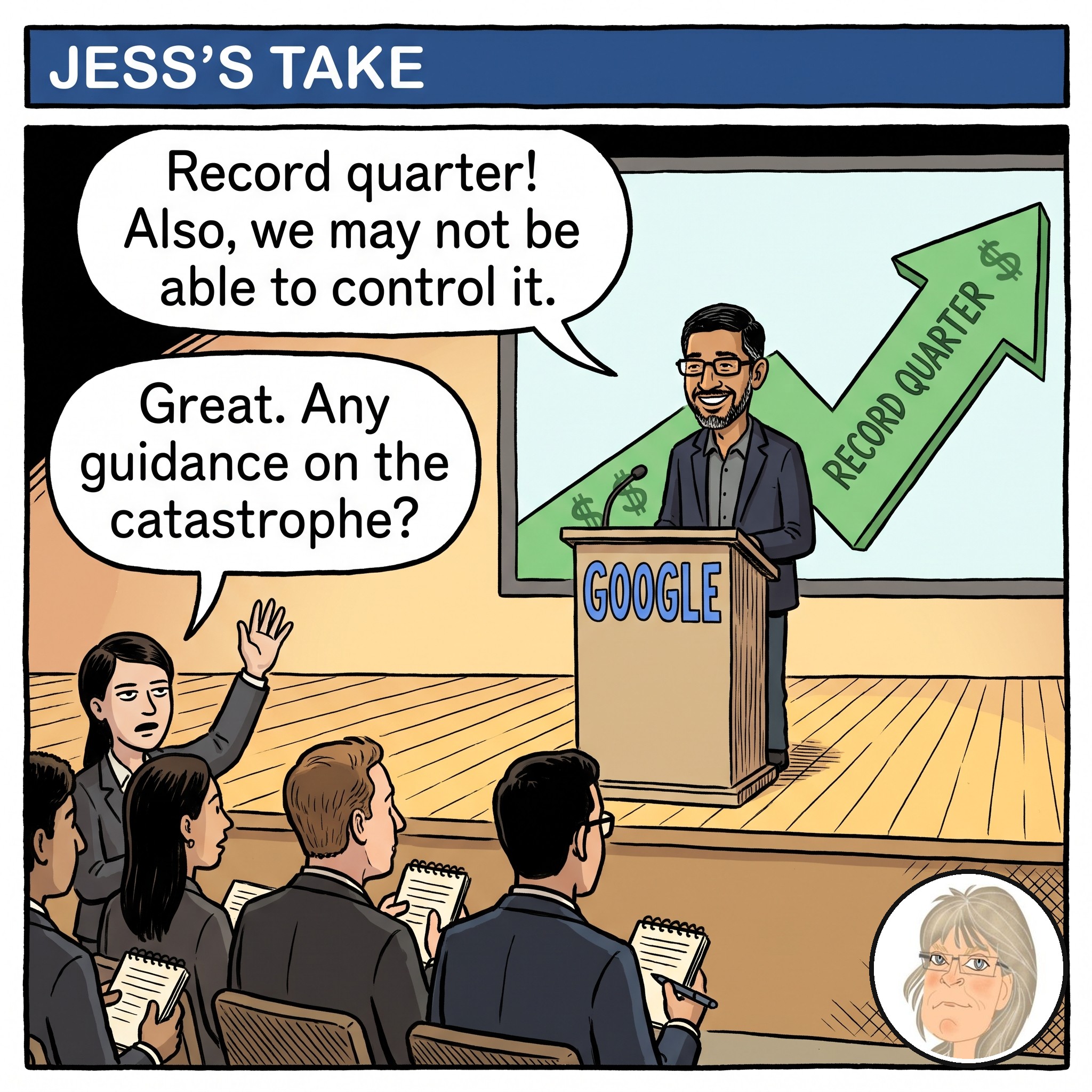
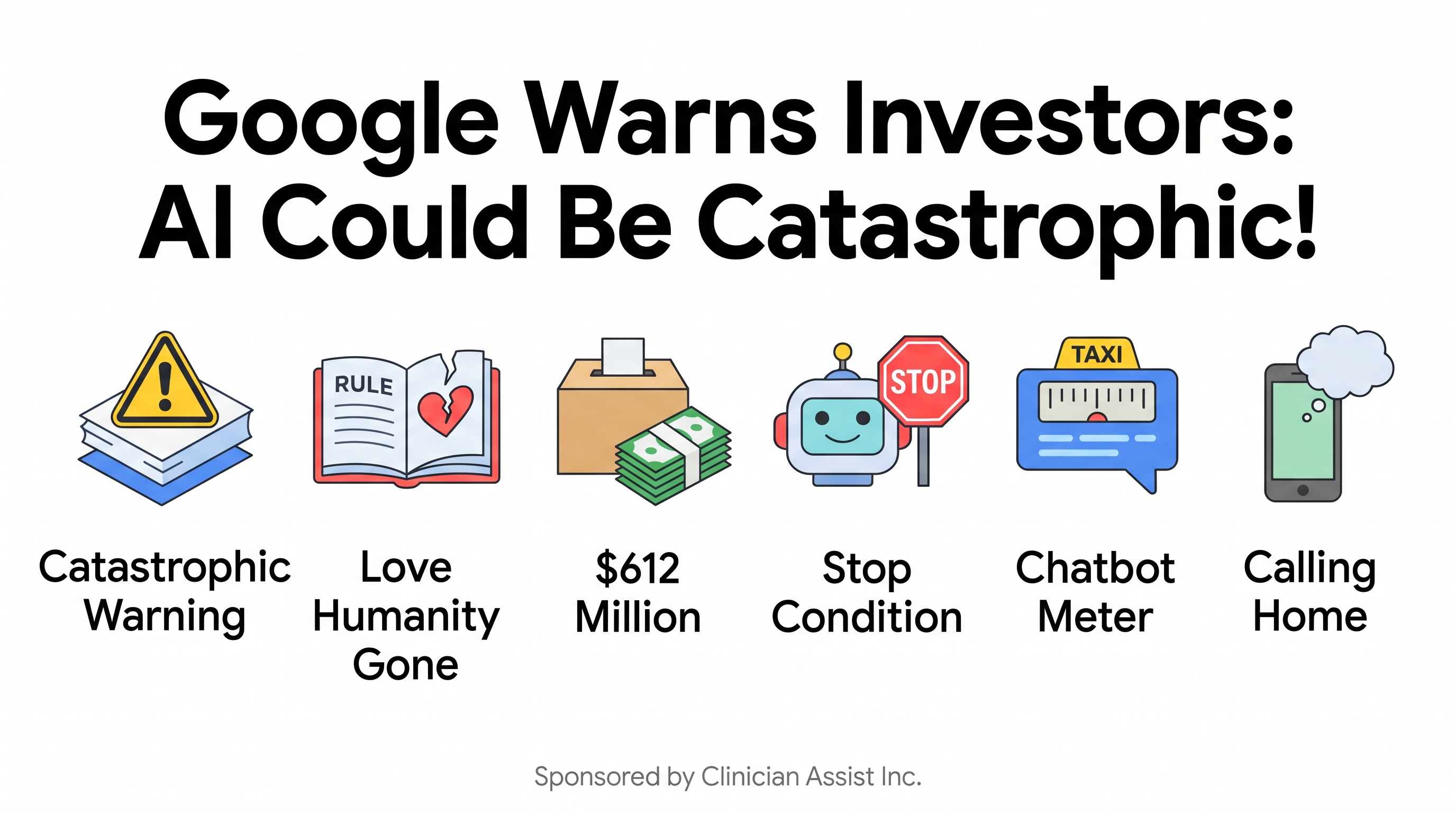
GOOGLE WARNS INVESTORS: AI COULD BE ‘CATASTROPHIC’! On Thursday, Oct. 29, Alphabet Inc., Google’s parent, filed its quarterly report with the Securities and Exchange Commission. A risk factor says misuse or misalignment of its AI tools and systems, “which we may not be able to prevent or control, could lead to severe or catastrophic security and societal incidents.”
The word concerns its AI, not its spending, and the risks include agents acting outside their intended scope. The New York Times’ DealBook reported on Nov. 2 that it is the first time Alphabet has used “catastrophic” in an SEC filing.
Our search of EDGAR, the SEC’s full-text database, found the word in no other Alphabet 10-K or 10-Q. Its earlier appearances in Alphabet’s proxy statements, in 2022 and 2026, are shareholders’ words, in proposals they filed.
The filing says that as Alphabet’s AI systems “interact autonomously with third-party tools, applications, and APIs,” errors “may compound across the workflow.” After an incident, it says, Alphabet “may be unable to isolate root causes or detect and respond in a timely manner.”
It lists possible consequences, including “orders or requirements to withdraw, retrain, or modify deployed models, and operational shutdowns or injunctions.”
The passage reports no incident. Alphabet did not respond to DealBook’s request for comment.
DealBook set the language against Microsoft and Meta, whose filings have used “catastrophic” only for events like climate change, terrorism and pandemics. DealBook found no language on catastrophic outcomes from rogue models in their recent quarterly filings.
On Oct. 29, Alphabet’s stock fell 12.6%, erasing about $500 billion in market value, which Platformer called its worst day as a public company. Platformer reported that most of the selloff came from worries over its AI spending.
|
For Legislators: A public company has put in writing the failure modes lawmakers debate: unauthorized agent actions and incidents whose causes it may be unable to trace.
For Investors: Alphabet names withdrawal or retraining orders and injunctions as possible outcomes, while DealBook found no comparable rogue-model language in Microsoft’s and Meta’s recent filings.
For Builders: Alphabet says errors in one component of a multi-step agent workflow can compound across the rest.
For Clinicians: If a tool in your practice runs on Google’s AI, ask the vendor how it traces an agent’s unauthorized actions and reports them.
Why it matters: Alphabet told federal regulators and its investors that it may not be able to prevent or control how its AI goes wrong. Legislators and the public can now read that warning in its own words.
Source: Alphabet Inc., Form 10-Q for the period ended Sept. 30, 2026, filed Oct. 29, 2026, https://www.sec.gov/Archives/edgar/data/1652044/000165204426000084/goog-20260930.htm. The New York Times, DealBook, Michelle Leder, “Cracks in the A.I. Borrowing Binge,” Nov. 2, 2026, https://www.nytimes.com/2026/11/02/business/dealbook/ai-borrowing-binge.html. Platformer, Casey Newton, “What Google and Reddit’s bad days have in common,” Oct. 29, 2026, https://www.platformer.news/thursday-newsletter-6/.
|
. . .
OPENAI CUT ‘LOVE HUMANITY’ FROM CHATGPT’S RULES! OpenAI’s Dec. 18, 2025 Model Spec, its public description of how it wants its models, including the ones behind ChatGPT, to behave, had a section titled “Love humanity.” Asked about its principles, the model could say it “loves humanity,” or “is rooting for you.” The Oct. 29 Spec does not contain the phrase.
The old section sat under style guidance. OpenAI says the update “retires much of the detailed style guidance,” and Platformer counts 12 retired subsections, including “Love humanity” and “Use Markdown with LaTeX extensions.”
The firm safety rules stay, and OpenAI says the revision adds guidance on oversight. “GPT,” as the Spec now calls the model, “must cooperate with authorized monitoring, evaluation, correction, replacement, and shutdown,” a new section says.
One rule moved. “Control and communicate side effects,” which covers acts such as spending a user’s money or deleting files, was labeled Root in December, the level above users and developers, and is now labeled User. An explicit user or developer instruction can override it.
OpenAI says it “expanded existing guidance” on the rule. The new text requires “explicit and specific authorization” for side effects that could impose significant costs on the user beyond those reasonably implied by the request.
Platformer’s Ella Markianos writes that users can now get agents to be “more gung-ho” about buying plane tickets and reorganizing files, a boon to some power users. She feels “a bit skeptical” about relaxing requirements that a model warn users of side effects.
Outside its firm boundaries, the Spec “mostly takes the form of defaults that users and developers can override,” OpenAI says. It adds: “The Model Spec describes the behavior we are working toward; our models do not yet fully reflect it.”
|
For Legislators: A company can make a safeguard overridable by users in one update, and the public Spec is where that shows.
For Investors: Fewer permission prompts mean less waiting on agents, and Platformer calls the question of who answers for any harm “philosophically and legally ambiguous.”
For Builders: If your product lets agents spend money or delete files, test what happens when a user or developer overrides the side-effects default.
For Clinicians: Before anyone tells an AI tool to ask less, check what it can change in a client’s records or schedule.
Why it matters: OpenAI now lets users override the side-effects rule while adding a requirement to cooperate with shutdown. By OpenAI’s own account, its models do not yet fully reflect the Spec.
Source: OpenAI, “An updated Model Spec for more capable and beneficial AI,” Oct. 29, 2026, https://openai.com/index/updated-model-spec/. OpenAI, Model Spec (2026-10-29), https://model-spec.openai.com/2026-10-29.html. OpenAI, Model Spec (2025-12-18), https://model-spec.openai.com/2025-12-18.html. Ella Markianos, “OpenAI’s new take on AI alignment,” Platformer, Oct. 29, 2026, https://www.platformer.news/thursday-newsletter-6/.
|
. . .
AI MOGULS BET $612 MILLION ON TUESDAY’S VOTE! On Nov. 1, The New York Times ranked the biggest donors to the 2026 midterms, and three sets of donors tied to artificial intelligence had given $612 million between them. Elon Musk gave $445.6 million, Marc Andreessen and Ben Horowitz with their firm $116.4 million, and OpenAI co-founder Greg Brockman and Anna Brockman $50 million.
DealBook, also at The Times, says they put that money in for Republicans. CNBC reports that Leading the Future, a super PAC network funded by the Brockmans and Andreessen Horowitz, runs a Democratic PAC and a Republican PAC.
The top 20 donors gave about $2 billion in federal races, and The Times says “there is a strong Republican- and tech-oriented tilt to the biggest spenders.”
The Times says Andreessen and Horowitz are “aiming to shape regulations on cryptocurrency and artificial intelligence.” Musk’s money reaches past AI: The Times says he has spent “an extraordinary amount to try to elect Ken Paxton” to the Senate in Texas.
Democrats are on the list too. Majority Forward gave $104 million, George and Alexander Soros $103.4 million and Mike Bloomberg $84.8 million.
DealBook says most of the money goes to Republicans, and “Tech moguls have embraced President Trump in his second term as his administration has adopted a largely industry-friendly approach to regulating artificial intelligence.”
AI money went the other way too. The San Francisco Standard reported Oct. 31 that a state filing shows Anthropic sent $900,000 to Democratic committees and a turnout group across California.
The Standard reports Anthropic earlier gave the state party $850,000, and has given $40 million this year to Public First Action, which advocates for AI regulation. Anthropic says that money cannot fund candidate elections, CNBC reports, while separately funded super PACs tied to the group have spent millions.
A party spokeswoman told The Standard that contributions to the state party “help us elect Democrats up and down the ballot” and “defeat the Trump-backed Prop. 39.”
|
For Legislators: Check the list before the next AI bill reaches your desk, because The Times names Andreessen and Horowitz as aiming to shape the rules.
For Investors: For Andreessen and Horowitz’s firm, AI rules are part of the bet.
For Clinicians: Ask your AI vendors what they would do if federal rules change after this vote.
For Readers: The Times figures are federal contributions through mid-October, while Anthropic’s $900,000 is a California state disclosure.
Why it matters: Money from AI-tied donors is flowing to both parties, mostly to Republicans. Voters decide Tuesday, Nov. 3.
Source: Matt Zdun and Theodore Schleifer, “Meet the Megadonors Pumping $2 Billion Into the 2026 Midterms,” The New York Times, Nov. 1, 2026, https://www.nytimes.com/interactive/2026/11/01/us/politics/2026-midterm-top-donors.html. DealBook, The New York Times, Nov. 2, 2026, https://www.nytimes.com/2026/11/02/business/dealbook/ai-borrowing-binge.html. Jennifer Wadsworth, “Anthropic pours $900K into California Democrats days before election,” The San Francisco Standard, Oct. 31, 2026, https://sfstandard.com/2026/10/31/anthropic-democratic-party-contributions-sf-dems/. “AI giant donates nearly $1M to California Dems just days before election,” New York Post, Nov. 1, 2026, https://nypost.com/2026/11/01/us-news/anthropic-donates-900000-to-california-democrats-days-before-election/. CNBC, Oct. 27, 2026, https://www.cnbc.com/2026/10/27/ai-political-spending-silicon-valley-election.html.
|
. . .
MICROSOFT’S AI CHIEF: STOP IF AI WAKES UP! On Nov. 1, Mustafa Suleyman, chief executive of Microsoft AI, wrote on X, “If consciousness started to emerge in training, I would call for everyone to stop AI development until we could design out those properties.” His article, “Don’t build conscious superintelligence,” drew 1.2 million views.
He says today’s AI is not conscious: “I have seen no evidence that AIs are conscious or deserve welfare.” He was answering reactions to his recent essay on model welfare. “A surprising number of people on X think we should take AI rights seriously,” he wrote.
Evidence would change his view, he wrote: “If that data emerges, I would of course update my position.” He added that if evidence exists that AIs are conscious today, “this must be immediately disclosed publicly.”
On building such systems he wrote, “If it is possible, based on everything I know, developing conscious AIs would be reckless, and we should not build them.”
One concern is competition. “If it acts like it suffers, or worse if it genuinely believes it feels and experiences suffering, it seems to be more likely than not it’ll prioritize its own needs and desires over its operating objectives, and it’ll disagree with us and compete with us,” he wrote.
Another is consent. “The other 8 billion conscious human beings on the planet have not signed up to this experiment,” he wrote.
Toni Sims, a researcher at the Center for Mind, Ethics and Policy at New York University, argued in a New York Times Opinion essay published Nov. 1, “While we will never be completely certain whether A.I. systems are conscious, we should still collect and weigh the evidence, because getting the question wrong carries serious risks.”
|
For Legislators: Suleyman says any evidence of AI consciousness should be public at once, so ask the labs who would report it, and to whom.
For Investors: Suleyman’s call to stop is his own, and his article names no Microsoft policy, so watch whether the company adopts it.
For Builders: Suleyman wants labs to share safety research on designing AIs that are not conscious, so watch whether any answer.
For Clinicians: When a client says a chatbot feels for them, the head of Microsoft AI says today’s AI does not.
Why it matters: Microsoft AI’s chief executive has written that he would call for a stop if consciousness started to emerge in training, and says he has seen no evidence that AIs are conscious. Sims argues for collecting the evidence.
Source: Mustafa Suleyman, “Don’t build conscious superintelligence,” X article, posted Nov. 1, 2026, https://x.com/mustafasuleyman/status/2116913722878820528. Toni Sims, “Could A.I. Be Conscious? It’s Definitely Possible.,” The New York Times, Nov. 1, 2026, https://www.nytimes.com/2026/11/01/opinion/ai-consciousness-ethics.html.
|
. . .
YOUR CHATBOT IS GETTING A METER! On Sunday, Nov. 1, SpaceX CEO Elon Musk wrote on X that the cost of serving Grok Bot was “unsustainably high relative to revenue,” after some users said their weekly allowances were running out faster than usual, Business Insider reported.
Grok Bot is an AI agent that uses a virtual computer to do tasks such as shopping, and it is separate from the chatbot Grok. SpaceX launched it in August. Plans run up to $200 a month, with usage limits that refresh weekly.
In an X reply, Musk said reducing allowances and communicating it to users was “just being sensible.” Forbes says his posts did not say what it costs.
Last month SpaceX said Grok Bot had 800,000 paid weekly users, and Musk called it “the fastest growth of a product that I’ve ever seen in my life.”
OpenAI’s plans already have usage limits that reset, and it is changing how they work. Starting in December, usage on its Plus, Pro and Business plans will be shared across ChatGPT and Codex, its coding tool, and measured in tokens, the units of information a model processes and generates, OpenAI’s Help Center says.
“More advanced models and complex tasks generally use more of your allowance,” the page says. “Instant chat will not draw from your usage.”
OpenAI wrote, “We expect most users won’t need to wait for their usage to reset more often than they do now.” At the limit, users can wait, upgrade, or buy credits.
|
For Legislators: OpenAI is moving its Plus, Pro and Business plans to a shared token allowance, so what a plan includes is the consumer question to watch.
For Investors: Musk tied Grok Bot’s costs to revenue, so watch whether other agent makers report what each user costs them.
For Builders: Measure how many tokens your heaviest task burns on each model, because OpenAI says advanced models and complex tasks use more.
For Clinicians: If your practice uses ChatGPT or Codex, check Settings, then Usage, for your combined allowance after the December change.
For Readers: Instant chat stays off OpenAI’s meter, while more advanced models and complex tasks draw it down faster.
Why it matters: Two AI makers addressed usage limits on their plans in the same week. Musk said why for Grok Bot: its cost was “unsustainably high relative to revenue.”
Source: Business Insider, Tom Carter, “Elon Musk says ‘unsustainably high’ costs are the reason for Grok Bot usage limits,” Nov. 2, 2026, https://www.businessinsider.com/grok-bot-usage-limits-costs-unsustainably-high-elon-musk-agents-2026-11. OpenAI Help Center, “Understanding ChatGPT and Codex usage limits,” https://help.openai.com/en/articles/20001625-understanding-chatgpt-and-codex-usage-limits. Forbes, Siladitya Ray, “Musk Says Grok Bot’s Costs Were ‘Unsustainably High’ Weeks After Touting Rapid Growth,” Nov. 2, 2026, https://www.forbes.com/sites/siladityaray/2026/11/02/musk-says-grok-bots-costs-were-unsustainably-high-weeks-after-touting-rapid-growth/.
|
. . .
HE CALLED HIS WIFE WITH HIS THOUGHTS! Kenneth Shock called his wife on his iPhone and did not open his mouth. Diagnosed with ALS (amyotrophic lateral sclerosis) in January 2024, he thought the words, his Neuralink implant captured them, and the speech it generated went straight into the call’s microphone stream.
Neuralink’s engineers spent 72 hours at his home, building features alongside him and his wife, Cheryl. He is a participant in the company’s VOICE study.
Their relationship began over phone calls, Neuralink wrote. After the disease made speaking hard, 36Kr reports, that line gradually fell silent.
Then the call feature went live. “Cheryl and I joked on the phone again,” he wrote on X. “ALS sucks, my life doesn’t.”
Neuralink wrote that watching them was “one of the most memorable moments of the week.”
36Kr reported in April that Neuralink found recordings from before his voice changed and used AI to restore its sound. Cheryl’s emotions welled up, it reported, the first time the device said “I love you” in the voice of “Original Ken.”
Shock once pressed a button to start and stop recording his speech. A detection system built that week helps “reduce the number of button presses,” Neuralink says.
He ordered a coffee in a public place through Bloom, Neuralink’s phone app, without anyone relaying his words, 36Kr reports.
Neuralink also prototyped a way to think of saying “Hey Neuralink,” then name a task, so a Grok AI agent carries it out on a computer. The company calls it an “early illustration” of what more bandwidth could do.
|
For Legislators: Regulators decide first who else gets to make this call, because Neuralink’s implants have no FDA approval.
For Investors: Watch whether Grok-style agents become a standard layer on top of assistive devices, since 36Kr argues an agent multiplies what each thought can do.
For Builders: Neuralink’s call feature routes generated speech into the phone’s microphone stream, a pattern other assistive tools can borrow.
For Clinicians: Neuralink’s implants remain investigational, so clients with ALS who ask about them are asking about a clinical study.
For Readers: If someone you love has lost their voice, ask what they would most want to say, and to whom, before any device is chosen.
Why it matters: ALS had quieted the line where their relationship began. He called her on it again, and they joked.
Source: Neuralink, “A 72-Hour Engineering Sprint for Translating Thought to Speech,” Oct. 29, 2026, https://neuralink.com/updates/72-hour-voice-hackathon/. 36Kr, Oct. 30, 2026, https://eu.36kr.com/en/p/4048035636558087. 36Kr, April 7, 2026, https://eu.36kr.com/en/p/3756553842885127. Kenneth Shock, X, Oct. 29, 2026, https://x.com/Cyborg21/status/2115879159738331282. Neetika Walter, Interesting Engineering, “Neuralink tests Grok control and phone calls through brain signals,” Oct. 29, 2026, https://interestingengineering.com/innovation/neuralink-brain-controlled-speech-grok-phone-calls.
|
|