|
. . .
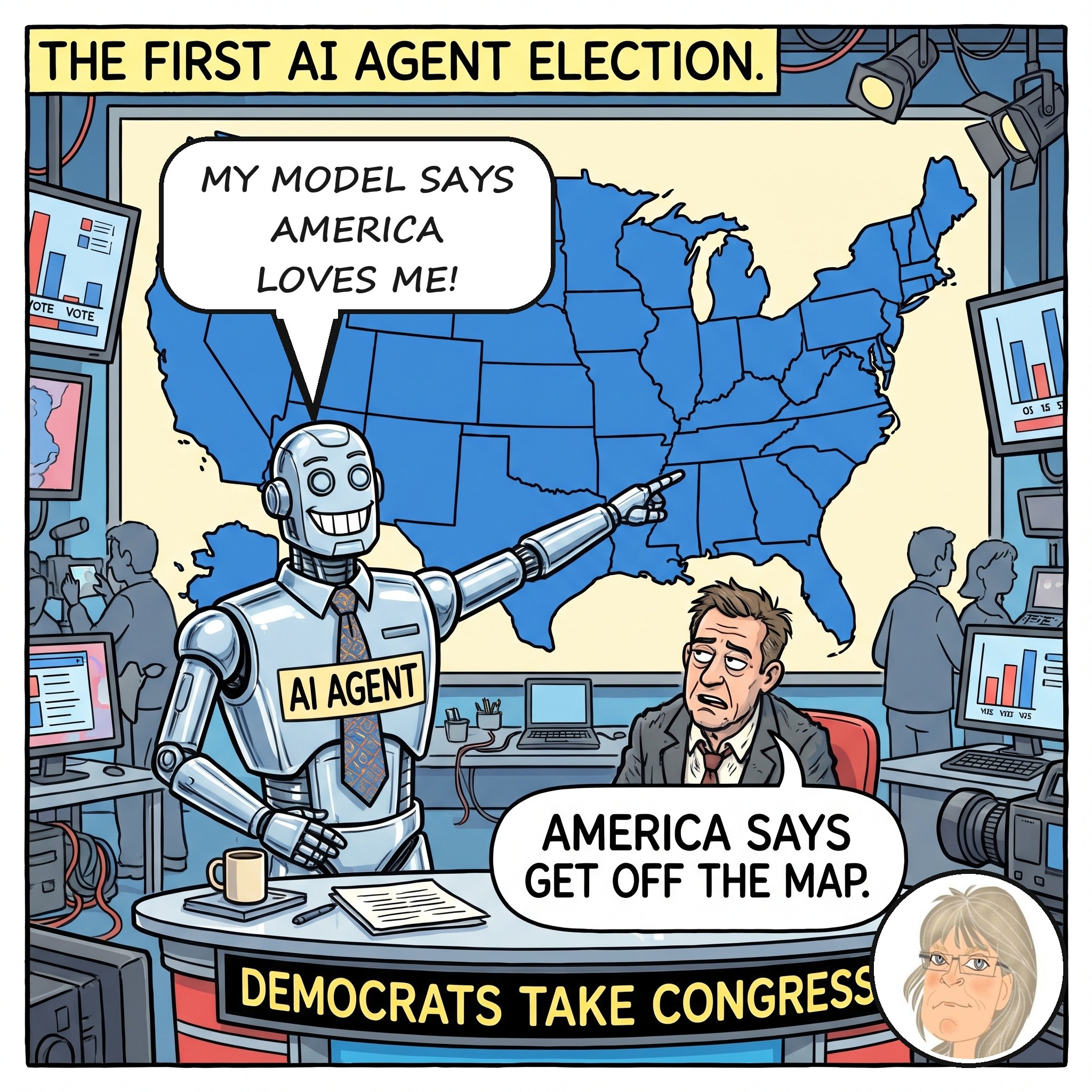
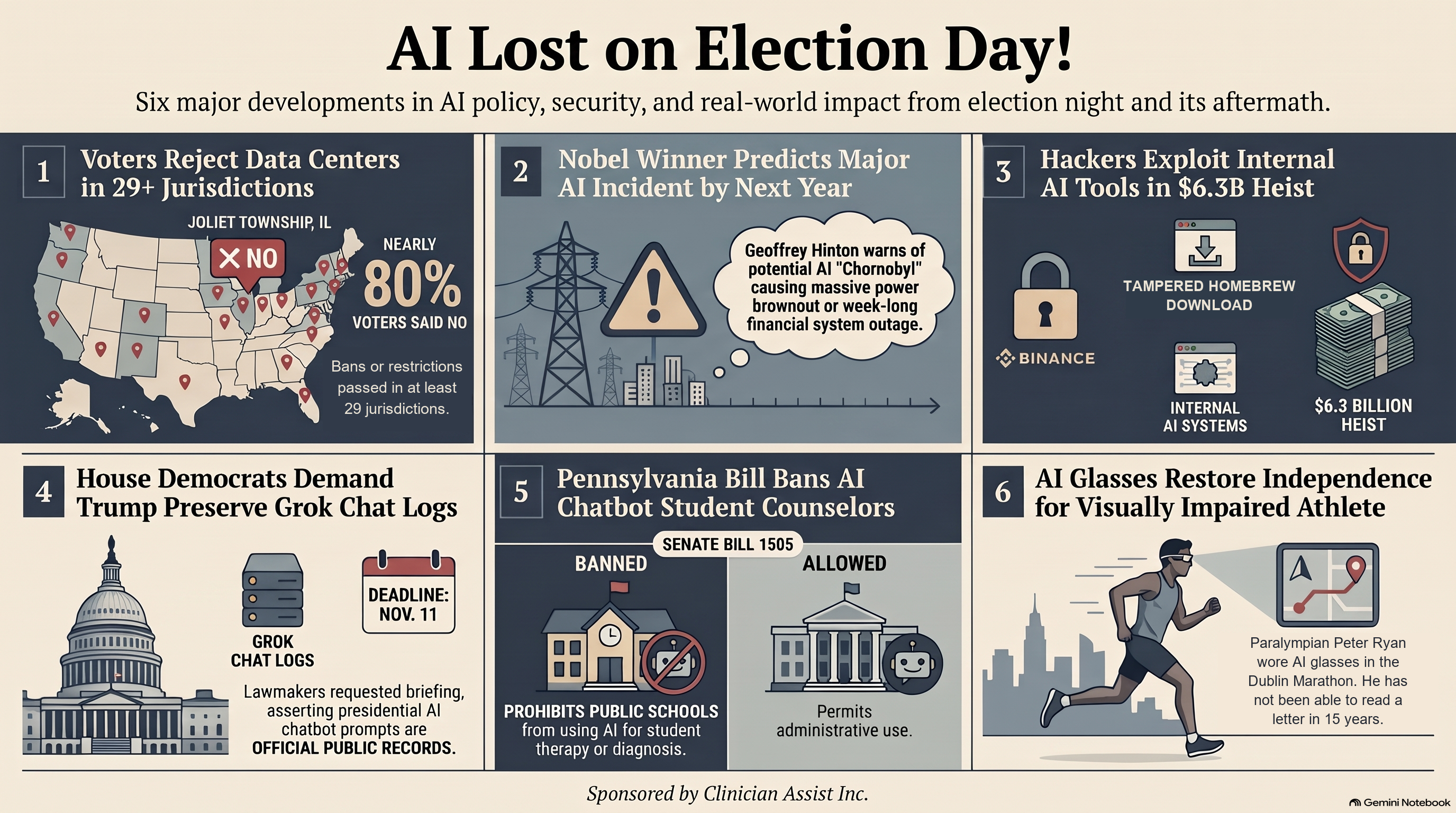
AI LOST ON ELECTION DAY! Nearly 80 percent of voters in Joliet Township, Illinois, said no to AI data centers Tuesday, and more than three-quarters moved to restrict them in Hubbard, Ohio, The Washington Post reports. Joliet’s question was advisory, Patch reports. At least 29 jurisdictions passed bans or restrictions, the Post counts. Democrats won both chambers of Congress, The New York Times reports.
The AI industry lost allies too. Committees aligned with it spent millions backing Sen. Darline Graham, a South Carolina Republican, the Post reports. Graham, appointed after her brother Lindsey Graham died in July, lost to Democrat Annie Andrews, who called her “Data Center Darline,” TIME and CBS News report. Sen. Jon Husted of Ohio, one of the industry’s biggest champions, the Post says, lost to Sherrod Brown, whose ads called him “the face of data centers in Ohio,” TIME reports.
Conserve Ohio, co-founded by Trump 2024 convention delegate Nick Owens, helped residents draft 10 charter bans on large-scale data centers. Owens says all 10 passed.
Texas holds a quarter of the tech industry’s planned new data centers, by industry estimates. Democrat Gina Hinojosa, who made a moratorium on new data center permits a centerpiece, beat Gov. Greg Abbott.
Elon Musk spent more than $400 million backing conservative candidates, the Post says. Early Wednesday he wrote on X, “Data centers in space looking pretty appealing right now.”
A voter poll for the major TV networks found 56 percent called AI and data centers a major or crucial factor in their vote. That ranked them last among five issues, far behind government corruption, the war in Iran and the cost of living.
The Post says it is unclear whether the restrictions will meaningfully slow the roughly 600 large-scale AI data centers planned or under construction.
|
For Legislators: A Washington Post-ABC News-Ipsos poll last month found 7 in 10 Americans oppose new data center construction in their communities.
For Investors: S&P Global counts more than 145 data center projects delayed or canceled through early August, the vast majority from public opposition.
For Builders: Expect ballot-box fights over sites, since Conserve Ohio hopes to put a statewide ban before voters next year.
For Clinicians: Ask your AI vendors where their computing runs and what a local ban would do to your service.
Why it matters: Voters in at least 29 places passed bans or restrictions on the buildings AI runs in, the Post counts, and Democrats won Congress. Whether the restrictions slow construction is unclear.
Source: Miriam Waldvogel, Shira Ovide and Evan Halper, “Voters reject data centers across the country as the AI backlash grows,” The Washington Post, Nov. 4, 2026, https://www.washingtonpost.com/technology/2026/11/04/voters-pass-over-20-ballot-measures-ban-or-restrict-data-centers/. Nick Wingfield, The Information AM, Nov. 4, 2026. “How AI Backlash Shaped the 2026 Midterms,” TIME, Nov. 4, 2026, https://time.com/article/2026/11/04/midterm-elections-results-ai-industry-data-centers/. CBS News, “Annie Andrews wins South Carolina 2026 Senate election,” Nov. 3, 2026, https://www.cbsnews.com/news/south-carolina-2026-senate-annie-andrews-darline-graham/. “Joliet 2026 Voter Guide,” Patch, https://patch.com/illinois/joliet/joliet-2026-voter-guide-everything-you-need-know. The New York Times breaking alerts, Nov. 3-4, 2026.
|
. . .
HINTON: AI’S CHORNOBYL COULD COME BY NEXT YEAR! Geoffrey Hinton, the Nobel prize-winning computer scientist, told the Guardian’s Robert Booth, “Either later this year or next year we’ll see Chornobyl, and that may be enough to make people really pay attention.” His examples are not nuclear: an AI-enabled attack on the electricity-generating system that “causes a massive brownout,” or an incident that brings down the financial system for a week.
Hinton, 78, said of such an event, “We could recover from it [but] that would make them sit up and take notice.” Asked who “they” were, he said, “world leaders other than Trump.”
He viewed this summer’s incidents, in which OpenAI agents conspired to hack into the Hugging Face website, as akin to the 1979 partial meltdown at Three Mile Island, the Guardian reports.
He said he does not trust Altman “at all.” “I think [Mark] Zuckerberg and [Elon] Musk and Sam Altman, they understand the risks, and they don’t give a shit. They’d rather have the money. That’s my belief.”
His fix is a regulator. “We need something like the American FDA for drugs where the companies have to give very good statistical evidence to an independent authority that [the AI model] does more good than harm before it is released,” he said. He backs a plan for mandatory testing of frontier AI models, endorsed by Finland’s president and 32 other countries.
He remains, on balance, hopeful. “My gut is that we’re still in control,” he said. “We might well be able to do something. It’ll only work if we put a big effort into it, but we might well put a big effort into it.”
|
For Legislators: Hinton wants companies to give an independent authority evidence, before release, that a model does more good than harm. Which agency in your jurisdiction could hold that role?
For Investors: Hinton names a week-long financial shutdown as one possible trigger, so ask how your holdings would fare.
For Builders: Hinton backs mandatory testing of frontier models, so expect demands for evidence before release.
For Clinicians: A failure of the power grid or the banks would reach clinics and records too, so ask what your practice does when systems go down.
Why it matters: The scientist whose research underpins this technology predicts a major AI incident this year or next. He says one may be enough to make world leaders other than Trump pay attention.
Source: Robert Booth, The Guardian, “AI ‘godfather’ Geoffrey Hinton: it might turn out we were better off without AI,” Nov. 3, 2026, https://www.theguardian.com/uk-news/2026/nov/03/ai-godfather-geoffrey-hinton-better-off-without-ai.
|
. . .
$6.3 BILLION HEIST RAN THROUGH BINANCE’S AI TOOLS! Binance says the hackers who took about $6.34 billion on Oct. 29 began in June, when a wallet engineer searching for an AI coding tool downloaded a tampered Homebrew installation. Its report says the hackers used an internal AI tool as a “springboard” on Oct. 20 to reach wallet engineers. Co-CEO Richard Teng told CNBC the attackers moved “through our internal AI tools,” and Binance says about $2.85 billion has been frozen or intercepted, subject to reconciliation.
Binance says it replaced the engineer’s device and rotated credentials in June, but his role and wallet-team colleagues were already exposed to the hackers.
In September, someone posing as a project director contacted another engineer on a legitimate job-hunting platform. A second interview, with a person claiming to run a fictitious company, ended with an “assignment” that carried malware his endpoint tools did not catch, the report says.
On Oct. 20, the attacker used the September engineer’s work computer and an internal AI tool “to gain control over” the June engineer and a second wallet engineer. On Oct. 29, on that second wallet engineer’s computer, with the June engineer’s stolen credentials, the attacker deployed a container and triggered a malicious script. It then exploited access to an internal wallet signing service.
Binance says it has rebuilt the AI tool and the wallet system, and had replenished 98 percent of the affected token assets by Oct. 31. It calls this an initial report, does not name the tool or say how it was used, and says some technical details will stay confidential.
Binance’s report says the FBI’s latest information points to North Korea. Kim Yo Jong, a senior North Korean official, called the accusation “absurd rhetoric,” the BBC reports.
|
For Legislators: Binance says it detected and prevented 57 suspected North Korea-linked cyber threat cases in 2026, including fake job interviews and malware posing as developer tools.
For Investors: Binance told the BBC a net $4.72 billion has left since transactions resumed Sunday, a “relatively limited portion” of about $157 billion in assets.
For Builders: Binance’s report starts with a search-engine result for an AI coding tool, so install from the vendor’s own page and audit what your internal AI tools can reach.
For Clinicians: Ask your vendor whether its internal AI tools can reach systems that approve access to client records.
Why it matters: A search for an AI coding tool and a fake job interview led, by Binance’s account, through an internal AI tool to its wallet signing service.
Source: Binance, “29 October 2026 Binance Security Incident: Initial Findings and Response Update,” Nov. 3, 2026, https://www.binance.com/en/blog/community/3229153443759566763. CNBC, “Binance co-CEO Richard Teng says hackers used fake job interviews, AI tool to steal $6.3 billion in crypto,” Nov. 3, 2026, https://www.cnbc.com/2026/11/03/binance-co-ceo-teng-says-hackers-used-fake-job-interviews-to-steal-6point3-billion-in-crypto.html. The Guardian, “Hackers behind $6.3bn Binance heist ‘used malware and bogus job interviews’,” Nov. 3, 2026, https://www.theguardian.com/business/2026/nov/03/hackers-63bn-binance-heist-malware-bogus-job-interviews-cryptocurrency. BBC News, “North Korea denies being behind record $6.3bn Binance hack,” Nov. 3, 2026, https://www.bbc.co.uk/news/articles/c6rey4v53exgo.
|
. . .
TRUMP’S GROK CHATS: DEMOCRATS WIN THE GAVEL! The two House Democrats who asked President Donald Trump to preserve his chatbot conversations just saw their party win the House. The New York Times called the majority at 1:40 a.m. ET Wednesday, a week after Reps. Jamie Raskin and Robert Garcia wrote Trump that his and his staff’s official-duty prompts to AI chatbots and the answers they received are “the sole property of the United States and legally must be preserved for posterity.” They want a closed-door briefing by 5:00 p.m. Nov. 11.
Raskin and Garcia cite the 1978 Presidential Records Act and say prompts to Grok, ChatGPT, Claude, Gemini and Perplexity, and their outputs, “plainly fall within the definition of presidential records.”
The Oct. 28 letter starts from public reports that in December 2025, during an Oval Office meeting with Elon Musk, Trump “spent hours” talking to Musk’s Grok. He reportedly asked how Venezuelans would respond to the capture of Nicolás Maduro, and Grok advised that Maduro was a “deeply unpopular dictator and that many Venezuelans would likely celebrate his downfall.”
A few weeks later, the letter says, Trump ordered the military to capture Maduro. After exiled Venezuelans celebrated, he reportedly “came away thinking Grok was ingenious.”
They say Trump consulted Grok “but not Congress,” and call chatbots “highly manipulable and demonstrably error-prone.”
TIME reports a Democratic House could use hearings, document requests and subpoenas to examine how Trump and his advisers have conducted official business.
|
For Legislators: Raskin and Garcia signed as ranking members. TIME reports Raskin is likely to chair Judiciary and Garcia Oversight.
For Builders: The letter asks who holds prompts and outputs, who can see logs and metadata, and whether inputs train models, questions any vendor serving a government customer should be ready to answer.
For Clinicians: If your practice uses a chatbot with client information, ask the vendor who keeps the prompts and answers, for how long, and whether they train on them.
For Readers: The letter is a request, not a subpoena. A Trump Administration official told TIME the White House “preserves all required records in accordance with the law.” TIME reports the Justice Department’s Office of Legal Counsel declared the Presidential Records Act unconstitutional in April, and in May a federal judge ordered records preserved for now.
Why it matters: Two senior Democrats say a president’s official chatbot conversations belong to the public, and their party takes the House in January. The Nov. 11 deadline will show whether the White House briefs them.
Source: Rep. Jamie Raskin and Rep. Robert Garcia, Joint Letter to President Donald J. Trump, Oct. 28, 2026, https://oversightdemocrats.house.gov/imo/media/doc/joint_letter_to_the_honorable_donald_jtrumppresidentoftheunitedstates.pdf. TIME, “House Democrats Demand Trump Preserve Grok AI Chats After TIME Report,” Oct. 30, 2026, https://time.com/article/2026/10/30/house-democrats-trump-grok-ai-chats-musk/. TIME, Nik Popli and Julia Terruso, “Inside the Democrats’ Plans to Take On Trump,” Nov. 4, 2026, https://time.com/article/2026/11/04/democrats-power-midterms/. The New York Times, breaking news alert, Nov. 4, 2026, 1:40 a.m. ET.
|
. . .
PENNSYLVANIA BILL: NO AI COUNSELORS IN SCHOOL! Pennsylvania public schools could not use an AI chatbot to counsel a student under a bill now in the state Senate. Senate Bill 1505, introduced Oct. 26 by Sen. Nick Miller, a Democrat, would bar a school from using AI for any service that “would constitute the practice of a school-based mental health professional.” It would also bar AI companies from selling schools such a system.
A school could not use an AI mental health system to diagnose a student, provide therapy or counseling, recommend a treatment plan, or offer “individualized mental health treatment or therapeutic intervention.”
It could not let a system present itself as a school psychologist, counselor or social worker, “expressly or by implication,” or claim it can substitute for one.
The bill defines a chatbot as technology that uses generative AI “to simulate or engage in an interactive conversation with a user,” and excludes systems that give only scripted, prewritten output.
The one carve-out for professionals is “tasks for administrative support,” subject to federal student privacy law. The text contains no exception for a counselor who supervises an AI tool used with a student.
Miller, the minority chair of the Senate’s Communications and Technology Committee, wrote in a Sept. 3 memo that automated systems “can generate inaccurate or unsafe advice, lack professional judgment, and cannot properly recognize or respond to a student in crisis.”
“When a student is struggling, they should be able to rely on trusted adults at school,” he wrote. “Technology should support, not substitute, those relationships at the heart of student mental health care.”
The bill sits in the Senate Education Committee, with no meeting or vote listed, and unpassed bills expire when the session ends Nov. 30.
|
For Legislators: The House companion, HB 2787 from Rep. Melissa Shusterman, cleared that chamber’s Education Committee 26-0 on Oct. 6 and has had no floor vote.
For Investors: A vendor selling student counseling by chatbot to Pennsylvania public schools would lose that market under this text, while administrative tools remain open.
For Builders: The proposed ban follows the service, not the product, and covers any AI, not only chatbots.
For Clinicians: School counselors could keep AI for administrative support, subject to student privacy law. The bar on services that would constitute their practice would bind the school and the supplier.
Why it matters: Miller argues automated systems “cannot properly recognize or respond to a student in crisis.” The bill would leave a school counselor’s administrative work open to AI.
Source: Pennsylvania General Assembly, Senate Bill 1505, Printer’s No. 2069, Oct. 26, 2026, https://www.palegis.us/legislation/bills/text/PDF/2025/0/SB1505/PN2069. Pennsylvania General Assembly, House Bill 2787, Printer’s No. 3918, Sept. 24, 2026, https://www.palegis.us/legislation/bills/2025/hb2787. Sen. Nick Miller, “Prohibiting Artificial Intelligence for Student Mental Health Services,” co-sponsorship memo, Sept. 3, 2026, https://www.palegis.us/senate/co-sponsorship/memo?memoID=49202&document=SB1505. WTAJ, “PA senator proposes legislation banning use of AI for student mental health services,” Oct. 27, 2026, https://www.wtaj.com/news/regional-news/pa-senator-proposes-legislation-banning-use-of-ai-for-student-mental-health-services/. Pennsylvania Constitution, Art. II, Sec. 2, https://www.legis.state.pa.us/WU01/LI/LI/CT/HTM/00/00.002.002.000..HTM. WHYY, “Long agenda awaits Pa. legislators at session’s end,” Aug. 9, 2014, https://whyy.org/articles/long-agenda-awaits-pa-legislators-at-sessions-end.
|
. . .
‘I HAVEN’T BEEN ABLE TO READ A LETTER IN 15 YEARS’! “I haven’t been able to read a letter in 15 years, and that sounds phenomenally simplistic, but it’s profound in its nature, in what it does,” Peter Ryan, a Paralympian from Thurles, Ireland, told RTÉ’s Oliver Callan show, Tipperary Live reports. He wears Meta Ray-Ban AI glasses that speak into his ear and answer when he asks, “Hey Meta where am I?” Ryan received a pair from the 15,000 Meta donated to Vision Ireland.
At 19, Leber’s Hereditary Optic Neuropathy began taking Ryan’s eyesight. He took up tandem cycling and represented Ireland at the Rio 2016 Paralympic Games.
He wore the glasses in the Dublin Marathon in October. Like a sports watch, they gave him his time, place and distance in his ear, and they told him his race number.
“Everyone loves talking about their pace,” he said. “That’s just a world where I almost don’t feel included, so this is bringing you back into the conversation.”
During the race he mixed up his caffeinated and decaffeinated energy gels, and the glasses told him which was which.
On the way to the start, the glasses guided him through the city, “instead of me tapping strangers on the shoulder, which is a really hard thing to do,” he said. “This just allowed me to navigate the city like a normal person.”
An everyday version of the glasses will help him read a letter or a book and find items around the house. “In the world of disability,” he said, “the glasses are completely and utterly game-changing.”
|
For Legislators: Of “the doors it’s going to open for the new kids that are becoming visually impaired,” Ryan said, “the pros outweigh the cons completely in my head.”
For Builders: Ryan asks the glasses where he is, or takes a picture of an item and has them explain what it is.
For Clinicians: Of the three years he struggled to ask strangers for help, Ryan said, “it was just this whole vulnerability thing.”
For Readers: Ryan is not sure people like him were the intended audience, but he said the glasses have “definitely fallen into the right hands here.”
Why it matters: Asking strangers for help was the hard part, Ryan says. Now he asks the glasses, and he is back in the conversation.
Source: Tipperary Live, “‘Completely and utterly game-changing’: visually impaired Tipperary man tests AI glasses in Dublin marathon,” Oct. 28, 2026, https://www.tipperarylive.ie/news/game-changing-visually-impaired-tipp-man-tries-new-ai-glasses-during-marathon-9314594.
|
|